
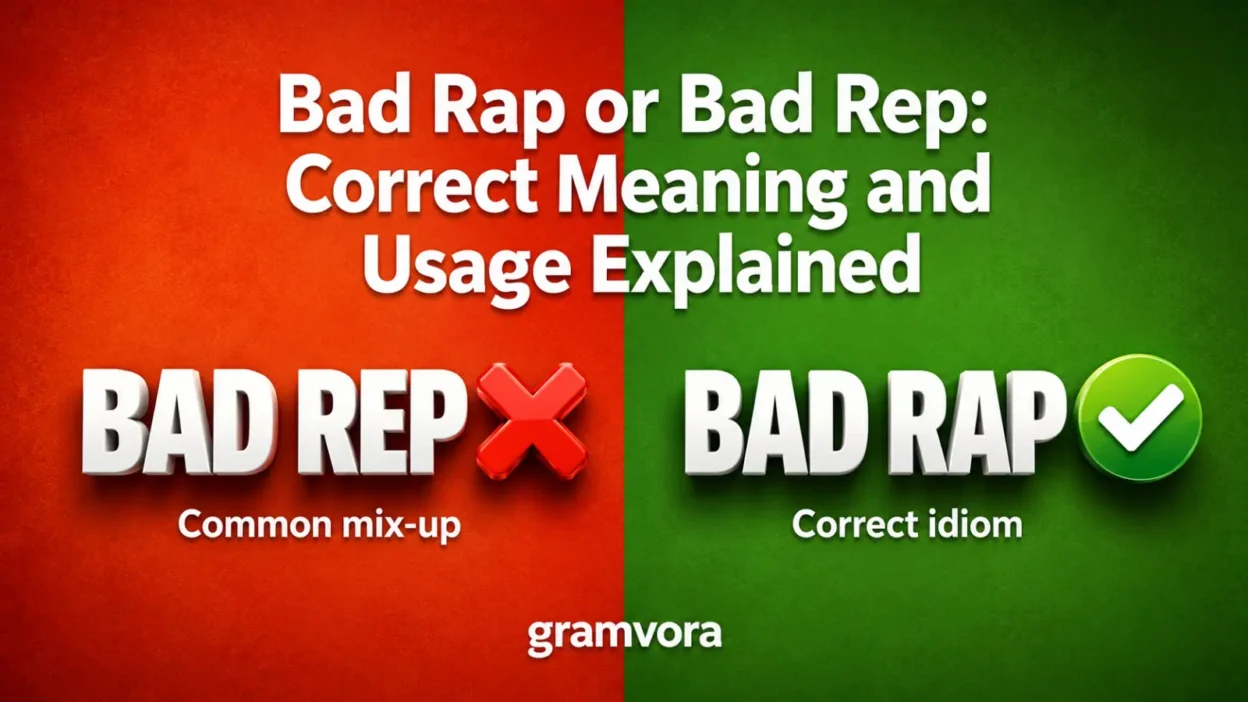
Bad rap or bad rep is confusing because both phrases point toward reputation. They also sound close in fast speech, so many writers pause before choosing one.
The safest choice in standard US English is usually bad rap when you mean an unfairly negative image, unfair blame, or undeserved criticism. Bad rep can mean “bad reputation,” but it sounds more casual and may look less polished in formal writing.
Quick Answer
Use bad rap when you mean someone or something has been judged unfairly or has an undeserved negative reputation. Use bad rep only in casual writing when you clearly mean “bad reputation.” In edited writing, schoolwork, workplace copy, and articles, bad rap is usually the better choice.
Why People Confuse Them
People confuse these phrases because rep is a natural short form of reputation. So, at first glance, bad rep seems more logical.
However, bad rap is the established idiom. In this phrase, rap connects to blame, criticism, charge, or an unfavorable judgment. That is why people say a person “gets a bad rap” when others judge them too harshly.
The confusion grows because both phrases can describe how people see someone. The difference is tone and expectation: bad rap is the familiar phrase; bad rep is a clipped informal phrase.
Key Differences At A Glance
| Context | Best Choice | Why |
|---|---|---|
| Unfair blame | bad rap | It suggests the judgment may be undeserved. |
| Polished writing | bad rap | It is the standard idiom most readers expect. |
| Casual speech | bad rap | It still sounds natural and clear. |
| Texting a friend | bad rep | It can work as a short form of “bad reputation.” |
| Brand image | bad reputation or bad rap | Use bad reputation for direct clarity; use bad rap if the image is unfair. |
| School or work writing | bad rap | It avoids looking like a mistaken phrase. |
Meaning and Usage Difference
Bad rap means an unfairly negative reputation, unfair blame, or undeserved criticism. It often suggests that the person, place, product, or idea does not deserve all the negativity.
Example:
“Frozen vegetables get a bad rap, but they can be healthy and affordable.”
This means people judge frozen vegetables too harshly.
Bad rep means bad reputation in a shortened, informal way. It does not always suggest unfairness. It may simply mean people think poorly of someone or something.
Example:
“That repair shop has a bad rep around town.”
This means the shop has a negative reputation. The sentence does not clearly say whether that reputation is fair or unfair.
Both phrases are noun phrases. Pronunciation can add to the confusion: rap sounds like “rap,” and rep sounds like “rep.” They are close, but not identical. In fast speech, listeners may not notice the difference.
Tone, Context, and Formality
Bad rap fits everyday US English and works well in polished writing. It sounds idiomatic, natural, and familiar.
Bad rep sounds more casual. It may fit a text message, social post, review, or informal conversation. Still, in more careful writing, some readers may pause because they expect the idiom bad rap.
Here is the practical tone difference:
| Feature | bad rap | bad rep |
|---|---|---|
| Main meaning | unfair blame or undeserved negative image | bad reputation |
| Tone | natural, idiomatic | casual, clipped |
| Best use | polished and everyday writing | informal speech or quick writing |
| Risk | low | may look too casual or mistaken |
Which One Should You Use?
Choose bad rap most of the time.
It works when you mean unfair criticism, an undeserved negative image, or a reputation that seems harsher than the facts support.
Use bad rep only when you want a casual short form of bad reputation. It can be clear in relaxed writing, but it is not the safest choice for formal or edited sentences.
Better:
“Small towns get a bad rap for being boring.”
More casual:
“That gym has a bad rep with beginners.”
Most direct:
“That company has a bad reputation for poor service.”
When One Choice Sounds Wrong
Bad rap sounds wrong when you only mean a proven, straightforward reputation with no unfairness implied.
Less clear:
“The restaurant has a bad rap because it failed health inspections three times.”
Better:
“The restaurant has a bad reputation because it failed health inspections three times.”
In that sentence, the negative image appears earned, so bad reputation is clearer.
Bad rep sounds wrong when the sentence needs the familiar idiom.
Less polished:
“Teachers get a bad rep for giving homework.”
Better:
“Teachers get a bad rap for giving homework.”
The better sentence suggests teachers are judged unfairly.
Common Mistakes (and Quick Fixes)
Mistake: Using bad rep in a formal sentence where the idiom is expected.
Fix: Use bad rap.
Weak:
“Public schools often get a bad rep in national debates.”
Better:
“Public schools often get a bad rap in national debates.”
Mistake: Using bad rap when the reputation is clearly earned.
Fix: Use bad reputation or bad rep, depending on tone.
Weak:
“The contractor has a bad rap after missing six deadlines.”
Better:
“The contractor has a bad reputation after missing six deadlines.”
Mistake: Treating both phrases as fully equal in every context.
Fix: Remember that bad rap is the standard idiom, while bad rep is informal.
Everyday Examples
• The neighborhood gets a bad rap, but most streets are quiet and friendly.
• Mondays get a bad rap because people focus only on the workweek.
• The new manager got a bad rap before anyone gave her a chance.
• Electric cars used to get a bad rap for short battery range.
• The cafeteria has a bad rep among students because the food is often cold.
• That app has a bad rep for crashing during updates.
• He is trying to fix his bad rep after years of missed deadlines.
• The breed gets a bad rap, even though many of those dogs are gentle.
• Group projects get a bad rap because one person often does most of the work.
• The store has a bad rep online, so I checked reviews before ordering.
Dictionary-Style Word Details
Verb
• bad rap: Not commonly used as a verb in standard US English. You can give someone a bad rap, but the full phrase itself works as a noun phrase.
• bad rep: Not commonly used as a verb in standard US English. The word rep can be a verb in other contexts, as in “rep your team,” but bad rep is normally a noun phrase.
Noun
• bad rap: A noun phrase meaning unfair blame, unfair criticism, or an undeserved negative reputation.
• bad rep: A noun phrase meaning a bad reputation, usually in informal language.
Synonyms
• bad rap: closest plain alternatives include unfair blame, undeserved criticism, unfair reputation, and negative image.
• bad rep: closest plain alternatives include bad reputation, poor image, negative reputation, and poor public image.
Clear opposites may include good reputation, good name, or positive image, depending on the sentence.
Example Sentences
• bad rap: “Public transportation gets a bad rap, but the train is often faster than driving.”
• bad rap: “The intern got a bad rap after one mistake, even though the project was already behind.”
• bad rep: “That landlord has a bad rep for slow repairs.”
• bad rep: “The old laptop model had a bad rep because the battery wore out quickly.”
Word History
• bad rap: The phrase comes from a use of rap connected with blame, criticism, charge, or punishment. That history helps explain why the phrase often suggests unfair judgment.
• bad rep: This phrase comes from rep as a shortened form of reputation. Its meaning is easy to understand, but it remains more casual than the established idiom bad rap.
Phrases Containing
• bad rap: get a bad rap, give someone a bad rap, have a bad rap, a bad rap for something.
• bad rep: have a bad rep, get a bad rep, a bad rep for something, protect your rep.
FAQs
Is it bad rap or bad rep?
Bad rap is usually the correct choice in standard US English. It means unfair blame, undeserved criticism, or a negative reputation that may not be fully deserved. Bad rep can mean “bad reputation,” but it sounds more casual and is not the safest choice in polished writing.
What does bad rap mean?
Bad rap means someone or something has received unfair criticism or has been judged too harshly. For example, “Fast food gets a bad rap” means people often criticize fast food, sometimes without considering every situation fairly.
Is bad rep ever correct?
Yes, bad rep can be correct when it clearly means bad reputation. However, it is informal. It works better in casual speech, texts, reviews, or social posts than in school, business, or article writing.
Why do people say bad rap instead of bad rep?
People say bad rap because it is the established idiom. In this phrase, rap relates to blame, criticism, or a charge against someone. That is why bad rap often suggests the criticism may be unfair.
Can I use bad rap and bad rep interchangeably?
Not always. Bad rap usually points to unfair or undeserved criticism. Bad rep simply means a bad reputation. If the negative opinion is unfair, use bad rap. If you only mean reputation, use bad reputation or casual bad rep.
Which phrase should I use in professional writing?
Use bad rap if you mean unfair criticism or an undeserved negative image. Use bad reputation if the negative opinion is direct and clearly earned. Avoid bad rep in professional writing unless the tone is intentionally casual.
Conclusion
For most writing, choose bad rap. It is the standard phrase when someone or something is judged unfairly, blamed too quickly, or given an undeserved negative image.
Use bad rep only when you want the casual meaning bad reputation. It can work in relaxed writing, but it is not as safe in polished sentences. When fairness matters, write bad rap. When you simply mean reputation, bad reputation is often the clearest choice
[…] Since bad is an adjective, the combination too + bad is grammatically correct. […]