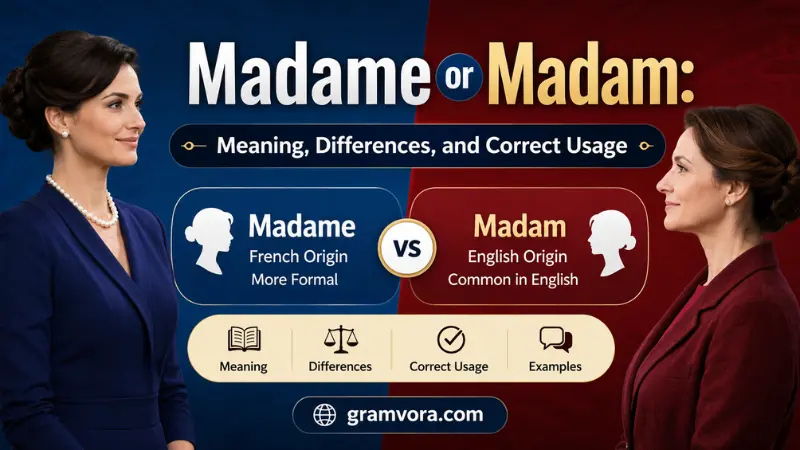
Both madame and madam are correct words, but they do not normally serve the same purpose in American English. Their similar spelling and shared history make the choice look harder than it is.
Use madam for a formal English form of address, especially when speaking to an unnamed woman or addressing someone by an official position. Use Madame mainly as a French or foreign-style title before a surname, as in Madame Dupont.
The sentence pattern often reveals the right choice. A hotel employee may address a guest as madam, while an English writer may refer to a French woman as Madame Laurent. Understanding that structural difference prevents most errors.
Quick Answer
Use madam as the standard English form of formal address:
- “May I help you, madam?”
- “Dear Madam”
- “Madam President”
Use Madame mainly as a French or foreign-style title before a surname or in an established name:
- “Madame Dupont”
- “Madame Curie”
- “Madame Tussaud”
For ordinary spoken American English, the shorter form ma’am is usually more natural than the full word madam.
Why People Confuse Them
The words differ by only one final letter, and both can show respect toward a woman. They also come from the same French expression meaning “my lady.”
However, English adapted the forms differently. Madam became the normal English word for formal direct address. Meanwhile, Madame kept a stronger connection to French titles, foreign names, and French cultural settings.
Pronunciation can add to the confusion. Madam is normally pronounced MAD-um. Madame is often pronounced muh-DAM or ma-DAM, although an Anglicized pronunciation may occur in established names.
Key Differences At A Glance
| Feature | madame | madam |
|---|---|---|
| Main use | French or foreign-style title | Formal English address |
| Typical position | Before a surname or established name | Alone or before an official position |
| Example | Madame Laurent | Madam President |
| Usual pronunciation | muh-DAM or ma-DAM | MAD-um |
| Capitalization | Usually capitalized before a name | Capitalized in salutations and official titles |
| Common in everyday US speech | Rare | Full form is formal; ma’am is more common |
The safest distinction is based on context rather than spelling alone. Choose madam when the sentence uses an English form of address. Choose Madame when preserving a French or established foreign title.
Meaning and Usage Difference
Madam is a noun used to address a woman politely and formally. It may stand alone because it replaces the person’s name:
“Your reservation is ready, madam.”
It can also appear before the name of an office or position:
“Madam President, the committee is ready.”
“Thank you, Madam Chair.”
In modern American English, madam is not normally placed before an ordinary surname. Calling someone Madam Wilson may sound unusual unless a special tradition or setting supports it.
Madame is also a noun. English mainly uses it as a title associated with French-speaking women, foreign dignitaries, historical figures, performers, or established names:
“Madame Lefèvre will arrive at noon.”
“The class read about Madame Curie.”
The word therefore behaves more like a title before a name. It is not the usual choice for addressing an unknown woman in an American store, restaurant, or office.
Tone, Context, and Formality
Both forms sound respectful, but their tones differ.
Madam sounds formal, official, or service-oriented. It appears in ceremonies, government proceedings, traditional business greetings, and highly polite exchanges. In ordinary American conversation, the complete form can sound stiff. Speakers commonly use ma’am instead.
Madame sounds French, international, historical, theatrical, or culturally specific. Using it for an American woman without a relevant reason may sound affected or playful.
Capitalization depends on function. Use Madam in a formal salutation or before an official position:
“Dear Madam”
“Madam Secretary”
Use lowercase when the word is a general direct address within a sentence:
“May I take your coat, madam?”
Capitalize Madame before a surname or as part of an established name:
“Madame Bernard”
“Madame Tussaud”
Which One Should You Use?
| Context | Best Choice | Why |
| Addressing an unnamed woman formally | madam | It is the standard English form of address |
| Speaking politely in everyday American English | madam, usually shortened to ma’am | The English form fits, though the contraction sounds more natural |
| Addressing a woman by an official office | Madam | It precedes titles such as President, Chair, and Secretary |
| Beginning a traditional formal letter | Madam | Dear Madam is the established English salutation |
| Referring to a French woman by surname | Madame | It preserves the French-style title |
| Writing an established historical or professional name | Madame | The title belongs to the recognized name |
| Addressing an American woman by surname | Neither in most cases | Use Ms., Mrs., or the person’s preferred title instead |
A practical test is to remove the woman’s name. When the word can stand alone as direct English address, madam is usually correct. When it belongs before a French or established foreign name, Madame is usually correct.
When One Choice Sounds Wrong
Madame President usually looks wrong in standard American usage because the English official title is Madam President.
Incorrect: “The delegates welcomed Madame President.”
Correct: “The delegates welcomed Madam President.”
Conversely, Madam Curie looks wrong because the established historical form is Madame Curie.
Incorrect: “Madam Curie conducted pioneering research.”
Correct: “Madame Curie conducted pioneering research.”
Using madame for an unnamed customer may also sound overly French or theatrical in an American setting:
Unnatural in most US contexts: “Would you like a receipt, madame?”
Natural: “Would you like a receipt, ma’am?”
Finally, avoid using Madam before an ordinary American surname unless a specific convention requires it. Ms. Carter is more natural than Madam Carter.
Common Mistakes (and Quick Fixes)
Mistake: Treating the words as free spelling variants
They share an origin, but modern usage separates them. Match the word to the context.
Quick fix: Use madam for English direct address and Madame for a French or foreign-style title.
Mistake: Writing “Madame President” in US English
The extra e gives the title a French appearance.
Quick fix: Write Madam President, Madam Secretary, or Madam Chair.
Mistake: Placing “madam” before a French surname
This removes the French title’s conventional spelling.
Quick fix: Write Madame Dubois, not Madam Dubois, when preserving the French form.
Mistake: Using the full “madam” casually
Although polite, the complete word may sound very formal in everyday American speech.
Quick fix: Use ma’am in normal spoken interactions.
Mistake: Avoiding “madam” because of an unrelated meaning
As a countable noun, madam can refer to a woman who manages a brothel. That separate definition does not make respectful expressions such as Madam President or Dear Madam improper.
Everyday Examples
- “Excuse me, madam, you left your phone at the counter.”
- “Yes, ma’am, your order will be ready in five minutes.”
- “Madam President, may I ask a follow-up question?”
- “The letter began with the greeting ‘Dear Madam.’”
- “Madame Girard teaches French literature at the university.”
- “The exhibit included a section about Madame Curie.”
- “Madame Laurent greeted the visitors in the hotel lobby.”
- “The chair recognized the senator, who thanked Madam Chair.”
- “The biography described the early work of Madame Tussaud.”
- “No, madam, there is no additional charge for delivery.”
Dictionary-Style Word Details
Verb
- madame: Not commonly used as a verb in standard US English.
- madam: Not commonly used as a verb in standard US English.
Both words function mainly as nouns or titles. Avoid turning either one into a verb.
Noun
- madame: A French or foreign-style title for a woman, particularly before a surname or in an established name. It may traditionally correspond to Mrs. in English.
- madam: A formal English term used to address a woman directly or before an official position. It also has a separate countable meaning for a woman who manages a brothel.
Both are nouns, but their normal sentence positions differ. Madam often stands alone, while Madame commonly accompanies a name.
Synonyms
Exact synonyms are limited because these words serve specific forms of address.
- madame — closest plain alternatives: Mrs. plus surname, Ms. plus surname, or another culturally appropriate title.
- madam — closest plain alternatives: ma’am, formal lady, or an official title such as President or Chair where appropriate.
There are no useful direct antonyms for either title.
Example Sentences
- madame: “Madame Fournier will lead the afternoon discussion.”
- madame: “The museum displayed letters written by Madame Curie.”
- madam: “May I show you to your table, madam?”
- madam: “Madam Speaker called the chamber to order.”
Word History
Both words come from the French expression ma dame, meaning “my lady.”
Madam entered English earlier and developed into the standard English form of respectful address. Madame retained the French spelling and remained closely associated with French, foreign, and established title-based uses.
Their shared history explains the similar spelling, but it does not make them interchangeable in every modern sentence.
Phrases Containing
Phrases and titles with madam:
- Madam President
- Madam Speaker
- Madam Secretary
- Madam Chair
- Dear Madam
- yes, madam
Names and expressions with madame:
- Madame Curie
- Madame Tussaud
- Madame Bovary
- Madame Butterfly
- croque madame
- mesdames et messieurs
FAQs
Is It Madam or Madame?
Both are correct, but they are used differently. Madam is the standard English form of formal address, while Madame is mainly used as a French or foreign-style title before a surname.
Should I Write Madam President or Madame President?
In standard American English, write Madam President. The same pattern applies to titles such as Madam Speaker, Madam Secretary, and Madam Chair.
Is Ma’am Short for Madam or Madame?
Ma’am is a shortened form of madam, not madame. It is common in polite spoken American English and usually sounds more natural than the full word madam.
Can Madam Be Used Before a Last Name?
Usually, no. In modern American English, Ms., Mrs., or another preferred title is more natural before a surname. Madam Wilson may sound unusual unless a special tradition requires it.
When Should I Use Madame?
Use Madame mainly before a French surname, for a French-speaking woman, or as part of an established historical, literary, or professional name, such as Madame Curie or Madame Bovary.
Are Madam and Madame Pronounced Differently?
Yes. Madam is usually pronounced MAD-um. Madame is commonly pronounced muh-DAM or ma-DAM, with the stress on the second syllable.
Conclusion
Both madame and madam are correct, but the sentence context determines which one belongs.
Use madam for formal English direct address, traditional greetings, and official positions such as Madam President. Use Madame mainly before a French surname, in a foreign-style title, or as part of an established name such as Madame Curie.
Remember the structural difference: madam usually stands alone or precedes an office, while Madame commonly precedes a name. In everyday American speech, ma’am is generally more natural than the full form madam.


