
Family relationships can get confusing once you move beyond first cousins. Two expressions that often cause trouble are cousin once removed and second cousin.
Both can describe valid family relationships, but they do not mean the same thing. Second cousin tells you the degree of the cousin relationship. Once removed tells you that two cousins are one genealogical generation apart.
There is also an important detail behind the wording. Cousin once removed does not give the complete cousin degree by itself. For an exact relationship, you would normally say first cousin once removed, second cousin once removed, or another numbered cousin degree.
Understanding that difference makes the whole cousin system much easier.
Quick Answer
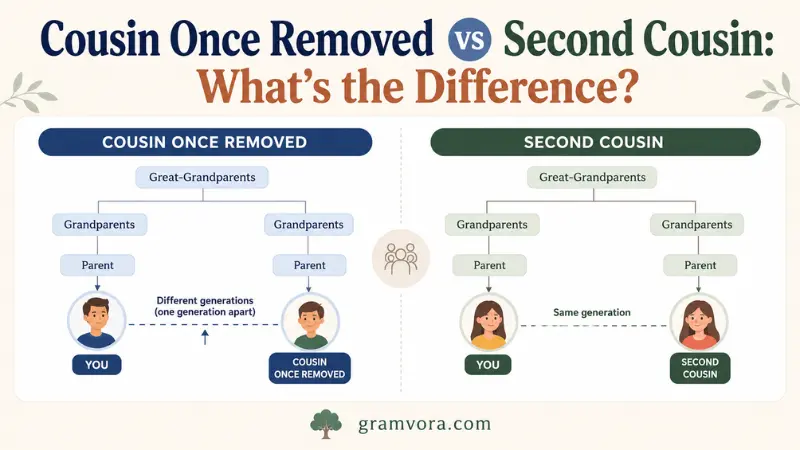
A second cousin is someone who typically shares great-grandparents with you and is the same number of generations away from those shared ancestors.
A cousin once removed is a cousin who is one genealogical generation above or below you.
So, second tells you the cousin degree, while once removed tells you the generation difference.
For example, your first cousin’s child is your first cousin once removed, not your second cousin.
Why People Confuse Them
The confusion often starts when a cousin has a child.
Imagine that Lisa is your first cousin. Lisa later has a son named Noah. It may seem logical to think that Noah becomes your second cousin because he comes one generation after your first cousin.
That is not how cousin numbering works.
Noah is your first cousin once removed. The relationship remains connected through the first-cousin branch, but Noah is one generation below you.
A true second cousin follows a different family-tree pattern. For example, the child of your parent’s first cousin is your second cousin.
People also confuse the terms because everyday families often use cousin loosely. Precise family-tree terminology follows a more specific system.
Key Differences At A Glance
- Cousin once removed: Describes cousins separated by one genealogical generation.
- Second cousin: Describes a specific cousin degree.
- Second cousins usually share: Great-grandparents.
- Once removed answers: How many generations apart are the cousins?
- Second answers: What degree of cousins are they?
- Cousin once removed alone: Does not identify whether the relationship is first, second, third, or another degree.
- Second cousin: Is a complete cousin relationship when both people are in matching genealogical generations.
Age does not determine the relationship. Two second cousins can have a large age difference and still be in the same genealogical generation.
Meaning and Usage Difference
The simplest way to understand the difference is to separate cousin degree from removal.
The cousin number describes how the two family branches connect.
First cousins share grandparents. Second cousins share great-grandparents. Third cousins share great-great-grandparents.
Removal measures something different: the difference between the two people’s positions in those family branches.
Once removed means one person is one generation farther from the shared ancestor than the other person.
Suppose you and Sarah are first cousins. Sarah’s daughter is one generation below Sarah and you. Therefore, Sarah’s daughter is your first cousin once removed.
Now suppose Daniel is your second cousin. Daniel’s son is one generation below him. Daniel’s son is your second cousin once removed.
This is why second cousin and once removed can even appear together. They describe two separate parts of the relationship.
Tone, Context, and Formality
Neither expression is inherently more formal or more polite. Both belong to standard family terminology.
The main difference is how much precision you need.
In everyday conversation, someone might simply say:
“My cousin and her daughter are visiting.”
That wording is usually enough when the exact family relationship does not matter.
In a family tree, genealogy discussion, inheritance record, or detailed family explanation, the precise relationship becomes more useful.
In those situations, second cousin clearly states a cousin degree. The phrase cousin once removed gives only the generational difference unless a degree such as first or second is also included.
Which One Should You Use?
First, identify the closest shared ancestor. Then count how many generations each person is from that ancestor.
If both people are the same number of generations away, there is no removal.
If one person is one generation farther away, the relationship is once removed.
| Context | Best Choice | Why |
|---|---|---|
| You both share great-grandparents and are equally distant from them | Second cousin | You have a second-cousin relationship with no removal |
| The person is your first cousin’s child | First cousin once removed | You are one genealogical generation apart |
| The person is your parent’s first cousin | First cousin once removed | That person is one generation above you |
| The person is your second cousin’s child | Second cousin once removed | The second-cousin degree has a one-generation difference |
| You know only that two cousins are one generation apart | Cousin once removed | It gives the removal but not the exact cousin degree |
A simple memory trick is to ask two questions:
What degree of cousin are we?
Then ask: Are we the same number of generations from our shared ancestor?
When One Choice Sounds Wrong
Calling every cousin’s child a second cousin creates incorrect family relationships.
For example:
“My first cousin’s daughter is my second cousin.”
That is incorrect in precise family terminology. She is your first cousin once removed.
The opposite mistake also happens. Someone may call a true second cousin “once removed” simply because the two relatives are far apart in age.
Age does not create removal.
Imagine one second cousin is 25 and another is 55. If both occupy corresponding generations in their family branches and are the same number of generations from their shared great-grandparents, they remain second cousins.
Another unclear choice is using only cousin once removed when an exact family-tree relationship is required. The listener knows there is a one-generation difference but still does not know the cousin degree.
Common Mistakes (and Quick Fixes)
Mistake: My first cousin’s child is my second cousin.
Fix: Your first cousin’s child is your first cousin once removed.
Mistake: “Removed” means the relative is emotionally distant.
Fix: In cousin terminology, removed refers to a difference in genealogical generations.
Mistake: Second cousins must be about the same age.
Fix: Age does not determine cousin degree. Family-tree position does.
Mistake: Cousin once removed and second cousin mean the same thing.
Fix: They measure different features. Second identifies cousin degree; once removed identifies a one-generation difference.
Mistake: Every cousin once removed is a first cousin once removed.
Fix: A person can be a first cousin once removed, second cousin once removed, third cousin once removed, and so on.
Mistake: A younger cousin automatically becomes a removed cousin.
Fix: Being younger does not matter. The person must be in a different genealogical generation.
Everyday Examples
Suppose your mother has a first cousin named Eric.
Eric is your first cousin once removed because he is in your mother’s genealogical generation.
Eric has a daughter named Mia. You and Mia are second cousins. You occupy corresponding positions in your two family branches and share great-grandparents.
Now imagine that your own first cousin, Jack, has a son named Ethan.
Ethan is your first cousin once removed because he is one generation below you.
If your second cousin Olivia has a daughter, Olivia’s daughter is your second cousin once removed.
The relationship can work in the other direction too. Your parent’s first cousin is your first cousin once removed, with that relative one generation above you rather than below you.
Dictionary-Style Word Details
Verb
Cousin once removed: Not commonly used as a verb in standard US English. It functions as a kinship phrase.
Second cousin: Not used as a verb in its normal family meaning. It functions as a noun phrase.
Noun
Cousin once removed: A cousin relationship in which the two people are separated by one genealogical generation. For an exact label, the cousin degree also needs to be known.
Second cousin: A cousin of the second degree. A second cousin is commonly the child of a parent’s first cousin, and second cousins in matching generations share great-grandparents.
Synonyms
Neither expression has an exact everyday synonym that preserves all of its genealogical information.
Cousin once removed — closest plain alternatives:
cousin, relative, or a descriptive phrase such as my cousin’s child. These forms are less precise.
Second cousin — closest plain alternatives:
cousin or relative. Again, these alternatives do not identify the exact degree.
There is no clear, useful antonym for either relationship term.
Example Sentences
Cousin once removed:
- My first cousin’s daughter is my first cousin once removed.
- I knew he was a cousin once removed, but I had to check the family tree to find the exact degree.
- My mom’s first cousin is my first cousin once removed.
Second cousin:
- Ava is my second cousin because our grandmothers are sisters.
- I met several of my second cousins at the family reunion.
- My parent’s first cousin has a son, and he is my second cousin.
Word History
The word cousin has been part of English since the Middle English period. It came through Anglo-French and ultimately traces back to Latin family vocabulary.
English later developed more specific numbered expressions such as first cousin and second cousin to distinguish different degrees of extended-family relationships.
The word removed serves another purpose in these phrases. It indicates that two cousins belong to different genealogical generations.
The important point for modern usage is that the cousin number and the number of removals measure separate parts of the family relationship.
Phrases Containing
Common phrases built with cousin once removed include:
- first cousin once removed
- second cousin once removed
- third cousin once removed
Common phrases built with second cousin include:
- second cousin
- second cousins
- second cousin once removed
- second cousin twice removed
The phrase second cousin once removed is especially useful for seeing how the two systems work together: second gives the cousin degree, while once removed gives the generation difference.
FAQs
What is the difference between a cousin once removed and a second cousin?
A second cousin is a specific cousin degree. Second cousins typically share great-grandparents and are in matching genealogical generations. Once removed means two cousins are one generation apart in the family tree.
Is my first cousin’s child my second cousin?
No. Your first cousin’s child is your first cousin once removed. A second cousin comes from a different family-tree relationship and usually shares great-grandparents with you.
What does “once removed” mean in a family relationship?
“Once removed” means there is a difference of one genealogical generation between two cousins. For example, your first cousin’s child and your parent’s first cousin are both your first cousins once removed.
Who is considered my second cousin?
Your second cousin is typically the child of your parent’s first cousin. You and your second cousin usually share the same great-grandparents.
Can a second cousin also be once removed?
Yes. A second cousin once removed is a second cousin who is one generation above or below you. For example, your second cousin’s child is your second cousin once removed.
Does age determine whether cousins are once removed?
No. Age does not determine removal. Two cousins can be many years apart in age and still belong to the same genealogical generation. Removal depends only on their positions in the family tree.
Conclusion
The difference between cousin once removed vs second cousin comes down to two separate measurements.
A second cousin identifies the degree of the relationship. Second cousins in matching genealogical generations share great-grandparents.
Once removed means the two cousins are one generation apart. For complete precision, it normally appears with a cousin degree, as in first cousin once removed or second cousin once removed.
The easiest way to remember the difference is simple: the cousin number tells you how you are related, while “removed” tells you the generation gap.
So, your first cousin’s child is not your second cousin. That person is your first cousin once removed.


