
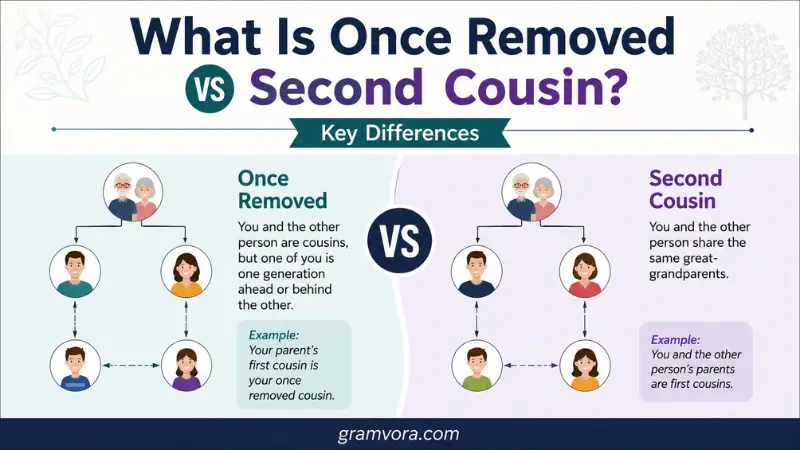
The choice between once removed and second cousin can be confusing because the two expressions describe different parts of a family relationship.
The key is simple: second cousin identifies the cousin degree, while once removed identifies a generation difference.
That means these are not true substitutes. In fact, they can appear together in a complete relationship such as second cousin once removed.
Quick Answer
Use second cousin when you are naming a specific cousin relationship. In the usual family-tree structure, second cousins share great-grandparents and are in corresponding generations.
Use once removed when two cousins are one generation apart.
For example, your first cousin’s child is your first cousin once removed, not your second cousin. Your parent’s first cousin is also your first cousin once removed.
So remember:
Second cousin = cousin degree.
Once removed = generation difference.
A second cousin can also be once removed. The terms are not competing labels; they can describe two different aspects of the same relationship.
Why People Confuse Them
People often assume that the child of a first cousin automatically becomes a second cousin. That sounds logical, but precise cousin terminology does not work that way.
If you and another person are first cousins, your cousin’s child is one generation below you. The cousin degree remains first, and once removed is added to show the generation difference.
A second cousin is different. Your parent and your second cousin’s parent are first cousins. You and that person are then in the corresponding generation and are second cousins.
Another source of confusion is age. Family-tree generations are not determined by birthdays. Two relatives can be close in age while occupying different generations in the family relationship.
Key Differences At A Glance
| Context | Best Choice | Why |
|---|---|---|
| You and the other person share great-grandparents and are in corresponding generations | second cousin | This identifies the cousin degree |
| Your first cousin has a child | first cousin once removed | The child is one generation below you |
| Your parent has a first cousin | first cousin once removed | That relative is one generation above you |
| Your second cousin has a child | second cousin once removed | The cousin degree stays second, with a one-generation gap |
| You need only a casual family label | cousin | The exact degree may not matter in conversation |
The important point is that once removed normally needs a cousin degree with it. Saying only “my once removed” does not identify the exact relationship.
Feature | Once Removed | Second Cousin
| Feature | Once Removed | Second Cousin |
| Main job | Shows a generation gap | Names a cousin degree |
| Generation | One generation apart when used as “once removed” | Usually corresponding generations |
| Complete relationship by itself | Usually no | Yes |
| Can appear together? | Yes | Yes |
| Example | first cousin once removed | second cousin |
Meaning and Usage Difference
Second cousin is a noun phrase for a particular family relationship. In the standard pattern, second cousins are the children of first cousins and share great-grandparents.
Once removed works differently. In cousin terminology, it marks a one-generation difference. The cousin degree remains separate.
For example:
- Your first cousin’s daughter is your first cousin once removed.
- Your second cousin’s son is your second cousin once removed.
- Your parent’s first cousin is your first cousin once removed.
- Your parent’s second cousin is your second cousin once removed.
The word removed does not mean “less related.” It tells you that the two relatives are separated by one generation in the family tree.
Tone, Context, and Formality
Both expressions are neutral family-relationship terms.
Second cousin is easy to use in everyday conversation:
“My second cousin lives in Chicago.”
Once removed is also standard, but it is normally part of a more complete relationship label:
“She’s my first cousin once removed.”
Because the full relationship requires more family-tree information, once removed may sound more technical in casual conversation. It is especially useful when someone needs to describe a family relationship precisely.
Pronunciation is not a major source of confusion here. Second cousin is pronounced roughly “SEK-und KUZ-un,” while removed is pronounced “ri-MOOVD.”
Which One Should You Use?
Start by asking what you are trying to identify.
If you are naming the cousin degree, use a term such as second cousin.
If you are explaining that two cousins are one generation apart, use once removed after the appropriate cousin degree.
For example, suppose your grandmother and another person’s grandmother were sisters. You and that person’s child would normally be second cousins if you are in corresponding generations. If that person has a child, the child is your second cousin once removed.
The easiest approach is to look at the family tree rather than the relatives’ ages.
When One Choice Sounds Wrong
Some common statements sound reasonable but are not precise.
“My first cousin’s child is my second cousin.”
Not in standard cousin terminology. That child is your first cousin once removed.
“My mother’s first cousin is my second cousin.”
No. Your mother’s first cousin is your first cousin once removed.
“Once removed means we are distant relatives.”
Not exactly. It specifically describes a generational difference.
“She is my once removed.”
This is incomplete when you want to name the exact relationship. Say first cousin once removed, second cousin once removed, or the appropriate full label.
“Second cousin means someone who is simply a distant cousin.”
No. It identifies a particular cousin degree.
Common Mistakes (and Quick Fixes)
Mistake: Treating “second” and “once removed” as two versions of the same label.
Fix: Think degree versus generation gap.
Mistake: Calling a first cousin’s child a second cousin.
Fix: The relationship is first cousin once removed.
Mistake: Assuming “removed” refers to age.
Fix: It refers to the family-tree generation difference.
Mistake: Using “once removed” alone.
Fix: Attach it to the appropriate cousin degree.
Mistake: Thinking second cousins cannot be removed.
Fix: They can. Second cousin once removed is a valid relationship.
Everyday Examples
Here are a few everyday examples:
- “I met my second cousin at our family reunion.”
- “My dad’s first cousin is my first cousin once removed.”
- “My first cousin’s daughter is my first cousin once removed.”
- “My second cousin’s son is my second cousin once removed.”
- “My mom’s first cousin’s daughter is my second cousin.”
- “We share great-grandparents, so we’re second cousins.”
Consider this simple family pattern:
Your parent and another person’s parent are first cousins. Their children are second cousins to each other.
Now suppose one of those second cousins has a child. That child is second cousin once removed to the other second cousin.
This shows why the two expressions can work together rather than compete with each other.
Dictionary-Style Word Details
Verb
- once removed: Not used as a verb in this family-relationship expression. Although removed comes from the verb remove, the expression describes a kinship relationship.
- second cousin: Not used as a verb. It is a noun phrase naming a family relationship.
Noun
- once removed: Not normally a standalone noun for a relative. It works as part of a fuller expression such as first cousin once removed.
- second cousin: A noun phrase referring to a person who has a second-cousin relationship with you.
Synonyms
- once removed: There is no exact one-word synonym in standard family terminology. The closest plain explanation is one generation apart.
- second cousin: There is no exact common synonym. A plain explanation is the child of your parent’s first cousin.
Neither expression has a useful direct antonym. Same generation can contrast with “once removed,” but it is a description rather than a formal antonym.
Example Sentences
once removed:
- “My father’s first cousin is my first cousin once removed.”
- “My second cousin’s daughter is my second cousin once removed.”
- “The family tree showed that we were once removed.”
second cousin:
- “Jordan is my second cousin.”
- “I met my second cousin at a family wedding.”
- “Our parents are first cousins, so we are second cousins.”
Word History
once removed: In family terminology, removed describes separation by a degree of descent or generation. Once indicates one generation of separation.
second cousin: The expression uses the numbered cousin system, with second identifying the cousin degree. Merriam-Webster dates the first known use of second cousin to 1660, while Dictionary.com gives a first-recorded range of 1650–60.
Phrases Containing
once removed:
- first cousin once removed
- second cousin once removed
- cousin once removed
second cousin:
- my second cousin
- second cousin once removed
- second cousin twice removed
- second cousin on my mother’s side
These combinations show the basic structure clearly: second cousin supplies the cousin degree, while once removed supplies the generation difference.
FAQs
1. Is a second cousin the same as a cousin once removed?
No. A second cousin and a cousin once removed describe different aspects of a family relationship. “Second cousin” identifies the cousin degree, while “once removed” indicates a one-generation difference.
2. What does “once removed” mean?
Once removed means two relatives are one generation apart. For example, your first cousin’s child is your first cousin once removed.
3. Is my first cousin’s child my second cousin?
No. Your first cousin’s child is your first cousin once removed. The relationship remains a first-cousin relationship, but the two of you are one generation apart.
4. Is my parent’s first cousin my first cousin once removed?
Yes. Your parent’s first cousin is your first cousin once removed because that person is one generation above you.
5. What is a second cousin?
A second cousin is generally someone who shares the same great-grandparents with you while being in the same generation in the family tree.
6. Can someone be a second cousin and once removed?
Yes. Second cousin once removed is a correct family relationship. It means the person is your second cousin by degree but is one generation above or below you.
7. Does “removed” mean that someone is less closely related?
No. In family terminology, removed does not mean less related or emotionally distant. It describes the difference in generations between two relatives.
8. Is my second cousin’s child my second cousin once removed?
Yes. Your second cousin’s child is your second cousin once removed because the child is one generation below your second cousin.
9. Is “once removed” a complete family relationship by itself?
Usually, no. It is normally used with a cousin degree, such as first cousin once removed or second cousin once removed.
10. What is the easiest way to remember second cousin vs once removed?
Remember this simple rule: the number tells you the cousin degree, while “removed” tells you the generation difference. So “second cousin” identifies the relationship, and “once removed” adds information about the generation gap.
Conclusion
The difference between once removed vs second cousin is easier once you separate two ideas.
Second cousin identifies a specific cousin degree. Once removed indicates that two cousins are one generation apart.
So your first cousin’s child is your first cousin once removed, while the child of your parent’s first cousin is your second cousin.
The simplest rule to remember is:
The number tells you the cousin degree; “removed” tells you the generation gap.


