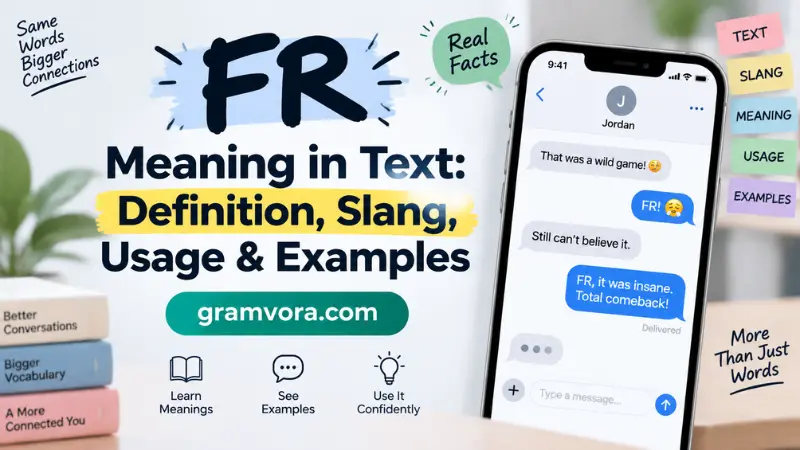
If you have received a text that says “fr”, you may have wondered what the abbreviation means. In most casual messages, fr means “for real.” People use it to show agreement, emphasize a statement, or say that they are being serious.
You may see fr in text messages, social media comments, group chats, gaming conversations, and direct messages. It is especially common when people want to respond quickly without typing a complete phrase.
The exact meaning can change slightly with context. For example, someone who replies “fr” may mean “I agree,” while someone who writes “fr?” may mean “Really?” or “Are you serious?”
This guide explains the fr meaning in text, its slang use, pronunciation, common contexts, sentence examples, related expressions, and situations where you should avoid it.
Quick Answer
FR usually means “for real” in text messages and online conversations. It can mean “seriously,” “honestly,” “exactly,” or “I agree,” depending on the context.
When written as “fr?”, it often means “Really?” or “Are you serious?”
TL;DR
• FR usually stands for “for real.”
• It is informal texting and internet slang.
• A standalone “fr” often means “I agree.”
• It can emphasize a statement.
• “Fr?” can mean “Really?”
• FR is unsuitable for most formal writing.
• FRFR adds extra emphasis to “for real.”
What Does FR Mean in Text?
In text messages, fr is a shortened form of “for real.” The phrase is used to indicate that something is true, genuine, serious, or sincerely meant.
For example:
“That test was so difficult.”
“Fr.”
The second person is saying something like “For real,” “I agree,” or “Seriously.”
The abbreviation can also appear at the end of a sentence:
“I need a vacation fr.”
Here, fr emphasizes the speaker’s statement. It suggests that the person genuinely means they need a vacation.
Another example is:
“That was the funniest movie ever fr.”
In this sentence, fr adds emphasis. The speaker is saying that they genuinely believe the movie was extremely funny.
The full phrase “for real” is an informal English expression associated with truth, genuineness, or seriousness. The abbreviation simply makes the expression shorter for digital conversations.
FR Meaning in Slang
In online slang, fr is mainly used as a casual way to express agreement or sincerity. It can work almost like a quick reaction to something another person says.
For example:
“I can’t believe how expensive groceries are now.”
“Fr.”
Here, fr means “I know,” “I agree,” or “Seriously.”
It can also emphasize an opinion:
“This is the best pizza I’ve had fr.”
The speaker is stressing that the statement is genuine.
Sometimes, fr appears at the beginning of a sentence:
“Fr, I was thinking the same thing.”
In this case, it introduces agreement with the previous idea.
Because fr is slang, its tone is relaxed and conversational. It fits naturally in messages between friends, casual social-media conversations, and other informal settings.
It does not usually belong in formal essays, business reports, academic assignments, or professional documents.
What Does FR Mean When Someone Replies to You?
A person who replies only “fr” to your message is usually agreeing with what you said.
For example:
“I could sleep for twelve hours today.”
“fr”
The reply means:
“For real.”
“Same.”
“I completely agree.”
The exact wording is different, but the basic message is agreement or shared feeling.
The meaning can also depend on the subject. Consider this example:
“That restaurant was disappointing.”
“Fr.”
The person is confirming that they had the same opinion.
A standalone fr is therefore often less like a dictionary definition and more like a quick conversational response.
What Does “Fr?” Mean in Texting?
Adding a question mark can change the function of the abbreviation.
“Fr?” often means:
• “Really?”
• “Are you serious?”
• “Is that actually true?”
• “For real?”
For example:
“I got tickets to the concert.”
“Fr?”
The second person is asking whether the news is genuine.
Another example:
“I finished the whole project in one night.”
“Fr?”
This could express surprise or doubt.
Compare these two messages:
“Fr.” — usually agreement or confirmation.
“Fr?” — usually a question about whether something is true.
This small punctuation change can therefore make a noticeable difference.
How FR Is Used in Everyday Conversations
There are several natural ways to use fr in casual communication.
FR as Agreement
The most common use is as a quick agreement.
“That was a long meeting.”
“Fr.”
Here, the person agrees with the observation.
Another example:
“Mondays are exhausting.”
“Fr.”
The response communicates shared agreement.
FR as Emphasis
A speaker can place fr after a statement to make it stronger.
“I’m tired fr.”
This means the person is genuinely tired.
Another example:
“That was scary fr.”
The abbreviation emphasizes the speaker’s feelings.
FR as Sincerity
A person can use fr to show that they are being honest or serious.
“I really appreciate your help fr.”
The abbreviation reinforces the idea that the appreciation is genuine.
FR as a Strong Reaction
It can also express an emotional reaction.
“That ending was wild fr.”
The speaker is strongly emphasizing their reaction to the ending.
Common Contexts Where You May See FR
The abbreviation appears in many casual digital environments.
Text Messages
Friends may use fr when responding quickly to each other.
“I need coffee.”
“Fr.”
It keeps the conversation short and natural.
Social Media
People may write fr in comments when they strongly agree with a post.
For example:
“Getting enough sleep makes such a difference.”
“Fr.”
The comment shows agreement with the original post.
Group Chats
In a group conversation, fr can quickly confirm that someone shares the same opinion.
“We should leave earlier next time.”
“Fr.”
Gaming Chats
Players may use the abbreviation during fast conversations.
“That level was impossible.”
“Fr.”
Direct Messages
It can also appear in private messages between friends or acquaintances.
The main pattern remains the same: fr communicates agreement, seriousness, or emphasis.
Examples of FR in Text Messages
Understanding real examples is one of the easiest ways to learn the expression.
Example 1: Agreement
Alex: “That homework took forever.”
Sam: “Fr.”
Meaning: Sam strongly agrees.
Example 2: Emphasis
“I’m exhausted fr.”
Meaning: The speaker is genuinely exhausted.
Example 3: Surprise
Alex: “She actually moved to California.”
Sam: “Fr?”
Meaning: Sam is surprised and wants confirmation.
Example 4: Strong Agreement
Alex: “That was the best game this season.”
Sam: “FR!”
Meaning: Sam strongly agrees.
Example 5: Sincerity
“Thanks for helping me today fr.”
Meaning: The speaker genuinely appreciates the help.
Example 6: Casual Opinion
“This coffee shop is underrated fr.”
Meaning: The speaker strongly believes the coffee shop is underrated.
Example 7: Shared Experience
Alex: “I can’t focus without music.”
Sam: “Fr, same.”
Meaning: Sam agrees and says they have the same experience.
Example 8: Question
Alex: “I just saw a celebrity downtown.”
Sam: “Fr?”
Meaning: Sam wants to know whether the claim is true.
FR, FRFR, and “For Real”
The full phrase “for real” and the abbreviation fr are closely connected.
For real is the complete informal expression:
“Are you for real?”
FR is the shortened texting form:
“Are you fr?”
The abbreviation is more casual because it is designed for quick digital communication.
You may also see frfr, which means “for real, for real.” Repeating the expression adds emphasis.
For example:
“I’m serious frfr.”
This suggests that the speaker really wants to make clear that they are serious.
Another example:
“That was amazing frfr.”
The repeated form strengthens the speaker’s enthusiasm.
Although frfr is common in casual online language, it is even less appropriate for formal communication than fr.
FR vs. Similar Expressions
Several words and phrases can communicate ideas similar to fr, but they are not identical in every situation.
| Expression | Common Meaning | Typical Tone |
|---|---|---|
| FR | For real; I agree | Very casual |
| Seriously | Truly; without joking | Casual to neutral |
| Honestly | Truthfully | Casual to neutral |
| Exactly | Strong agreement | Casual to neutral |
| Really | Actually; truly; surprise | Neutral |
| Genuinely | Truly; sincerely | More polished |
For example, “Exactly” is a close replacement when fr means agreement.
However, “genuinely” is not a natural replacement in every text message. The tone is more formal.
The best alternative depends on what the speaker wants to express.
Pronunciation of FR
The complete phrase “for real” is commonly pronounced approximately as “for REEL.”
When people refer to the written abbreviation aloud, they may pronounce it as the individual letters “F-R.”
Unlike ordinary English words, fr is mainly useful as written shorthand. People generally encounter it in messages rather than formal spoken conversation.
If someone says “for real” aloud, they are using the full expression rather than the abbreviation.
Part of Speech and Grammar
FR is not a traditional English word with a fixed grammatical category. In digital communication, it functions mainly as an informal abbreviation or conversational expression.
It can appear as a standalone response:
“Fr.”
It can also be placed inside or after a statement:
“That was difficult fr.”
The full phrase “for real” has broader grammatical uses in informal English. However, the abbreviation fr is mainly a feature of casual written communication.
The important point for learners is that you should treat fr as informal shorthand rather than standard formal vocabulary.
When Should You Use FR?
Use fr when the conversation is casual and the other person is likely to understand internet slang.
Good situations include:
• Texting close friends
• Casual group chats
• Social media comments
• Informal direct messages
• Gaming conversations
• Casual online discussions
For example:
“That movie was actually great fr.”
This sounds natural in an informal message.
You can also use it as a quick response:
“I need a break.”
“Fr.”
The abbreviation works best when the relaxed tone matches the conversation.
When Should You Not Use FR?
There are situations where fr should be avoided.
Do not normally use it in academic assignments, formal letters, professional reports, resumes, or serious workplace documents.
For example, this is too casual for a formal report:
“The results were surprising fr.”
A more appropriate version would be:
“The results were genuinely surprising.”
Likewise:
“Fr, I agree with your conclusion.”
Could become:
“I agree with your conclusion.”
The full version communicates the idea more clearly and professionally.
The issue is not that fr is wrong. The issue is that its informal tone does not fit every audience.
Common Mistakes With FR
Mistake 1: Thinking FR Always Means “I Agree”
Agreement is common, but it is not the only meaning.
In:
“I forgot my wallet fr.”
The speaker is emphasizing that the statement is true.
Mistake 2: Ignoring the Question Mark
“Fr?” and “Fr.” can communicate different intentions.
The first commonly asks for confirmation. The second usually expresses agreement.
Mistake 3: Using FR in Formal Writing
FR belongs mainly to informal digital communication.
In a school paper, professional email, or formal report, use standard wording instead.
Mistake 4: Assuming FR Has One Exact Translation
Depending on context, fr can mean:
• For real
• Seriously
• Honestly
• Exactly
• I agree
• Really?
Context determines the most natural interpretation.
Mistake 5: Overusing FR
Using fr repeatedly can make a message feel forced or unnatural.
For example:
“Fr this is fr so good fr.”
This sounds excessive.
One natural use is usually enough.
Is FR Formal or Informal?
FR is informal. It belongs primarily to texting, online slang, and casual conversations.
It is appropriate when the relationship and setting are relaxed.
For example:
“That was hilarious fr.”
This works well in a casual message.
In professional communication, however, a complete phrase is usually better:
“That was genuinely funny.”
The difference is mainly one of tone and context.
Can FR Mean Something Other Than “For Real”?
Yes. FR can represent other abbreviations in specialized contexts.
However, when you see lowercase fr in a casual text, comment, or direct message, “for real” is usually the intended meaning.
Context should always guide your interpretation.
For example, a technical document may use FR for a completely different term. That does not change the common texting meaning.
When learning internet slang, it is therefore useful to look at the surrounding words instead of interpreting an abbreviation by itself.
Synonyms and Similar Expressions
There is no single perfect synonym for fr because its meaning changes with context.
When fr means agreement, possible alternatives include:
• Exactly
• I agree
• Absolutely
• True
When it emphasizes sincerity, alternatives can include:
• Seriously
• Honestly
• Genuinely
• Truly
These expressions can communicate similar ideas, but their tone varies.
FAQs
FR usually means “for real.” It can show agreement, seriousness, sincerity, or emphasis.
In slang, fr is an informal abbreviation for “for real.” People commonly use it to agree with someone or emphasize that something is true.
It usually means “for real,” “I agree,” or “seriously.” The exact meaning depends on the surrounding conversation.
A reply of “fr” usually shows agreement. It can be similar to saying “exactly,” “same,” or “I know.”
“Fr?” usually means “Really?”, “Are you serious?”, or “Is that true?” The question mark signals that the person is asking for confirmation.
Frfr means “for real, for real.” It adds stronger emphasis and suggests that the speaker is especially serious or sincere.
FR is generally too informal for academic and professional writing. Use standard expressions such as “seriously,” “honestly,” or “I agree” instead.
Mini Quiz
Test your understanding of fr with these examples.
1.
“That exam was incredibly hard.”
“Fr.”
What does fr mean here?
2.
“I just won $500.”
“Fr?”
What does fr? communicate?
3.
“This is the best sandwich I’ve ever had fr.”
What does the final fr do?
4.
“I’m serious frfr.”
What does frfr add?
5.
Would you normally use fr in a formal business report?
Answer Key
1. It shows agreement.
2. It expresses surprise or asks for confirmation.
3. It emphasizes that the speaker genuinely means the statement.
4. It adds stronger emphasis to the idea of being serious.
5. No. A more formal expression would be better.
Conclusion
The fr meaning in text is usually “for real.” In casual conversations, it can express agreement, sincerity, seriousness, or emphasis.
The abbreviation is especially common in texts, social media, group chats, and other informal online conversations. A standalone “fr” often means “I agree,” while “fr?” can mean “Really?” or “Are you serious?”
Remember that fr is informal shorthand. It works naturally with friends and casual online conversations, but standard wording is a better choice for school, work, and formal writing.
When you see fr in a message, look at the sentence and punctuation around it. That context will usually tell you exactly what the person means.