
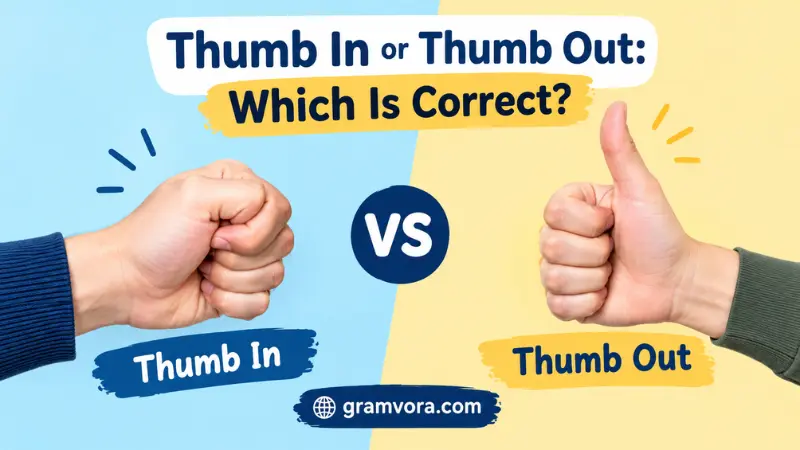
“Thumb in” and “thumb out” are both correct phrases. The choice depends on the position or movement you want to describe.
The two expressions are not different spellings of the same phrase. Instead, in and out show different directions or positions.
Use thumb in when the thumb is moving inward, staying tucked, or being placed inside a particular area.
Use thumb out when the thumb is moving outward, staying outside something, or being held in an extended position.
For example, these sentences describe different actions:
- “Keep your thumb in.”
- “Keep your thumb out.”
The first tells someone to keep the thumb inward. The second tells them to keep it outward.
The important point is that neither expression is automatically the “correct” choice in every situation. The surrounding context determines which one fits.
Quick Answer
Both thumb in and thumb out are correct.
Thumb in describes an inward, tucked, or enclosed position.
Thumb out describes an outward, extended, or external position.
| Context | Best Choice | Why |
|---|---|---|
| Thumb tucked toward the palm | thumb in | The thumb is positioned inward |
| Thumb extended away from the hand | thumb out | The thumb is positioned outward |
| Thumb placed inside a glove | thumb in | The thumb enters the glove |
| Thumb kept outside a pocket | thumb out | The thumb remains outside |
| Thumb extended for a visible gesture | thumb out | The thumb is visibly extended |
| Thumb moved toward an interior space | thumb in | The movement is inward |
A simple way to remember the difference is:
In = toward the inside.
Out = toward the outside.
However, the exact reference point matters. “In” does not always mean inside the palm, and “out” does not always mean pointing straight away from the body.
Why People Confuse Them
The confusion comes from the short form of the expressions.
When someone says “thumb in,” the listener may ask, “In where?” The answer depends on the situation.
For example:
“Put your thumb in the glove.”
Here, in refers to the glove.
Now compare:
“Keep your thumb in toward your palm.”
Here, in describes movement toward the inside of the hand.
The same thing happens with thumb out.
“Keep your thumb out of the pocket.”
Here, out means outside the pocket.
But:
“Move your thumb out from the palm.”
Here, out describes movement away from the palm.
Another reason for confusion is that people sometimes treat these expressions as fixed phrases with one universal meaning. They are better understood as short descriptions of position or movement.
That distinction becomes especially important in instructions. A coach, photographer, teacher, or friend may use “thumb in” or “thumb out” while pointing to a particular position. The surrounding situation supplies information that the short phrase leaves unstated.
Key Differences At A Glance
| Feature | Thumb In | Thumb Out |
|---|---|---|
| Basic idea | Inward or tucked | Outward or extended |
| Typical direction | Toward an interior position | Toward an exterior position |
| Possible hand position | Thumb close to or inside the hand | Thumb visible or outside the fingers |
| Common instruction | “Keep your thumb in.” | “Keep your thumb out.” |
| Meaning by itself | Physical position | Physical position |
| Always one fixed position? | No | No |
The most important difference is direction.
Thumb in focuses on movement toward an inside position or remaining within a stated area.
Thumb out focuses on movement toward an outside position or remaining beyond a stated area.
Neither phrase should automatically be interpreted as a particular emotional state, personality type, or social message.
Meaning and Usage Difference
What “Thumb In” Means
“Thumb in” usually describes a thumb that is tucked, folded inward, or placed inside a particular area.
For example:
“Tuck your thumb in before closing your hand.”
Here, the thumb moves inward.
The phrase can also refer to an enclosed position:
“Put your thumb in the glove.”
In this sentence, the glove provides the reference point.
Another example is:
“She kept her thumb in her pocket.”
The thumb is positioned inside the pocket.
These examples show why the phrase should not be reduced to one physical pose. The surrounding words establish exactly what in refers to.
What “Thumb Out” Means
“Thumb out” generally describes a thumb that is extended outward, visible, or kept outside a particular area.
For example:
“Keep your thumb out of the pocket.”
The thumb remains outside the pocket.
You might also hear:
“Hold your thumb out so I can see it.”
Here, the thumb is extended into a visible position.
A person hitchhiking may also hold out a thumb as a signal for a ride. The verb thumb itself has a related US usage in the expression “thumb a ride,” meaning to seek a ride by signaling with the thumb.
The physical meaning remains important: the thumb is being extended or held outward.
The Reference Point Matters
Consider these two sentences:
“Put your thumb in the glove.”
“Keep your thumb out of the glove.”
The expressions are both grammatical, but they describe opposite relationships to the glove.
Likewise:
“Move your thumb in toward your palm.”
“Move your thumb out away from your palm.”
The words in and out only become fully clear when the reader knows what the thumb is moving toward or away from.
This is why fuller wording is often preferable when an instruction must be precise.
Tone, Context, and Formality
Both phrases are plain, everyday English.
Neither thumb in nor thumb out is inherently more formal than the other. They can appear in casual conversation, instructions, descriptions, and other contexts where hand position needs to be explained.
For informal speech, a short instruction is natural:
“Thumb in.”
“Thumb out.”
In a more detailed written instruction, clarity is usually better:
“Tuck your thumb toward your palm.”
“Keep your thumb outside the fingers.”
The longer versions make the reference point clearer.
This matters when a reader cannot see the action. A person standing beside you can understand “thumb out” because they can see your hand. Someone reading the instruction later may need more detail.
The phrases also should not automatically be treated as body-language labels. A tucked thumb might occur for many ordinary reasons, including comfort or habit. An extended thumb may simply be part of a hand movement.
Therefore, the physical description should be separated from assumptions about emotion or personality.
Which One Should You Use?
Choose thumb in when your intended meaning is inward, tucked, or inside a stated area.
Choose thumb out when your intended meaning is outward, extended, or outside a stated area.
Here are some practical examples:
- If the thumb is tucked toward the palm, use thumb in.
- If the thumb is extended away from the palm, use thumb out.
- If the thumb goes inside a glove, use thumb in.
- If the thumb remains outside a glove opening, use thumb out.
- If you want to describe an outward hand signal, thumb out may fit.
- If you are describing a thumb being tucked into a closed hand, thumb in may fit.
When precision matters, describe the actual position rather than relying on the two-word phrase alone.
For example, instead of:
“Thumb out.”
you can write:
“Keep your thumb outside the curled fingers.”
That version leaves less room for misunderstanding.
When One Choice Sounds Wrong
The phrase sounds wrong when it describes the opposite physical position.
For example:
“Her thumb was out inside the pocket.”
This is confusing because out conflicts with the stated position inside the pocket.
A clearer sentence would be:
“Her thumb was in the pocket.”
The reverse problem can happen with thumb in:
“He held his thumb in, sticking far outside the hand.”
The two descriptions do not work well together because one suggests an inward position while the other explicitly describes an outward one.
Another common problem occurs when people assume that thumb out always means a thumbs-up.
That is not correct. An extended thumb can be part of many different hand positions. A thumbs-up is a specific gesture, while thumb out simply describes the thumb’s position.
Likewise, thumb in does not automatically mean nervousness, shyness, or any other emotion. The phrase primarily describes physical placement.
Common Mistakes (and Quick Fixes)
Mistake 1: Thinking One Phrase Is Always Correct
Incorrect idea: “Thumb out is always correct.”
Fix: Both expressions are correct. Select the one that matches the position you mean.
Mistake 2: Treating “Thumb In” as a Fixed Idiom
Problem: Assuming “thumb in” always means the thumb is inside the palm.
Fix: Look at the reference point. It could be the palm, a pocket, a glove, a grip, or another area.
Mistake 3: Assuming “Thumb Out” Means Approval
Problem: Treating every outward thumb as a thumbs-up.
Fix: Thumb out describes position. The complete gesture determines any additional meaning.
Mistake 4: Using Short Instructions Without Context
Problem: Writing only “thumb in” when the reader does not know what “in” means.
Fix: Add a reference point:
“Tuck your thumb in toward your palm.”
Mistake 5: Assuming Body Language Has One Meaning
Problem: Saying that a tucked thumb always means nervousness or that an extended thumb always means confidence.
Fix: Describe the physical position unless the surrounding situation clearly establishes a separate meaning.
Everyday Examples
Here are natural examples showing how the two expressions work:
- “Tuck your thumb in before you close your hand.”
The thumb moves inward. - “Keep your thumb out so I can see the gesture.”
The thumb remains visible and extended. - “Put your thumb in the glove.”
The glove is the reference point. - “Keep your thumb out of the pocket.”
The thumb stays outside the pocket. - “She pulled her thumb in when she noticed the cold.”
The thumb moves toward a more inward position. - “He held his thumb out while pointing toward the driveway.”
The thumb is extended outward. - “The photographer asked her to keep her thumb out.”
The intended position depends on the pose being described. - “Move your thumb in toward the center of your hand.”
The direction is clearly inward. - “Move your thumb out from the side of your hand.”
The direction is clearly outward. - “His thumb was in the pocket while the rest of his hand stayed outside.”
The pocket provides the reference point. - “She kept her thumb out of the opening.”
The thumb remained outside a specified area. - “The instructor said, ‘Thumb in,’ then demonstrated the position.”
The visual demonstration supplies the missing context.
These examples show why the surrounding sentence often matters more than the two-word phrase itself.
Dictionary-Style Word Details
Verb
Thumb in: Not normally treated as a standalone verb phrase. In a sentence such as “Put your thumb in,” put is the verb and thumb is the noun.
Thumb out: Likewise, it is usually a descriptive position phrase rather than a standalone verb. In “Hold your thumb out,” hold is the verb and thumb is the noun.
The word thumb itself can function as a verb in other constructions. Dictionaries record uses such as thumb a ride and thumb through. These are separate constructions from the simple descriptive phrases thumb in and thumb out.
Noun
Thumb: A noun referring to the short, thick digit on the side of the hand. It can also refer to the corresponding part of a glove.
In thumb in and thumb out, thumb is the noun being described.
In and out provide the positional or directional information.
Pronunciation is the same in both phrases because the word thumb remains the same: /θʌm/. The b is not pronounced.
Synonyms
Because thumb in and thumb out are descriptive combinations rather than single words, exact synonyms are limited.
Thumb in — closest plain alternatives:
- thumb tucked in
- thumb held inward
- thumb inside
- thumb toward the palm
Thumb out — closest plain alternatives:
- thumb extended
- thumb held outward
- thumb outside
- thumb sticking out
These alternatives are not interchangeable in every sentence. The best wording depends on the exact position being described.
For example, thumb extended emphasizes extension, while thumb outside the pocket emphasizes location.
Example Sentences
Thumb in:
- “Keep your thumb in while you adjust the grip.”
- “She tucked her thumb in toward her palm.”
- “Put your thumb in the glove.”
- “His thumb stayed in the pocket.”
Thumb out:
- “Keep your thumb out of the pocket.”
- “She held her thumb out so the signal was visible.”
- “Move your thumb out from your palm.”
- “His thumb was extended out to the side.”
The examples show that both expressions can be correct when they match the intended position.
Word History
The word thumb is an old English word. Major dictionaries trace it to Old English thūma and related Germanic forms.
The important point for this comparison is that the phrases thumb in and thumb out are not separate historical words. They are ordinary combinations of the noun thumb with the positional words in and out.
The exact history of these two short combinations as phrases is not necessary to understand their modern US-English usage.
Phrases Containing
Thumb in:
- thumb in the pocket
- thumb in the glove
- thumb in toward the palm
- keep your thumb in
Thumb out:
- thumb out of the pocket
- thumb out of the glove
- thumb out toward the side
- keep your thumb out
Other established expressions containing thumb include thumbs up, thumbs down, thumb through, and thumb a ride. These expressions have their own meanings and should not be treated as synonyms for thumb in or thumb out.
FAQs
Is “thumb in” correct?
Yes. “Thumb in” is correct when you mean that the thumb is tucked, moved inward, or placed inside a particular area. The exact meaning depends on the context.
Is “thumb out” correct?
Yes. “Thumb out” is also correct. It describes a thumb that is extended outward, kept outside something, or moved away from an inward position.
What is the difference between thumb in and thumb out?
Thumb in describes an inward, tucked, or enclosed position, while thumb out describes an outward, extended, or external position. The reference point determines the exact meaning.
Should I say “thumb in” or “thumb out”?
Use the phrase that matches the position you want to describe. Say “thumb in” for an inward or enclosed position and “thumb out” for an outward or external position.
Does “thumb out” mean thumbs-up?
Not necessarily. “Thumb out” simply describes the thumb as being extended or positioned outward. A thumbs-up is a specific hand gesture and should not be assumed from the phrase alone.
Does “thumb in” have a special body-language meaning?
Not by itself. “Thumb in” primarily describes physical position. Its meaning can change with the situation, so it should not automatically be interpreted as a sign of a particular emotion or personality trait.
Can “thumb in” mean inside a pocket or glove?
Yes. For example, “Keep your thumb in the pocket” means that the thumb is inside the pocket. Similarly, “Put your thumb in the glove” means to place the thumb inside the glove.
Can “thumb out” mean outside a pocket or glove?
Yes. “Keep your thumb out of the pocket” means that the thumb should remain outside the pocket. The same structure can describe keeping the thumb outside a glove or another area.
Are “thumb in” and “thumb out” opposites?
They can describe opposite positions when the same reference point is being used. For example, “thumb in toward the palm” and “thumb out away from the palm” describe opposing directions.
Is “thumb in” more formal than “thumb out”?
No. Neither phrase is inherently more formal. Both are simple, everyday expressions used to describe the position or movement of a thumb.
Conclusion
Thumb in and thumb out are both correct expressions, but they describe different positions.
Use thumb in for an inward, tucked, or enclosed position. Use thumb out for an outward, extended, or external position.
The key is the reference point. A thumb can be in a glove, in a pocket, or in toward the palm. It can also be out of a pocket, out of a glove, or out from the palm.
Neither phrase is automatically better, more formal, or more correct than the other. The right choice is the one that accurately describes the physical position you mean.
When the short phrase could be unclear, add a few words such as “toward the palm,” “outside the fingers,” “in the pocket,” or “out of the glove.” That makes the intended meaning immediately clear.


