
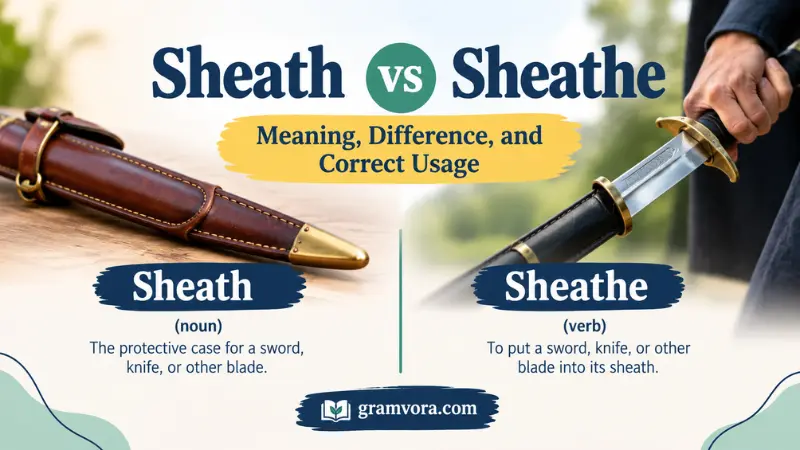
Sheath and sheathe look almost identical, so it is easy to mix them up. The extra e in sheathe also creates a small pronunciation difference.
The main distinction is grammatical. Sheath commonly names a protective covering or case. Sheathe is the clearer modern verb for putting something into that covering or enclosing it with a protective layer.
For example, you can say, “The knife is in its sheath.” When describing the action, say, “He sheathed the knife.”
There is one important detail, though. Some major dictionaries also record sheath as a verb. Therefore, saying that sheath can never be a verb would be too absolute. In ordinary modern American writing, however, sheathe is the more clearly recognized verb when you mean “put into a sheath” or “cover.”
Quick Answer
Use sheath when you mean the covering, case, or protective structure.
Use sheathe when you mean the action of putting something into a sheath or covering it.
| Context | Best Choice | Why |
|---|---|---|
| The protective case for a knife | sheath | It names the object |
| Putting a knife into its case | sheathe | It describes the action |
| A cable’s protective covering | sheath | It names the covering |
| Covering a cable with protective material | sheathe | It describes the action |
| “The sword is in its ___.” | sheath | A noun is needed |
| “He ___ the sword.” | sheathed | A past-tense verb is needed |
Simple rule: If you are naming the cover, choose sheath. If you are describing the action of covering or putting something inside, choose sheathe.
Why People Confuse Them
The two words are closely related and differ by only one letter. Both connect to the idea of a protective covering.
The spelling can cause problems because the words look like two forms of the same word. Their grammatical roles, however, are usually different.
Consider these sentences:
- The knife has a leather sheath.
- The camper sheathed the knife.
In the first sentence, sheath names a thing. In the second, sheathed describes an action.
Pronunciation can also contribute to the confusion. In American English, sheath ends with the unvoiced th sound, as in think. Sheathe ends with the voiced th sound, as in this. The difference is subtle but real.
Key Differences At A Glance
| Feature | Sheath | Sheathe |
|---|---|---|
| Main role | Noun | Verb |
| Basic idea | A protective cover | To put into or cover with protection |
| Example | “The blade is in its sheath.” | “Sheathe the blade.” |
| Common related form | sheaths | sheathed, sheathing |
| American pronunciation | /ʃiːθ/ | /ʃið/ |
| Typical context | Objects and coverings | Actions and processes |
The most important difference is not the spelling. It is the job each word performs in a sentence.
Meaning and Usage Difference
Sheath
A sheath is a close-fitting cover or case. It is often associated with a knife, sword, or other blade.
For example:
The hunting knife was stored in a leather sheath.
The word also applies to protective coverings that are not related to weapons. A cable can have a plastic sheath, and a nerve can have a protective sheath.
The broader meaning is therefore a covering or structure that closely surrounds and protects something.
Sheathe
Sheathe is a transitive verb. It commonly means to put something into its sheath.
For example:
She carefully sheathed the knife before putting it away.
The verb also has a broader meaning. Something can be sheathed in another material, meaning that it is covered or enclosed by that material.
For example:
The outside walls were sheathed in metal.
This broader use makes sheathe useful beyond knives and swords.
An important dictionary nuance
Some dictionaries also list sheath as a verb meaning essentially the same thing as sheathe. That use is legitimate dictionary English, but sheathe is the clearer choice when you want to describe the action in contemporary American writing.
So these two patterns are the safest for everyday writing:
- The knife has a sheath.
- He sheathed the knife.
Tone, Context, and Formality
Both words are standard English, but they often appear in different grammatical settings.
Sheath is natural when discussing a physical covering. You might encounter it in descriptions of knives, cables, biological structures, plants, or clothing.
Sheathe is more action-focused. It can appear in instructions, fiction, technical descriptions, and general writing when something is placed inside a covering or enclosed by one.
The words are not normally a matter of formal versus informal choice. The main issue is meaning and sentence structure.
For example:
The electrician checked the cable’s plastic sheath.
Here, the sentence names the protective covering.
The manufacturer sheathed the cable in a protective material.
Here, the sentence describes the process.
Which One Should You Use?
Choose sheath when the word functions as a noun naming a cover, case, or surrounding structure.
Choose sheathe when the word functions as a verb describing the act of putting something into a sheath or covering it.
When you are unsure, look at the words around the blank.
If you need a noun:
The knife is inside its leather sheath.
If you need a verb:
Please sheathe the knife before storing it.
For past actions, use sheathed:
He sheathed the sword after the demonstration.
For an ongoing action, use sheathing:
She was sheathing the cable with protective material.
When One Choice Sounds Wrong
A common mistake is using sheathe as the name of the protective case.
Incorrect in standard everyday usage:
The knife came with a leather sheathe.
Better:
The knife came with a leather sheath.
Another common mistake is using sheath where the sentence clearly calls for the familiar action verb.
Less natural:
He sheath the sword after the ceremony.
Better:
He sheathed the sword after the ceremony.
There is a dictionary-recorded verb sheath, but choosing sheathe avoids ambiguity and matches the form most readers expect for the action of placing something into a sheath.
Common Mistakes (and Quick Fixes)
Mistake 1: “The knife is in its sheathe.”
Use sheath because you are naming the protective case.
Correct: The knife is in its sheath.
Mistake 2: “Sheath the sword.”
In ordinary modern writing, sheathe is the clearer verb.
Better: Sheathe the sword.
Mistake 3: “He sheath the blade.”
The past tense is sheathed.
Correct: He sheathed the blade.
Mistake 4: “The cable has a plastic sheathe.”
The covering is a sheath.
Correct: The cable has a plastic sheath.
Mistake 5: Treating the two words as interchangeable
They are closely related, but their usual grammatical roles differ. Think about whether you are naming a covering or describing an action.
Everyday Examples
Here are natural examples that show the difference:
- The knife came with a durable leather sheath.
- He sheathed the knife before placing it in his backpack.
- The sword was resting in its sheath.
- The instructor told the student to sheathe the practice sword.
- The electrical cable has a thick protective sheath.
- The manufacturer sheathed the cable with an additional protective layer.
- The nerves are protected by thin tissue sheaths.
- The walls were sheathed in a protective material.
- She pulled the blade from its sheath.
- After the demonstration, he sheathed the blade and returned it to storage.
These examples show why context matters. The spelling difference reflects a change in grammatical function, not simply a different spelling preference.
Dictionary-Style Word Details
Verb
- Sheath: Some dictionaries recognize sheath as a transitive verb meaning to put something into a sheath or otherwise cover it. This use is less straightforward for learners because sheathe is the more familiar verb form in modern writing.
- Sheathe: A transitive verb meaning to put something, especially a knife or sword, into its sheath. It can also mean to cover or enclose something with a protective layer.
- Forms: sheathe, sheaths, sheathing, sheathed.
Noun
- Sheath: A countable noun meaning a close-fitting protective covering or case. Examples include a knife sheath, cable sheath, or biological sheath.
- Sheathe: Not normally used as a noun in standard modern English.
The plural of sheath is sheaths.
Synonyms
- Sheath: Closest plain alternatives include case, cover, and casing, depending on the context.
- Sheathe: Closest plain alternatives include cover, encase, or put into a sheath, depending on the sentence.
These alternatives are not exact replacements in every sentence.
For an opposite action, unsheathe can mean to remove a weapon from its sheath. It is useful when the context specifically involves drawing a blade.
Example Sentences
- Sheath: The knife was secured in its leather sheath.
- Sheath: The cable has a protective plastic sheath.
- Sheathe: The soldier sheathed his sword.
- Sheathe: The wires were sheathed in protective material.
- Sheath: The blade slid easily into the sheath.
- Sheathe: Please sheathe the knife before storing it.
Word History
The two words are historically related.
Sheath comes from Old English scēaþ and developed into the Middle English form shethe. Its original sense involved a protective case for a blade, and the word later gained broader meanings for similar coverings.
Sheathe developed from the related Middle English verb shethen. Its meanings included providing something with a sheath and putting an object into one. Later, its meaning broadened to include covering or enclosing something.
The exact historical development involves older forms of English, but the modern relationship is clear: sheath names the covering, while sheathe describes the action of covering or placing something inside it.
Phrases Containing
Common phrases include:
- knife sheath
- sword sheath
- leather sheath
- protective sheath
- cable sheath
- myelin sheath
- sheath dress
- sheathe a sword
- sheathe a knife
- sheathe the blade
- sheathed in metal
- sheathed in ice
The exact meaning depends on context, but the same basic distinction remains useful: sheath generally identifies a covering, while sheathe describes an action involving covering or enclosing.
FAQs
What is the difference between sheath and sheathe?
Sheath is usually a noun meaning a protective covering or case. Sheathe is a verb meaning to put something into a sheath or cover it with a protective layer.
Is a knife in a sheath or sheathe?
A knife is in a sheath. The sheath is the protective case that holds the knife.
Is it correct to say “sheathe the sword”?
Yes. Sheathe the sword is correct because sheathe is a verb meaning to put the sword into its sheath.
Is sheath a noun or a verb?
Sheath is most commonly used as a noun. However, some dictionaries also recognize sheath as a verb meaning to put something into a sheath or cover it.
Is sheathe a noun?
No. Sheathe is normally used as a verb in standard modern English. For the protective covering itself, use sheath.
What is the past tense of sheathe?
The past tense of sheathe is sheathed. For example: “He sheathed the knife after using it.”
How do you remember sheath vs sheathe?
A simple way to remember the difference is: sheath = the cover, sheathe = the action. A knife goes into a sheath, while you sheathe the knife.
Is “sheath” pronounced differently from “sheathe”?
Yes. Sheath ends with an unvoiced “th” sound, while sheathe ends with a voiced “th” sound. The difference is similar to the sounds in “think” and “this.”
Can you use sheathe for things other than swords and knives?
Yes. Sheathe can also mean to cover or enclose something with a protective material. For example, a cable can be sheathed in protective material.
Which is correct: “leather sheath” or “leather sheathe”?
Leather sheath is correct when referring to the protective covering. Sheathe is a verb, so it does not normally describe the covering itself.
Conclusion
Sheath vs sheathe is mainly a difference between a covering and the action associated with that covering.
Use sheath when you mean a protective case or covering:
The knife is in its sheath.
Use sheathe when you mean the action of putting something into a sheath or covering it:
He sheathed the knife.
Although dictionaries also record sheath as a verb, sheathe is the clearer and more familiar verb choice for most modern American writing.
The easiest practical reminder is simple: sheath is the cover; sheathe is the action.


