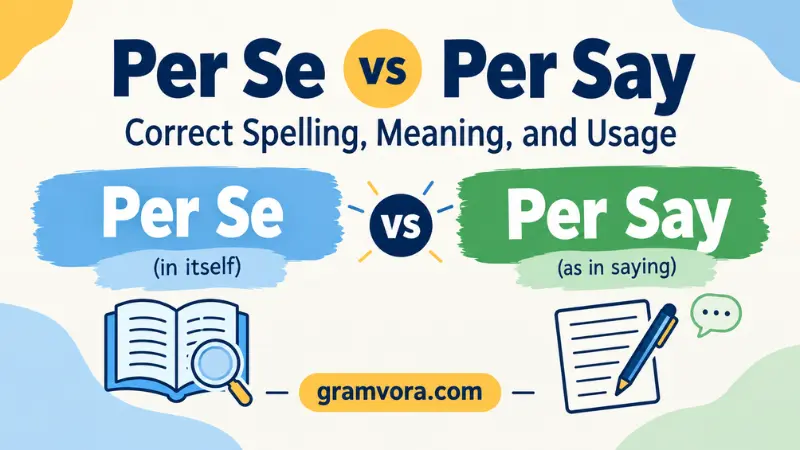
Per se and per say sound almost the same, so it is easy to understand why people confuse them. However, they are not two correct versions of the same expression.
Per se is the correct form when you mean “in itself,” “by itself,” or “considered on its own.” Per say is a common misspelling caused by the way per se is pronounced.
For example:
The movie wasn’t bad per se, but it was too long.
Here, per se means that the movie was not inherently bad. The speaker is separating the movie itself from another issue: its length.
The main rule is simple: when you mean “in itself,” write per se, not per say.
Quick Answer
Per se is correct. Per say is incorrect when it is used to mean “in itself” or “by itself.”
| Context | Best Choice | Why |
|---|---|---|
| Meaning “in itself” | per se | This is the standard expression. |
| Meaning “considered on its own” | per se | It focuses on the thing itself. |
| Formal or professional writing | per se | It is an established expression. |
| Using the verb “say” | say | This is a separate English word with a different meaning. |
| Writing “per say” to mean “in itself” | Neither | The standard expression is per se. |
A useful test is to replace per se with in itself. If the sentence still makes sense, per se may be the expression you need.
Why People Confuse Them
The confusion mainly comes from pronunciation.
In American English, per se is commonly pronounced roughly like “per SAY.” The final sound is therefore similar to the familiar English word say.
Someone who hears the expression before seeing it in writing may naturally assume that it is spelled per say. However, pronunciation does not determine the spelling in this case.
The expression has a traditional spelling that uses se, not say. The se is part of the established expression and should not be replaced with the English verb say.
This is why per say can look reasonable at first glance even though it is not the standard written form.
Key Differences At A Glance
The biggest difference is simple: per se is the established expression, while per say is not the correct spelling when the intended meaning is “in itself.”
| Feature | Per Se | Per Say |
|---|---|---|
| Standard expression | Yes | No |
| Meaning “in itself” | Yes | No |
| Meaning “by itself” | Yes, depending on context | No |
| Common source of confusion | Pronunciation | Phonetic spelling |
| Grammatical role | Adverbial expression | Not a standard expression |
| Suitable in standard writing | Yes | No |
Remember that per se is not an alternative spelling of per say. They do not represent two different usage choices.
Meaning and Usage Difference
Per se means “in itself,” “by itself,” or “considered on its own.” It is useful when you want to separate one thing from other circumstances surrounding it.
Consider this example:
The policy isn’t unfair per se, but it can create problems in certain situations.
The sentence does not necessarily say that the policy has no problems. Instead, it says that the policy itself is not inherently unfair. Other circumstances may create difficulties.
Here is another example:
I don’t dislike the neighborhood per se, but the commute is difficult.
The neighborhood itself is not the speaker’s problem. The commute is.
This pattern is common with per se. A speaker makes a statement about something on its own and then adds another factor that changes the overall situation.
For example:
The job isn’t difficult per se, but the hours are exhausting.
The work itself is manageable. The demanding schedule is the real concern.
Pronunciation
Per se is commonly pronounced approximately “per SAY” in American English.
That pronunciation explains much of the confusion with per say. Even though the expression sounds like it ends with “say,” its standard written form is per se.
Tone, Context, and Formality
Per se has a somewhat formal tone. It can appear in professional, academic, journalistic, and analytical writing, although it is also used in ordinary conversation.
For example:
I’m not against the idea per se.
This sentence can work in a workplace discussion as well as in a casual conversation.
However, per se is not always the clearest option for every reader. In simple or beginner-friendly writing, in itself may be easier to understand.
Compare these sentences:
The plan isn’t bad per se.
The plan isn’t bad in itself.
Both sentences express essentially the same idea. The second version is more straightforward for readers who are unfamiliar with the expression.
Therefore, use per se when it fits naturally, but do not feel that you must use it simply because it sounds more formal.
Which One Should You Use?
Use per se when you mean “in itself,” “by itself,” or “considered on its own.”
Do not use per say as an alternative spelling.
A simple memory trick is to connect se with the idea of something considered on its own.
For example:
The product isn’t expensive per se, but the shipping cost is high.
The product itself is not necessarily expensive. The additional shipping cost creates the concern.
If you are unsure, replace per se with in itself. If that replacement preserves the intended meaning, per se is likely appropriate.
When One Choice Sounds Wrong
In standard writing, per say is incorrect when it is intended to mean “in itself.”
For example:
❌ The proposal isn’t unreasonable per say.
The correct version is:
✅ The proposal isn’t unreasonable per se.
Here is another example:
❌ I don’t dislike the restaurant per say.
Correct:
✅ I don’t dislike the restaurant per se.
There is no special context in which per say becomes the standard spelling of this expression.
The word say itself is perfectly correct when it functions as the English verb:
She will say what she thinks.
However, that use has nothing to do with the expression per se.
Common Mistakes (and Quick Fixes)
Mistake 1: Writing “per say”
Incorrect:
The design isn’t ugly per say.
Correct:
The design isn’t ugly per se.
The problem is the spelling of the expression.
Mistake 2: Writing “perse”
Incorrect:
The design isn’t ugly perse.
Correct:
The design isn’t ugly per se.
Per se consists of two separate words.
Mistake 3: Spelling it according to pronunciation
Because per se sounds like “per SAY,” some writers use say when spelling it.
The sound can help explain the mistake, but it does not make per say correct.
Mistake 4: Using “per se” when another phrase is clearer
Sometimes writers use per se simply because it sounds sophisticated.
That is unnecessary. If in itself communicates the idea more clearly, use it.
For example:
The rule isn’t unfair in itself.
This can be easier to understand than:
The rule isn’t unfair per se.
Both can work when the intended meaning is the same.
Everyday Examples
Here are natural examples of per se in modern American English:
- The assignment wasn’t difficult per se, but it took several hours to finish.
- I don’t dislike online shopping per se; I just prefer seeing products in person.
- The restaurant isn’t expensive per se, but the extra fees add up.
- Working from home isn’t the problem per se. The issue is staying focused.
- The comment wasn’t offensive per se, but the timing was poor.
- I’m not opposed to the proposal per se. I just want to review the details.
- The neighborhood isn’t unsafe per se, but some streets are poorly lit at night.
- The phone isn’t bad per se, although the battery could be better.
- The new policy isn’t confusing per se, but the instructions could be clearer.
- The movie wasn’t boring per se; it was simply slower than I expected.
In these examples, per se helps distinguish the thing itself from another factor, condition, or result.
Dictionary-Style Word Details
Verb
- Per se: Not a verb. It functions as an adverbial expression.
- Per say: Not a standard verb phrase meaning “in itself.”
The English verb say is separate and means to express something in words.
For example:
She will say what she thinks.
That use should not be confused with per se.
Noun
- Per se: Not normally used as a noun in standard US English.
- Per say: Not a standard noun phrase meaning “in itself.”
The expression normally works within a sentence to modify or qualify a statement.
Synonyms
For per se, the closest plain alternatives include:
- in itself
- by itself
- as such
- intrinsically
- in and of itself
The best alternative depends on the sentence and the exact meaning intended.
For per say, there are no standard synonyms because it is not the correct expression for this meaning. If a writer means “in itself,” the sentence should use per se or an appropriate plain alternative.
Example Sentences
Per se:
- The idea isn’t unreasonable per se.
- The job isn’t difficult per se, but the schedule is demanding.
- I don’t object to the rule per se.
- The product isn’t defective per se; the problem is with the packaging.
- The decision wasn’t wrong per se, but it created unexpected problems.
Per say:
- ❌ The idea isn’t unreasonable per say.
- ✅ The idea isn’t unreasonable per se.
Word History
Per se comes from Latin and means “by itself” or “in itself.” Major dictionaries identify its Latin origin and retain the traditional two-word spelling.
The spelling per say is a common error influenced by pronunciation. Since per se sounds similar to “per say,” writers may substitute the familiar English word say for se.
For modern American English, the practical point is simple: the established expression is per se.
Phrases Containing
Common patterns with per se include:
- not bad per se
- not wrong per se
- not harmful per se
- not difficult per se
- something per se
- the issue per se
- the idea per se
- the problem per se
These patterns often separate the thing itself from another issue or circumstance.
For example:
The idea isn’t bad per se, but it would be expensive to implement.
The idea itself is not necessarily bad. The cost is the concern.
Per say does not form a standard expression with this meaning. Therefore, a phrase such as “not bad per say” should normally be corrected to “not bad per se.”
FAQs
Is it per se or per say?
Per se is correct when you mean “in itself,” “by itself,” or “considered on its own.” Per say is a common misspelling.
What does per se mean?
Per se means “in itself,” “by itself,” or “considered independently.” It is used when you want to focus on something on its own rather than its surrounding circumstances.
Why do people spell per se as per say?
People often write per say because per se is commonly pronounced like “per SAY.” The similar sound can make the incorrect spelling seem natural.
Is per say ever correct?
Not when it is intended to mean “in itself” or “by itself.” In that usage, the correct expression is per se.
How do you use per se in a sentence?
You can use per se to separate something itself from another issue. For example: “The plan isn’t bad per se, but it is too expensive.”
Is per se formal?
Yes. Per se has a somewhat formal tone and is common in professional, academic, and analytical writing. In simpler writing, in itself may sometimes be easier to understand.
Is per se one word or two words?
Per se is written as two separate words. Writing it as perse is incorrect when referring to this expression.
What is another way to say per se?
Depending on the sentence, alternatives include in itself, by itself, as such, and intrinsically. The best choice depends on the intended meaning.
Is per se an English word?
Per se is an established expression used in English, although it comes from Latin. In modern English, it commonly means “in itself” or “by itself.”
What is the difference between per se and per say?
Per se is the correct expression meaning “in itself” or “by itself.” Per say is a spelling mistake caused mainly by the similar pronunciation of the two forms.
Conclusion
The correct form is per se, not per say, when you mean “in itself,” “by itself,” or “considered on its own.”
The confusion mostly comes from pronunciation. Per se is commonly pronounced like “per SAY,” which makes per say seem logical when someone writes it from sound.
Remember that per se is written as two words and ends with se.
For example:
The idea isn’t bad per se, but it needs some changes.
When a simpler phrase would be clearer, in itself is a good alternative. The important point is to avoid treating per say as a valid spelling of the expression.
Correct: per se
Incorrect: per say