
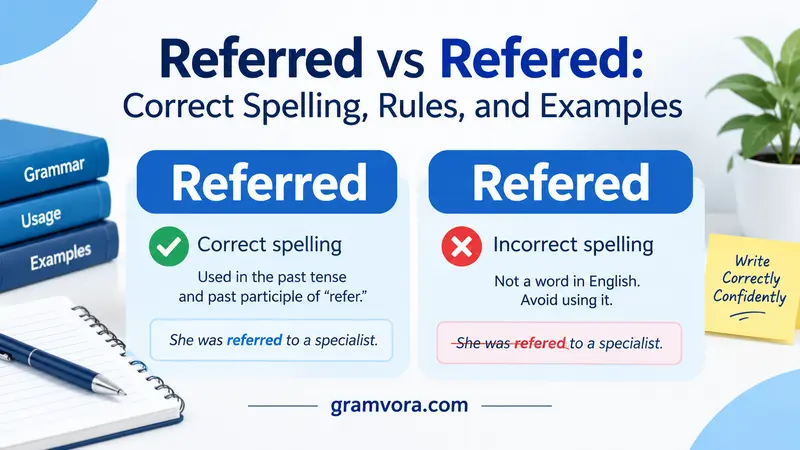
Choosing the right spelling can make your writing clearer and more professional. One common mistake occurs when people write refered instead of referred. Although the two forms look almost identical, only one is correct in standard English.
The correct spelling is referred, with two consecutive r’s in the middle of the word. The spelling refered, with only one r after the first part of the base word, is incorrect when you intend to use the past tense or past participle of refer.
This mistake is understandable. The base verb refer contains only one r at the end, so a writer might naturally add -ed without changing anything else. However, English spelling rules require the final consonant to double in this case.
For example:
- Correct: The doctor referred me to a specialist.
- Incorrect: The doctor refered me to a specialist.
The rule applies in American and British English. There is no regional spelling difference between these forms.
Understanding why referred is correct will help you avoid the same mistake in school assignments, workplace emails, reports, applications, and everyday messages.
Quick Answer
Referred is correct. Refered is incorrect.
Use referred when describing something that was mentioned, directed, sent, or recommended in the past.
Examples:
- My teacher referred me to an excellent book.
- The doctor referred the patient to a specialist.
- She referred to the email during the meeting.
- My colleague referred me for the position.
- The manager referred the complaint to the appropriate department.
In each sentence, referred is the past tense or past participle of refer.
The spelling rule is straightforward:
refer → referred
The final r doubles before the ending -ed. The same pattern applies when adding -ing:
refer → referring
Remember these forms, and you will be less likely to omit the extra r.
Why People Confuse Them
The confusion usually begins with the base word refer. Because it ends in a single r, some writers assume that adding -ed produces refered.
That approach works with many English verbs. For example, walk becomes walked, and clean becomes cleaned. The final consonant stays unchanged in those forms.
However, English also has a consonant-doubling pattern. Some verbs double their final consonant before adding an ending that begins with a vowel. The stress pattern of the word helps determine when this happens.
In refer, the second syllable receives the main stress: re-FER. When the verb takes -ed, the final r doubles, producing referred.
The same spelling pattern appears in other verbs:
- Prefer → preferred
- Defer → deferred
- Infer → inferred
- Transfer → transferred
These examples help demonstrate the pattern, although the precise spelling of each word should still be checked when you are unsure.
Another reason for confusion is that the extra r does not create a separate syllable. When people speak, they do not pronounce the word as though it contains an additional syllable. As a result, the correct spelling may be less obvious to learners.
Fast typing can also contribute to the error. A writer may know the correct form but accidentally leave out one letter while drafting a message.
The solution is to remember the complete word form rather than simply attaching -ed to the base verb.
Key Differences At A Glance
The difference between these forms concerns spelling, not meaning. Referred is the standard past-tense and past-participle form of refer. Refered is a misspelling.
| Context | Best Choice | Why |
|---|---|---|
| Past-tense verb | Referred | It is the correct form of refer. |
| Past participle | Referred | It works in sentences such as “She has referred me.” |
| American English | Referred | This is the standard spelling. |
| British English | Referred | British English uses the same spelling. |
| School assignments | Referred | It follows standard English spelling. |
| Professional emails | Referred | It communicates the intended meaning correctly. |
| Informal messages | Referred | Casual writing does not make refered correct. |
A compact comparison makes the distinction even clearer:
- Referred: Correct spelling; past tense and past participle of refer.
- Refered: Incorrect spelling; not an accepted alternative in standard English.
- Meaning: The intended meaning depends on the sentence, not on a difference between these spellings.
- Pronunciation: Both forms are usually intended to represent the same spoken word, but only referred is the standard written form.
The important point is that you do not need to choose between two accepted spelling variants. You need to use the correct form of the verb.
Are They the Same Word?
Referred and refered are not two accepted spellings of the same word. One is a standard English verb form, while the other is a spelling error.
The correct form, referred, is the past tense and past participle of refer. Its precise meaning depends on how the verb is used.
For example, referred can describe mentioning a subject:
“She referred to the earlier discussion.”
It can also describe directing someone to another person or service:
“The clinic referred him to a specialist.”
In a workplace, it may describe sending a question or complaint to another department:
“Customer service referred the issue to the billing team.”
These sentences use the same correctly spelled word in different situations.
By contrast, refered has no separate standard meaning. It does not mean something different from referred, and it is not a special form used in a particular industry.
When you encounter refered in a draft, correct it to referred if the intended verb is refer.
The distinction is important because treating the two forms as competing alternatives could make the spelling rule seem optional. It is not optional in standard written English.
US vs UK Preference
American and British English both use referred.
This spelling does not follow the familiar regional patterns found in words such as color and colour or traveled and travelled. In those examples, accepted regional conventions may differ. With referred, the standard spelling remains the same.
For American readers, use referred in essays, business documents, medical records, customer correspondence, and other forms of writing.
British readers should use it as well.
There is no need to select refered for a British audience, and it should not be presented as an alternative British spelling. The omission of the second r is an error rather than a regional convention.
This consistency makes the choice easy. Whether you are writing for a school in the United States, communicating with a British colleague, or preparing a document for an international audience, use referred.
Which Spelling Should You Use?
Use referred whenever you need the past tense or past participle of refer.
The following examples show how the correct form works in different situations.
In education
- The professor referred us to a chapter in the textbook.
- My teacher referred me to the school counselor.
- The assignment referred to several topics from last week’s lesson.
In healthcare
- The primary care doctor referred me to a dermatologist.
- The patient was referred for additional testing.
- The nurse said the specialist had referred the case to another department.
At work
- My supervisor referred the question to the finance team.
- Human resources referred my application to the hiring manager.
- The company referred the customer to its technical support department.
In everyday communication
- My friend referred me to a great local restaurant.
- She referred to our conversation when she sent the message.
- He referred me to a website with more information.
In all these examples, referred follows the same spelling rule.
If you are uncertain, return to the base verb refer. When you add -ed to form the past tense or past participle, double the final r.
It is also useful to learn the related form referring. Remembering both forms makes the pattern easier to recognize when writing quickly.
When One Spelling Looks Wrong
The spelling refered may look reasonable at first because it follows a simple pattern: take refer and add -ed. However, standard English spelling requires an additional r.
Compare the two forms:
- Incorrect: The manager refered the request to accounting.
- Correct: The manager referred the request to accounting.
The error is small, but it is easy to notice in a formal document. More importantly, it can distract readers from the message you want to communicate.
You may also see reffered, which contains an extra f. That spelling is incorrect, too. The correct form contains one f and two consecutive r’s before the final e and d.
The correct letter sequence is:
r-e-f-e-r-r-e-d
Do not confuse a repeated letter with a repeated sound or syllable. The spelling pattern concerns the written form of the word.
If a spell-checking program highlights refered, replace it with referred. If the word appears in an older document, a copied message, or an online post, its appearance does not make it an accepted spelling.
The safest practice is to use the standard form consistently.
Common Mistakes (and Quick Fixes)
Several simple mistakes can occur when writing referred. Each has an easy correction.
1. Leaving out the second r
Incorrect: She refered me to her supervisor.
Correct: She referred me to her supervisor.
Quick fix: Remember that refer doubles its final r before -ed.
2. Adding an extra f
Incorrect: The doctor reffered me to a specialist.
Correct: The doctor referred me to a specialist.
Quick fix: The word begins with one f. The doubled consonant is r, not f.
3. Forgetting the same pattern in referring
Incorrect: He is refering to the latest report.
Correct: He is referring to the latest report.
Quick fix: Remember both forms together: referred and referring.
4. Confusing referred with referral
Incorrect: My doctor gave me a referred.
Correct: My doctor gave me a referral.
Quick fix: Referred is a verb form, while referral is a noun in ordinary usage.
For example, a doctor may refer a patient to a specialist. The patient may then receive a referral.
5. Assuming the spelling changes between countries
Incorrect assumption: Referred is American, but refered is British.
Correct understanding: Both American and British English use referred.
Quick fix: Do not apply regional spelling patterns to a word without checking whether a regional difference actually exists.
6. Adding the suffix without checking the base word
Incorrect: Refer + ed = refered.
Correct: Refer + ed = referred.
Quick fix: Learn the complete form rather than relying on a simple addition of letters.
These corrections cover the most common problems without requiring you to memorize a long list of exceptions.
Everyday Examples
Seeing referred in natural sentences makes its spelling easier to remember. The following examples show its use in everyday American English.
At school
- The instructor referred students to the course handbook.
- I referred to my notes before answering the question.
- The counselor referred the student to another department.
- The teacher referred to an example from the previous lesson.
At work
- My manager referred the complaint to the human resources team.
- The recruiter referred me to another opening.
- The report referred to the latest quarterly figures.
- Our team referred the request to the project director.
In healthcare
- The physician referred my mother to a heart specialist.
- The clinic referred the patient for further evaluation.
- The doctor referred to the patient’s previous test results.
- The nurse said the case had been referred to the specialist.
In daily life
- My neighbor referred me to a reliable plumber.
- She referred to the directions on her phone.
- He referred his friend to the community center.
- I referred to the recipe before adding the ingredients.
In formal writing
- The author referred to several historical documents.
- The committee referred the proposal for further review.
- The contract referred to the payment terms agreed upon by both parties.
- The final report referred to the earlier findings.
Every example uses referred with the same spelling. The meaning changes with the context, but the spelling does not.
When proofreading your own writing, try reading the entire sentence rather than checking the word in isolation. This helps you confirm that referred is the right verb form for the sentence as well as the correct spelling.
Dictionary-Style Word Details
Verb
– Referred: The past tense and past participle of refer. It can describe mentioning something, directing someone to a source, or sending a person or matter elsewhere for help, attention, or review.
Example: “The supervisor referred the request to another department.”
– Refered: Not a standard verb form. When the intended meaning is the past tense or past participle of refer, use referred.
The base verb is refer. Its common forms include refers, referred, and referring. The final r doubles in referred and referring.
Noun
- Referred: Not normally a noun by itself in standard contemporary English. It is a verb form that can appear in a noun phrase, such as “the referred patient,” where it modifies patient.
- Refered: Not a standard noun.
The related noun referral describes an act of directing or recommending someone or something to another person, service, or place.
For example:
“The physician made a referral to a specialist.”
Here, referral names the action or arrangement. Referred describes what the physician did.
Synonyms
Because referred is a verb form, its closest alternatives depend on the sentence.
- Referred, meaning directed someone elsewhere: sent, directed, or guided may fit, depending on the context.
- Referred, meaning mentioned a subject: mentioned, cited, or alluded to may fit in some sentences.
- Referred, meaning recommended someone: recommended or suggested may fit when the context supports that meaning.
- Refered: It has no separate standard meaning and therefore has no distinct set of synonyms.
These are contextual alternatives, not exact replacements in every sentence. For example, cited may work when discussing a source, but it may not work when describing a doctor sending a patient to a specialist.
There is no single antonym for referred that fits all its uses. The opposite depends on the intended action and context.
Example Sentences
The following sentences show the correct form in different grammatical settings.
- Simple past: “I referred my coworker to the department manager.”
- Past participle with has: “She has referred three customers to our office.”
- Past participle with was: “The patient was referred to a specialist.”
- Mentioning a subject: “The speaker referred to the new policy.”
- Sending a complaint for review: “The board referred the complaint to its legal team.”
- Recommending someone: “My former supervisor referred me for the position.”
In each sentence, the spelling remains referred.
Incorrect versions would use refered in place of referred. Correcting the missing r fixes the spelling without changing the intended meaning.
Word History
Referred comes from the verb refer, with the past-tense and past-participle ending -ed. The doubled r reflects an established English spelling pattern used when certain verbs take endings such as -ed and -ing.
The key point for learners is the spelling of the modern verb forms:
- Refer
- Refers
- Referred
- Referring
The base verb has one final r. Before the endings in referred and referring, that r doubles.
There is no need to assign a special historical meaning to refered. It is simply a misspelling of the standard form when the intended word is referred.
Phrases Containing
The correct spelling appears in several common phrases.
- Referred to a specialist: The patient was referred to a specialist for further care.
- Referred to the report: The manager referred to the report during the meeting.
- Referred for review: The application was referred for review.
- Referred by a friend: I was referred by a friend who already works there.
- Referred to another department: The support team referred the issue to billing.
- Referred for the position: She was referred for the position by a former colleague.
In all these phrases, use referred with two consecutive r’s. The spelling remains the same whether the sentence describes a recommendation, a mention, or a transfer of responsibility.
FAQs
Is it referred or refered?
Referred is the correct spelling. Refered is a misspelling. The correct form doubles the final r before adding -ed.
Why is referred spelled with two r’s?
The verb refer doubles its final consonant before adding -ed because the final syllable is stressed. Therefore, the correct spelling is referred, not refered.
Is refered ever correct?
No. Refered is not an accepted standard spelling in modern American or British English. Use referred instead.
Is referred correct in American English?
Yes. Referred is the standard spelling in American English and is appropriate for school assignments, business emails, reports, and everyday writing.
Is referred correct in British English?
Yes. British English also uses referred. The spelling refered is not a British alternative.
What is the past tense of refer?
The past tense of refer is referred. For example: “The doctor referred me to a specialist.”
What is the past participle of refer?
The past participle is also referred. For example: “My doctor has referred me to another specialist.”
What is the difference between refer and referred?
Refer is the base form of the verb, while referred is its past-tense and past-participle form. For example: “I refer customers to the support team” and “I referred a customer yesterday.”
Is it referring or refering?
Referring is correct. Like referred, it doubles the final r before adding an ending. Refering is incorrect.
What is the noun form of referred?
The related noun is referral. For example: “The doctor gave me a referral to a specialist.” Referred is a verb form, while referral is a noun.
Conclusion
When comparing referred and refered, the correct choice is referred. The spelling refered is a common mistake, not an accepted American or British English variant.
Use referred as the past tense and past participle of refer. It can describe mentioning a subject, directing someone to another person, recommending someone for a position, or sending a matter for further review.
The spelling rule is easy to remember:
- Refer → Referred
- Refer → Referring
The final r doubles before the endings -ed and -ing. Remembering these two forms can help you avoid similar errors in emails, essays, reports, and professional documents.
Before submitting your writing, check that referred contains two consecutive r’s. If you see refered, correct it.
The simplest rule is also the most useful: Always write “referred” when you mean the past tense or past participle of “refer.”