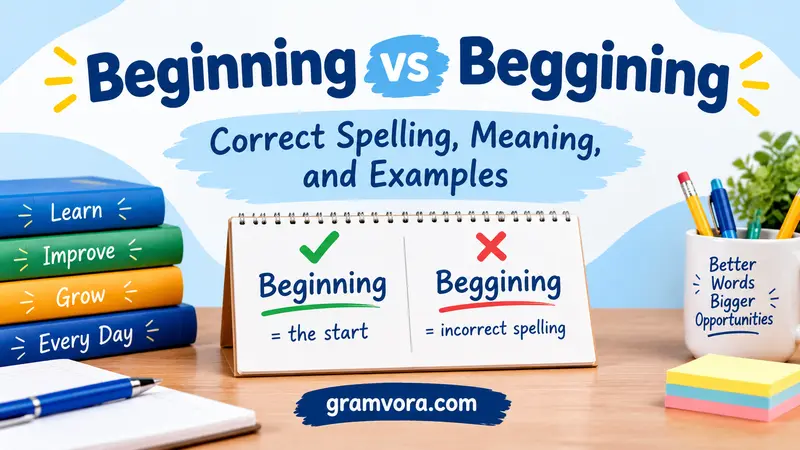
English spelling can be confusing, especially when a word contains repeated letters. One common example is beginning vs beggining. Both forms may look familiar to readers, but only one is the correct spelling in standard English.
The correct word is beginning. It refers to the start of something, the first part of an event, or the early stage of a process. By contrast, beggining is a misspelling of beginning. It is not an accepted alternative spelling in standard American English. Oxford Learner’s Dictionaries and other spelling references recognize beginning as the standard form.
The confusion usually happens because the base word begin contains one g and ends with n. When you add -ing, you double the final n, producing beginning. Some writers mistakenly double the g instead, creating beggining.
Learning the correct spelling helps you write more clearly in school assignments, emails, essays, work documents, and everyday messages. It also makes your writing look more polished and professional.
This guide explains the correct spelling, meaning, pronunciation, grammar, common mistakes, and practical examples so you can use beginning confidently.
Quick Answer
Beginning is the correct spelling. Beggining is incorrect.
- Correct: The beginning of the movie was exciting.
- Incorrect: The beggining of the movie was exciting.
The word beginning means the start, first part, or early stage of something. Remember to spell it with one g and two n letters: b-e-g-i-n-n-i-n-g.
Why People Confuse Them
People often confuse beginning and beggining because English uses different rules when adding endings to words. Sometimes a final consonant doubles, but the correct consonant depends on the original word.
The base word is begin. When you add -ing, you do not double the g. Instead, you double the final n:
- Begin + ing = beginning
- Begin + er = beginner
The repeated n is easy to overlook, especially when writing quickly. A person may remember that the word contains a doubled consonant but place the extra letter in the wrong position.
Another reason for the mistake is the sound of the word. In ordinary speech, the spelling difference between beginning and beggining is not clearly audible because beggining is usually intended to represent the same spoken word. Since pronunciation alone cannot help writers distinguish the forms, remembering the spelling pattern is important.
Typing habits can also contribute to the error. Someone who types quickly may repeat the g by mistake or fail to notice that the word needs two n letters. Spell-checking software may identify the error, but writers should still learn the correct form.
The easiest solution is to connect the word to its base form: begin. Keep the original g, double the final n, and add -ing. This simple pattern makes the spelling easier to remember.
Key Differences At A Glance
| Context | Best Choice | Why |
|---|---|---|
| Standard American English | Beginning | This is the accepted spelling. |
| Academic writing | Beginning | It is correct for essays, reports, and assignments. |
| Professional communication | Beginning | It maintains spelling accuracy and credibility. |
| Casual messages | Beginning | Informal writing still uses the standard spelling. |
| Beggining | Incorrect | It doubles the wrong consonant. |
The two forms do not have different meanings. Instead, beginning is the correct word, while beggining is a spelling error.
A useful way to remember the difference is to focus on the final part of the base word. The word begin ends in n, so the correct form doubles that letter before adding -ing.
Are They the Same Word?
No. Beginning and beggining are not two standard spellings of the same word. Only beginning is correct in ordinary modern English.
The incorrect form may appear in online posts, schoolwork, comments, messages, or other writing. Its appearance does not make it an accepted spelling. English readers can often understand what the writer intended, but the word should still be corrected in edited writing.
For example:
- Correct: We are beginning a new project.
- Incorrect: We are beggining a new project.
The intended meaning is clear in the second sentence, but the spelling is wrong. Use beginning whenever you mean the start or early stage of something.
It is also important not to confuse this error with legitimate words that contain doubled consonants. English includes words such as bigger, running, and beginning, but their spelling patterns depend on the base word and the ending being added.
US vs UK Preference
There is no meaningful American-versus-British spelling difference in this case. Beginning is the standard spelling in both American and British English.
Some English words have different regional forms. For example, American English commonly uses color, while British English often uses colour. Likewise, center is common in the United States, while centre is standard in British English.
However, beginning does not follow that kind of regional variation. Writers in the United States, the United Kingdom, Canada, Australia, and other English-speaking regions generally use the same spelling.
The form beggining is not the standard British alternative. It should not be used to make writing appear more British or American.
For consistent writing, use beginning in essays, articles, business correspondence, school assignments, and everyday communication, regardless of your preferred English variety.
Which Spelling Should You Use?
Choose beginning every time you mean the start or first stage of something.
Use it when discussing the start of an event, the opening part of a book, the first stage of a career, or the origin of a process.
Examples include:
- The beginning of the semester is always busy.
- I enjoyed the beginning of the film.
- She made a strong beginning in her new role.
- We are beginning our research today.
- The beginning of the road is near the bridge.
Avoid beggining in all these situations. It is not a correct alternative, even in informal writing.
If you are uncertain about the spelling, break the word into parts:
begin + ing = beginning
Notice that the base word begin has one g and one final n. When the ending is added, the n doubles. This gives you the correct spelling without changing the original g.
You can also check the word in a reliable dictionary whenever you are unsure. Making this habit part of your writing process can prevent repeated errors.
When One Spelling Looks Wrong
The spelling beggining may look plausible because many English words double a consonant before adding an ending. Nevertheless, it looks wrong in standard writing because it does not follow the spelling pattern used by begin.
The correct form contains two n letters in the middle-to-later part of the word: beginning. The incorrect form places the extra consonant on g: beggining.
Compare the two forms carefully:
- Beginning: b-e-g-i-n-n-i-n-g
- Beggining: b-e-g-g-i-n-i-n-g
The difference is the extra g in the incorrect version and the missing second n in the correct letter sequence.
In schoolwork, formal documents, published articles, and professional emails, spelling errors can distract readers from the message. Although readers may understand beggining, the error can make the writing appear less carefully edited.
A simple proofreading habit can help: check words with repeated letters before submitting or publishing your work. Pay particular attention to common words you type quickly, including beginning, different, necessary, and successful.
Common Mistakes (and Quick Fixes)
Here are several mistakes related to beginning and practical ways to correct them.
1. Writing “beggining”
Incorrect: The meeting is beggining now.
Correct: The meeting is beginning now.
Quick fix: Keep one g and double the n.
2. Writing “begining”
Incorrect: The class is begining at nine.
Correct: The class is beginning at nine.
Quick fix: Remember that the final n in begin doubles before -ing.
3. Forgetting the repeated consonant
Incorrect: We are begining a new chapter.
Correct: We are beginning a new chapter.
Quick fix: Write the base word first, then add the ending: begin + ning gives beginning.
4. Using the wrong form in a formal document
Incorrect: The beggining of the report explains the problem.
Correct: The beginning of the report explains the problem.
Quick fix: Read your work aloud and check the spelling of repeated-letter words before sending it.
5. Assuming readers will not notice
A reader may understand an incorrect spelling, but that does not make it correct. Quick messages can contain occasional typing errors, yet important documents deserve careful proofreading.
Quick fix: Use a spell-checker as a second check, not as a replacement for learning standard spelling.
Everyday Examples
The following examples show how beginning works in common situations.
School and education
- The beginning of the school year can feel overwhelming.
- At the beginning of the lesson, the teacher explained the rules.
- She struggled at first but made progress from the beginning.
- The essay has a clear beginning and a strong conclusion.
Work and business
- We are beginning a new project next week.
- The beginning of the presentation should introduce the main goal.
- His career had a difficult beginning, but he continued working.
- The company is beginning to expand into new markets.
Daily life
- I usually feel nervous at the beginning of a journey.
- The beginning of winter brought colder weather.
- We met at the beginning of summer.
- Every new habit has a beginning.
Books, movies, and stories
- The beginning of the novel introduces the main character.
- I missed the beginning of the movie.
- The story has an unusual beginning.
- The beginning was confusing, but the ending made sense.
Incorrect and corrected examples
| Incorrect | Correct |
|---|---|
| The beggining was interesting. | The beginning was interesting. |
| We are beggining the lesson. | We are beginning the lesson. |
| At the beggining of the year, I moved. | At the beginning of the year, I moved. |
| The story’s beggining needs work. | The story’s beginning needs work. |
These examples show that the spelling stays the same regardless of the subject. Whether you are describing a lesson, a meeting, a story, or a personal experience, use beginning.
Dictionary-Style Word Details
Verb
The related verb is begin, which means to start doing something or to enter the first stage of an action or process.
Examples:
- We begin work at eight.
- The ceremony will begin soon.
- I want to begin learning Spanish.
The verb begin has several forms:
- Base form: begin
- Third-person singular: begins
- Past tense: began
- Past participle: begun
- Present participle: beginning
Remember that the past tense is began, not beginned, and the past participle is begun, not began when used with a helping verb such as has or have.
Examples:
- She began the assignment yesterday.
- They have begun their journey.
- He is beginning a new course.
Noun
Beginning is commonly used as a noun. It refers to the first part of something, the time when something starts, or the origin of a process.
Examples:
- The beginning of the book is exciting.
- We have reached the beginning of the trail.
- Small beginnings can lead to major achievements.
The plural form is beginnings. It often refers to the early stages or origins of multiple things.
Example: The town had humble beginnings.
Synonyms
Depending on the sentence, synonyms for beginning include:
- Start
- Beginning point
- Opening
- Commencement
- Origin
- Outset
- Inception
- Dawn
- Onset
- First stage
These words are related but do not always fit every context equally well. For example, opening often refers to the first part of a book, speech, or event. Origin emphasizes where something comes from, while commencement may sound more formal.
Examples:
- The start of the meeting was delayed.
- The opening of the story caught my attention.
- The project was successful from its inception.
Example Sentences
- The beginning of the concert was delayed by rain.
- At the beginning of each chapter, the author includes a quotation.
- She is beginning to understand the topic.
- The beginning of their friendship was unexpected.
- We returned to the beginning to find the mistake.
- The first few weeks marked the beginning of a new routine.
- A clear beginning helps readers follow a story.
- The company is beginning to see positive results.
Word History
The word beginning comes from the verb begin, which has a long history in English and is related to older Germanic forms. Over time, begin developed the meaning of starting or commencing an action or process.
The ending -ing is commonly used in English to form present participles and gerunds. When it is added to begin, the final consonant n doubles, creating beginning. The doubled consonant reflects the spelling pattern used in words such as beginner and beginning.
The misspelling beggining likely arises from confusion about which consonant should be doubled. It does not represent a separate standard word with its own meaning.
Phrases Containing
The word beginning appears in several common phrases.
At the beginning of: Refers to the first part of a period, event, or place.
Example: At the beginning of the meeting, everyone introduced themselves.
In the beginning: Means at first, often before a later change.
Example: In the beginning, learning to drive felt difficult.
From beginning to end: Refers to an entire process or experience.
Example: She read the book from beginning to end.
A new beginning: A fresh start or opportunity.
Example: Moving to a new city gave him a new beginning.
The beginning of the end: The first sign that something is approaching its conclusion.
Example: The loss was the beginning of the end for the team’s championship hopes.
correct word meaning the start of something. Beggining is an incorrect spelling that doubles the wrong consonant.
What is an example of beginning in a sentence?
Example: “At the beginning of the class, the teacher explained the lesson.” Here, beginning refers to the first part of the class.
What is the plural of beginning?
The plural form is beginnings. For example, “The company had humble beginnings.”
Conclusion
The correct spelling is beginning, while beggining is a misspelling. The two forms are not accepted spelling alternatives, and there is no American-versus-British difference that makes beggining correct.
To remember the correct form, start with the base word begin. When adding -ing, double the final n, not the g: beginning. Use this spelling in schoolwork, professional documents, articles, emails, and everyday writing.
A little attention to repeated letters can make a noticeable difference in writing accuracy. When in doubt, remember this simple rule: one g, two n’s—beginning.