English spelling can be confusing when two words look almost identical. Sometimes, a single missing letter makes the difference between a correct word and a spelling mistake. The comparison between possession and posession is a good example.
Both forms may look reasonable at first glance, especially when you are writing quickly. However, only one is the standard English spelling. The correct form is possession, with two s’s after the letter e in the ending sequence.
The incorrect form, posession, leaves out one of those letters. It is not an accepted alternative spelling in standard American English. The same correction applies to standard British English.
Understanding the correct spelling matters in school assignments, professional emails, legal documents, business reports, and everyday messages. Although readers may understand what you mean when you write posession, the mistake can distract them from your message.
The good news is that possession becomes easier to remember when you connect it with the related word possess. Learning this connection and practicing a few examples can help you avoid the error in future writing.
Quick Answer
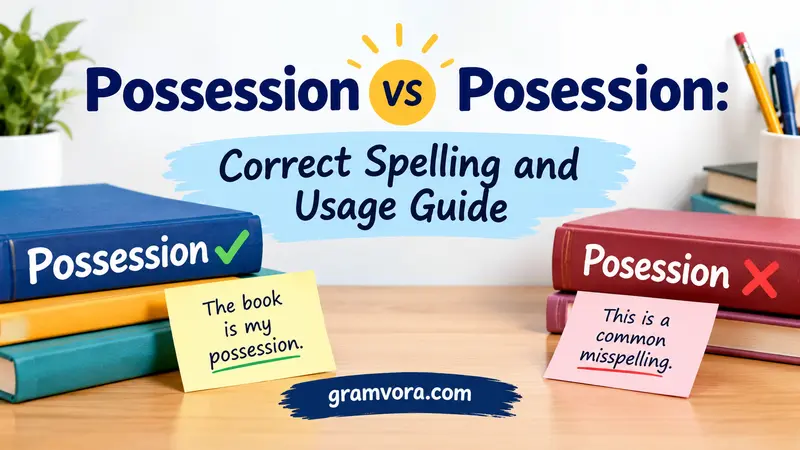
Possession is the correct spelling. Posession is incorrect.
The word possession is a noun that can refer to ownership, control, custody, or something that someone owns. It also appears in sports, legal discussions, and expressions about personal belongings.
For example:
- Correct: She placed her personal possessions in a suitcase.
- Incorrect: She placed her personal posessions in a suitcase.
- Correct: The team maintained possession of the ball.
- Incorrect: The team maintained posession of the ball.
Remember the double s in possession. It appears in the related verb possess, which means to own, have, or control something.
There is no meaningful difference in definition between the two spellings because posession is not a standard alternative form. When you intend to use this word, write possession every time.
Why People Confuse Them
Several features of English spelling make possession easy to misspell.
1. The word contains repeated letters.
The correct spelling includes two s’s in the middle and another pair in the final consonant sequence. Writers who remember the sound but not the exact letter pattern may leave out one s.
2. Pronunciation does not reveal every letter.
Possession is commonly pronounced approximately as puh-ZESH-uhn. The repeated letters do not produce separate, clearly noticeable sounds. Consequently, hearing the word may not help a learner identify every letter in its written form.
3. The related word can help, but it is easy to forget.
The verb possess has a double s at the end. Adding the ending -ion produces possession, with the spelling pattern preserved. Remembering this relationship provides a useful clue.
4. Typing quickly encourages small mistakes.
When writing a message, completing homework, or preparing a report, people may focus on the meaning of a sentence instead of checking every letter. A missing consonant can easily remain unnoticed.
5. Spellings that look plausible are not always correct.
English contains many words with different spelling patterns. However, a form that looks consistent with other words is not automatically accepted. Possession has an established spelling that writers should learn.
These factors explain why the mistake occurs. They do not make posession an acceptable alternative.
Key Differences At A Glance
The main distinction is straightforward: possession is correct, while posession is a misspelling.
| Context | Best Choice | Why |
|---|---|---|
| American English writing | Possession | This is the standard spelling. |
| British English writing | Possession | The spelling remains the same. |
| School assignments | Possession | It follows standard English spelling. |
| Business documents | Possession | It is appropriate for formal writing. |
| Discussions about property | Possession | It expresses ownership or control. |
| Sports reports | Possession | It describes control of the ball. |
| Personal belongings | Possession | It can refer to an owned item. |
| Posession in any of these contexts | Possession | Posession is a spelling error. |
The spelling does not change according to the meaning. Whether you are discussing a house, a phone, a sports match, or personal property, possession remains correct.
The word also does not change spelling according to the formality of a sentence. It works in casual conversations as well as formal documents.
Are They the Same Word?
Possession and posession are not two accepted spellings of the same word. Instead, possession is the standard word, and posession is an incorrect written form intended to represent it.
The correct noun has several related uses.
First, it can describe ownership or the state of having something. For example, a person may take possession of a new apartment after completing the purchase.
Second, it can refer to an item that someone owns. A favorite book, a family photograph, or a treasured watch may be described as a valued possession.
Third, possession can describe control in sports. A basketball team, for instance, may maintain possession while moving the ball around the court.
The word also appears in legal contexts, where its meaning depends on the situation being discussed. A report might refer to possession of property or possession of a particular item.
None of these meanings requires the spelling posession.
It is also important to distinguish the noun possession from the related verb possess. Possess is used when describing the act of owning or having something, while possession names the state of having something or the thing itself.
For example:
- Verb: They possess the necessary documents.
- Noun: They have possession of the documents.
Both words use the double-s spelling pattern.
US vs UK Preference
American and British English use the same standard spelling: possession.
Some English words differ between the United States and the United Kingdom. For example, certain words use different combinations of letters depending on the regional convention. Possession is not one of those words.
American writers should use possession in essays, reports, applications, business correspondence, and published content. British writers should also use possession.
There is no regional spelling rule that makes posession correct in the United Kingdom. Likewise, it is not an alternative spelling accepted specifically in the United States.
This consistency makes the choice simple. Writers do not need to check the country of their audience before deciding how to spell the word.
If you are preparing content for an international audience, use possession. It is the standard form recognized across major varieties of English.
The same approach applies when editing documents written by several people. If one contributor writes posession, correct it to possession to maintain accurate and consistent writing.
Which Spelling Should You Use?
Choose possession whenever you need this noun.
A useful way to remember it is to start with possess. The verb ends with ss, and the noun possession retains that spelling pattern before adding the ending.
Try dividing the word into smaller parts:
possess + ion = possession
This is a practical memory aid rather than a reason to invent a different spelling. The standard noun is written as one word, possession.
You can apply the word in different situations:
- Personal ownership: My bicycle is one of my most useful possessions.
- Property: The family took possession of the house on Friday.
- Sports: Our team lost possession near the end of the game.
- Documents: Keep possession of your receipt until the refund is complete.
- Legal writing: The agreement addresses possession of the property.
In each sentence, the spelling stays the same.
When writing for school, read your sentence again after completing it. In professional writing, use your document’s spelling checker and proofread the final version. These simple steps can catch a missing letter before someone else notices it.
If you have already typed posession, do not change the meaning of your sentence. Simply correct the spelling to possession.
When One Spelling Looks Wrong
The incorrect form may not immediately stand out because it differs from the correct spelling by only one letter. Nevertheless, spelling standards do not depend on how similar two forms appear.
Possession is the form you should recognize in dictionaries, educational materials, and professional writing.
Posession is a misspelling. It should be corrected during proofreading rather than treated as a regional preference.
Here are a few examples:
- Incorrect: The company took posession of the building.
- Correct: The company took possession of the building.
- Incorrect: Please check that all your posessions are packed.
- Correct: Please check that all your possessions are packed.
- Incorrect: The players fought hard to regain posession.
- Correct: The players fought hard to regain possession.
The second example uses possessions, the plural of possession when referring to owned items. Notice that the double s remains in the word.
Do not assume that a word becomes correct simply because people use it online or because a search engine displays it. Misspellings can appear in informal messages, comments, and unedited documents. Repeated exposure does not turn an error into a standard spelling.
When in doubt, check a reputable dictionary and use the established form.
Common Mistakes (and Quick Fixes)
The most useful way to prevent this error is to recognize the letter pattern and review the forms that commonly appear in writing.
Mistake 1: Leaving out an s
Incorrect: posession
Correct: possession
Quick fix: Remember the double s in possess and possession.
Mistake 2: Misspelling the plural
Incorrect: The children collected their posessions.
Correct: The children collected their possessions.
Quick fix: Add the plural ending to possessions without removing either s from the base word.
Mistake 3: Repeating the mistake throughout a document
Incorrect: The report mentions posession several times.
Correct: The report mentions possession several times.
Quick fix: Search your document for posession and replace each incorrect instance with possession after checking the surrounding sentence.
Mistake 4: Confusing the noun with the verb
Incorrect: The family possession three cars.
Correct: The family possesses three cars.
Quick fix: Use possess or possesses for the verb, depending on the subject. Use possession for the noun.
Mistake 5: Forgetting the word’s spelling in a compound phrase
Incorrect: personal posessions
Correct: personal possessions
Quick fix: Learn common combinations as complete phrases, such as personal possessions, take possession, and in possession of.
Mistake 6: Trusting automatic correction without reviewing the sentence
A spelling checker can be useful, but you should still read your work. A correction may be missed, or an unusual sentence may require a decision based on context.
Quick fix: Check the final text manually, especially when the word appears in a title, heading, or important document.
A short review can prevent repeated errors and make your writing easier to read.
Everyday Examples
The following sentences show how possession works in natural American English.
Personal belongings
- Please collect your personal possessions before leaving the hotel.
- Her grandmother’s ring is her most treasured possession.
- He packed all his possessions into two suitcases.
- The school asked students to label their possessions.
Ownership and property
- The new owners took possession of the house in June.
- The signed agreement confirmed possession of the property.
- She kept possession of the original receipt.
- The keys were handed over when the buyer took possession.
Sports
- Our team maintained possession throughout most of the first half.
- The players regained possession after a quick defensive move.
- The coach emphasized keeping possession under pressure.
- The opposing team lost possession near the goal.
Work and education
- The manager asked everyone to keep possession of their identification cards.
- The student wrote about the importance of protecting personal possessions.
- The report describes possession of company property.
- Please make sure you have possession of the correct documents.
Everyday conversation
- Is that camera your most valuable possession?
- I left several possessions at my friend’s apartment.
- She took possession of the package after signing for it.
- He was happy to be back in possession of his favorite book.
In all these examples, possession or possessions is the correct form. The choice between the singular and plural depends on the sentence’s meaning, not on a change in spelling convention.
Dictionary-Style Word Details
Verb
- Possession: This is a noun, not a verb. The related verb is possess, meaning to own, have, or control something.
- Posession: This is not a standard verb spelling or a standard noun spelling.
Examples of the related verb include “I possess the required documents” and “She possesses excellent communication skills.”
Use possession when naming the state of having something. Use possess when describing the action or condition expressed by the verb.
Noun
- Possession: A standard noun referring to ownership, control, custody, or something that someone owns.
- Posession: An incorrect spelling of possession.
Possession may be countable or uncountable, depending on its meaning and context.
For example, “The painting is a valuable possession” uses the singular countable form. “The family took possession of the house” uses the noun to describe a state of ownership or control.
The plural possessions commonly refers to belongings, such as clothes, books, bags, and other personal items.
Synonyms
- Possession: Depending on the context, useful alternatives include ownership, control, custody, belongings, and property.
- Posession: It has no separate standard meaning or distinct set of synonyms because it is a misspelling.
These alternatives are not interchangeable in every sentence.
Ownership emphasizes having something as one’s own. Custody emphasizes holding or caring for something. Control emphasizes the ability to direct or manage something. Belongings refers to items that a person owns or carries.
There is no single antonym that fits every use of possession. Depending on the context, loss, surrender, or dispossession may express an opposing idea.
Example Sentences
- Possession: The museum took possession of the donated artwork.
- Possession: She placed her most valuable possession in a safe.
- Possession: The team regained possession during the final minutes.
- Posession: The sentence contains a spelling error and should be corrected to possession.
The examples show that possession works in personal, professional, legal, and sports-related contexts. The incorrect form should not appear in polished writing.
Word History
- Possession: The word entered English through French from Latin. Its history is connected with the Latin word possessio and the verb possidere. Its established spelling reflects this historical development.
- Posession: There is no separate standard word history for this misspelling. It is an incorrect form of possession.
The historical background can help explain the established word, but you do not need to memorize its origin to spell it correctly. Remembering the relationship between possess and possession is more practical for everyday writing.
Phrases Containing
The following common expressions use the correct spelling:
- Take possession of: To begin having or controlling something.
- In possession of: Having or holding something.
- Personal possessions: Items owned by an individual.
- Possession of property: Having or controlling property.
- Regain possession: To recover control of something, often a ball in sports.
- Change of possession: A transfer of control, including in sports.
- Possession is nine-tenths of the law: A saying suggesting that having or controlling something can make it difficult for another person to take it away.
The misspelling posession should be corrected in all these expressions.
FAQs
Is it possession or posession?
Possession is the correct spelling. Posession is a misspelling. Always use possession in standard American and British English.
What does possession mean?
Possession means owning, holding, or having control of something. It can also refer to an item that someone owns, such as a phone, book, or piece of jewelry.
Why is posession incorrect?
Posession is incorrect because it leaves out one of the letters in the standard spelling. The correct word is possession, with a double s after the letter e in the spelling sequence.
Is possession spelled the same in American and British English?
Yes. Both American and British English use possession. There is no regional spelling difference between these varieties of English.
How do you remember the spelling of possession?
Remember the related verb possess. Both possess and possession contain a double s. Connecting the two words can help you remember the correct spelling.
What is the plural of possession?
The plural is possessions. It commonly refers to things that someone owns, such as clothes, books, bags, or personal belongings.
Example: She packed all her possessions before moving.
Is possession a noun or a verb?
Possession is a noun. The related verb is possess, which means to own, have, or control something.
Example: They possess the necessary documents.
What is an example of possession in a sentence?
Here is an example: “Her grandmother’s necklace is her most treasured possession.”
In this sentence, possession refers to an item that someone owns and values.
What are synonyms for possession?
Depending on the context, synonyms or close alternatives include ownership, control, custody, property, and belongings. These words have slightly different meanings, so choose the one that fits your sentence.
Is “take posession” correct?
No. The correct phrase is “take possession.”
Example: “The family will take possession of their new home on Friday.”
Always spell possession with both s’s in the middle of the word.
Conclusion
The spelling decision is simple: possession is correct, and posession is incorrect. The two forms are not accepted regional alternatives, and there is no US-versus-UK spelling difference to remember.
Possession can refer to ownership, personal belongings, control of a ball in sports, or other situations involving having or controlling something. Its spelling remains the same across these uses.
To avoid mistakes, remember the double s in possess and possession. Proofread your work, check repeated words, and correct posession whenever it appears.
Whether you are writing a school assignment, a business email, a sports report, or a website article, use possession for clear and accurate English.
The easiest rule to remember is this: when you mean ownership or something owned, spell the word possession.