English spelling can be confusing, especially when two words look almost identical. A small difference in the letters can make the difference between a correctly written word and a spelling mistake. The comparison between concede vs conceed is a good example of this problem.
Many writers hesitate when spelling this word. They may remember words such as proceed, succeed, and exceed, which contain the letter combination “-ceed.” Consequently, they may assume that conceed follows the same pattern. However, English spelling does not always follow one consistent rule for similar-looking words.
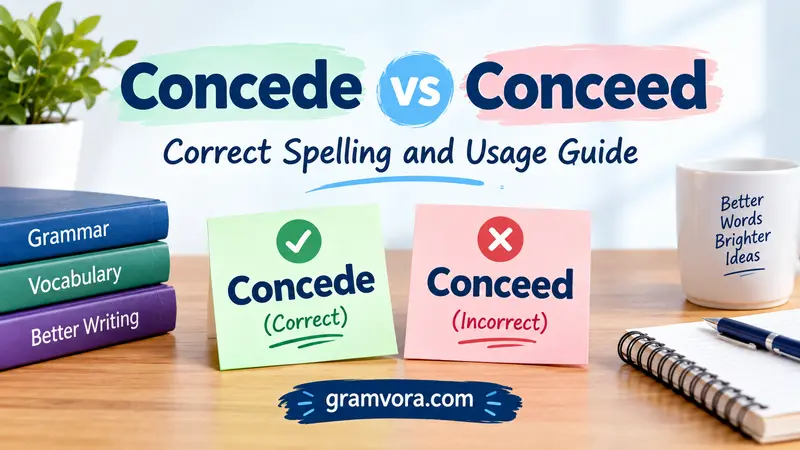
The correct spelling is concede. The spelling conceed is incorrect when used as an alternative to the standard English verb.
The word concede appears in everyday conversations, school assignments, business discussions, political reporting, and sports coverage. People use it when they acknowledge a point, admit that something is true, accept defeat, or give up a position or advantage.
For example, someone might say, “I concede that your explanation is correct.” In a sports report, a writer might say, “The team conceded two goals during the second half.”
Both examples use the same standard spelling.
This guide explains why concede is correct, why conceed is a mistake, and how to use the word naturally. It also covers common word forms, practical examples, and simple ways to remember the correct spelling.
Quick Answer
Concede is correct. Conceed is incorrect in standard English.
Use concede when you mean to admit something, acknowledge another person’s point, accept defeat, or give something up.
Examples:
- Correct: I concede that you made a good argument.
- Incorrect: I conceed that you made a good argument.
- Correct: The candidate conceded the election.
- Incorrect: The candidate conceeded the election.
The correct spelling is C-O-N-C-E-D-E.
The incorrect form adds an unnecessary letter e before the final d. There is no standard American or British English spelling rule that makes conceed an accepted alternative.
Remember that the correct base form is concede, and its past-tense form is conceded.
Why People Confuse Them
The confusion between concede and conceed usually comes from familiar spelling patterns.
English contains several common words ending in “-ceed,” including proceed, succeed, and exceed. Because these words are familiar, writers may mistakenly apply the same letter pattern to concede.
However, concede uses a different ending: “-cede.”
Compare the correct spellings:
- Concede
- Proceed
- Succeed
- Exceed
- Recede
- Precede
Although these words have similar endings and may sound alike in certain parts, their spellings must be learned individually.
Another reason for the mistake is the pronunciation of concede. The word is commonly pronounced kuh n-SEED, with the stress on the second syllable. The final sound resembles the ending of proceed and succeed, which can encourage people to add an extra e when writing it.
Nevertheless, pronunciation alone cannot determine the spelling.
A useful approach is to remember the entire word rather than trying to spell it by sound. Write concede as one complete unit and check that the ending is “-cede,” not “-ceed.”
The same principle applies to its past-tense form. The correct spelling is conceded, not conceeded.
Key Differences At A Glance
The main difference is spelling accuracy, not meaning. Only concede is the standard spelling of the English verb.
| Context | Best Choice | Why |
|---|---|---|
| American English | Concede | Standard spelling |
| British English | Concede | The spelling is the same |
| School assignments | Concede | Appropriate for standard written English |
| Professional emails | Concede | Correct and widely understood |
| Past-tense sentences | Conceded | Correct past-tense form |
| Present-participle sentences | Conceding | Correct form ending in “-ing” |
| Formal reports | Concede | Standard spelling for professional writing |
| Informal messages | Concede | The spelling does not change in casual writing |
Here is another quick comparison:
- Concede: A standard English verb.
- Conceed: A misspelling of concede.
- Concedes: The third-person singular present-tense form.
- Conceded: The simple past and past participle.
- Conceding: The present participle and gerund.
Learning these forms together makes it easier to recognize the correct spelling in different sentences.
Are They the Same Word?
No. Concede is the standard English word, while conceed is not an accepted alternative spelling of that word in standard usage.
When someone writes conceed, readers will generally understand that the writer intended to use concede. However, understanding the intended word does not make the spelling correct.
The verb concede has several related uses.
First, it can mean admitting that a statement or argument is correct.
Example: “After reviewing the evidence, Maya conceded that her original conclusion was mistaken.”
Second, it can mean accepting defeat in a competition or election.
Example: “The candidate conceded the race after the final results were announced.”
Third, it can mean giving up a position, demand, right, or advantage.
Example: “The company agreed to concede one point during the negotiations.”
Finally, in sports, it can mean allowing an opponent to score.
Example: “The goalkeeper conceded a goal shortly before halftime.”
These uses share the standard spelling concede. None requires conceed.
The word also appears in expressions such as concede defeat, concede a point, concede an argument, and concede a goal. Learning these familiar combinations can help writers remember the correct form.
US vs UK Preference
American and British English use the same spelling: concede.
Unlike words that have recognized regional spelling differences, this word does not normally change between the United States and the United Kingdom.
For example, an American newspaper might write:
“The candidate conceded defeat after the vote count.”
A British publication can use the same spelling:
“The candidate conceded defeat after the vote count.”
Both sentences are correct.
The spelling conceed is not a recognized British alternative, either. Therefore, there is no need to choose between American and British conventions when writing this word.
The same spelling applies in academic writing, professional communication, journalism, and general English usage.
Writers should also keep the standard spelling when changing the verb’s form. For example, concedes, conceded, and conceding remain correct in both varieties of English.
If your school, workplace, or publication follows a particular style guide, use its general spelling and editing rules. However, those rules do not make conceed an accepted alternative to concede.
Which Spelling Should You Use?
Choose concede whenever you need this verb in standard English writing.
The word is useful in many situations because it can express acknowledgment, acceptance, or surrender without requiring a long explanation.
Use concede when acknowledging a valid argument.
Example: “I concede that your solution is more practical.”
Use concede when discussing an election.
Example: “The candidate refused to concede defeat before the official results were released.”
Use concede when describing negotiations.
Example: “The company agreed to concede a minor point to reach an agreement.”
Use concede when reporting a sporting result.
Example: “The team conceded an early goal but recovered before the end of the match.”
Use concede in academic writing when discussing evidence or an opposing argument.
Example: “The author concedes that the study has certain limitations.”
In every example, the spelling remains unchanged at the base-form level. When the sentence requires another verb form, use the correct form, such as conceded or conceding.
Avoid conceed in essays, reports, applications, articles, emails, and other written material. Spell-checking software may identify the error, but learning the correct spelling helps prevent it from appearing in the first place.
When One Spelling Looks Wrong
The spelling conceed may look reasonable at first because English contains several words with the “-ceed” ending. Nevertheless, visual similarity is not proof that a spelling is accepted.
The clearest way to identify the mistake is to examine the letters.
Correct:
C-O-N-C-E-D-E
Incorrect:
C-O-N-C-E-E-D
The incorrect form contains an extra e before the d.
This error can also appear when writers change the word into the past tense.
Incorrect: “She conceeded that the figures were inaccurate.”
Correct: “She conceded that the figures were inaccurate.”
The correct past-tense form is conceded. Do not add another e to the base word before adding the past-tense ending.
A related spelling mistake occurs when writers are unsure whether to use concede or conceding. The correct present participle is formed by dropping the final e and adding “-ing.”
For example:
- Correct: “He is conceding the point.”
- Incorrect: “He is concedeing the point.”
Understanding these patterns helps you avoid mistakes without memorizing every possible incorrect version separately.
The important point is simple: use the standard spelling of the base word first, then apply the appropriate rule when changing its form.
Common Mistakes (and Quick Fixes)
Several common errors involve concede and its related forms. The following examples show how to correct them.
Mistake 1: Adding an extra e
Incorrect: “I conceed that you were right.”
Correct: “I concede that you were right.”
Quick fix: Remember that concede ends in “-cede.”
Mistake 2: Misspelling the past tense
Incorrect: “The team conceeded three goals.”
Correct: “The team conceded three goals.”
Quick fix: Learn concede and conceded as a pair.
Mistake 3: Using the wrong present-tense form
Incorrect: “She concede that the plan needs work.”
Correct: “She concedes that the plan needs work.”
Quick fix: Add “-s” when the subject is a singular third-person subject in the simple present tense.
Mistake 4: Adding -ing incorrectly
Incorrect: “They are concedeing the argument.”
Correct: “They are conceding the argument.”
Quick fix: Drop the final e before adding “-ing.”
Mistake 5: Confusing spelling with meaning
Incorrect assumption: “Conceed must have a different meaning from concede.”
Correction: Conceed is not a standard alternative spelling with a separate accepted meaning in ordinary English.
Quick fix: Check whether a form is an established word before assigning it a new definition.
Mistake 6: Assuming British English uses conceed
Incorrect assumption: “Conceed is British, while concede is American.”
Correction: Both American and British English use concede.
Quick fix: Remember that this is not a regional spelling difference.
Mistake 7: Relying only on pronunciation
Incorrect assumption: “The ending sounds like ‘ceed,’ so it must be spelled conceed.”
Correction: The standard spelling is concede.
Quick fix: Learn the complete spelling instead of relying on sound alone.
These corrections are useful for students, English learners, and anyone who wants to produce clear written communication.
Everyday Examples
Seeing the correct spelling in different situations makes it easier to remember.
Everyday Conversation
“I concede that you were right about the movie.”
The speaker acknowledges another person’s point.
“After thinking about it, I concede that we should leave earlier.”
The speaker accepts that another suggestion is better.
School and Academic Writing
“The student conceded that the answer in the textbook was correct.”
The student acknowledges the accuracy of the answer.
“The researcher conceded that more evidence was needed.”
The researcher recognizes a limitation.
Workplace Communication
“After reviewing the schedule, the manager conceded that the deadline was unrealistic.”
The manager acknowledges a problem with the plan.
“The company conceded one request during the final meeting.”
The company agreed to give up a point during negotiations.
Politics and Elections
“The candidate conceded the election after the results became clear.”
The candidate accepted the outcome.
“Officials did not concede that the policy had failed.”
The officials did not acknowledge that the policy had failed.
Sports
“The team conceded two goals in the first half.”
The opposing team scored twice.
“The player conceded defeat after a difficult match.”
The player accepted the loss.
Family and Personal Discussions
“I concede that I should have listened more carefully.”
The speaker admits a mistake.
“After discussing the issue, both friends conceded that they had misunderstood each other.”
Both friends acknowledge their misunderstanding.
Correct and Incorrect Forms
- Correct: “She conceded the point.”
- Incorrect: “She conceeded the point.”
- Correct: “He is conceding that the plan needs changes.”
- Incorrect: “He is conceeding that the plan needs changes.”
- Correct: “The coach conceded defeat.”
- Incorrect: “The coach conceeded defeat.”
These examples demonstrate that the correct spelling stays consistent across different situations.
Dictionary-Style Word Details
Verb
Concede: A standard English verb meaning to admit that something is true, acknowledge a point, accept defeat, yield, or grant something.
Examples:
- “I concede that your argument is stronger.”
- “The candidate conceded the election.”
- “The company conceded a minor demand.”
Conceed: Not a standard spelling of the verb. When this form appears in ordinary writing, it should generally be corrected to concede.
Common forms of concede include:
- Base form: concede
- Third-person singular: concedes
- Simple past: conceded
- Past participle: conceded
- Present participle: conceding
Noun
Concede: This is a verb, not a noun. The related noun concession refers to an act of yielding, granting something, or acknowledging a point.
Example: “The agreement included a small concession from each side.”
Conceed: This is not a standard noun spelling. It does not have a recognized noun form in ordinary English usage.
Remember that concession is a related word, not another spelling of concede.
Synonyms
Concede: Depending on the context, useful synonyms include admit, acknowledge, accept, yield, and grant.
These words are not interchangeable in every sentence.
For example, admit and acknowledge often fit when someone recognizes a fact. Yield may fit when someone gives up a position or advantage. Grant can work when someone allows or gives something to another person.
Conceed: No separate synonym list applies because this is a misspelling rather than an accepted word with its own meaning.
The closest plain alternatives for concede depend on the intended meaning.
Example Sentences
Concede:
- “I concede that your explanation is correct.”
- “The candidate conceded the race after the final count.”
- “The team conceded a goal in the opening minutes.”
- “The manager conceded that the original plan had failed.”
- “Both sides conceded a few points during negotiations.”
- “The author concedes that the evidence is limited.”
- “She refused to concede defeat before the match ended.”
- “He conceded that he had misunderstood the instructions.”
Conceed:
The following sentence contains the incorrect spelling:
“I conceed that your explanation is correct.”
The corrected sentence is:
“I concede that your explanation is correct.”
The same correction applies in the past tense:
Incorrect: “The candidate conceeded the election.”
Correct: “The candidate conceded the election.”
Word History
Concede: The word has a long history in English and is associated with a Latin word meaning to yield or give way. Its modern uses include acknowledging a point, accepting defeat, and granting something.
Its spelling is established in standard English as concede. The historical background does not support treating conceed as an accepted regional variant.
Conceed: There is no separate standard word history to explain for this misspelling. It is generally an incorrect written form of concede, often influenced by the spelling of other familiar English words.
A useful way to remember the correct form is to connect concede with concession. Both belong to the same word family, although their endings differ.
Phrases Containing
Concede: This word appears in several common expressions.
- Concede defeat: Accept that you have lost.
- Concede a point: Acknowledge that another person has a valid argument.
- Concede an argument: Accept the strength of another person’s reasoning.
- Concede a goal: Allow an opposing team to score.
- Concede ground: Give up part of a position or advantage.
- Concede a demand: Agree to give something up or accept a request.
- Concede that something is true: Admit or acknowledge a fact.
- Concede an election: Accept defeat in an election.
Examples:
“The candidate finally conceded defeat.”
“After reviewing the evidence, the lawyer conceded the point.”
“The team conceded a goal just before halftime.”
Conceed: This misspelling should not be used in these expressions. Write concede defeat, concede a point, and concede a goal.
Learning these phrases provides useful reminders of the correct spelling in real sentences.
FAQs
Is it concede or conceed?
Concede is the correct spelling in standard English. Conceed is a misspelling and should not be used in formal or informal writing.
What does concede mean?
Concede means to admit that something is true, accept defeat, acknowledge another person’s point, or give up a position or advantage.
Is conceed ever correct?
No. Conceed is not an accepted standard spelling of the verb concede. Use concede in school assignments, emails, articles, and professional documents.
How do you spell concede correctly?
The correct spelling is C-O-N-C-E-D-E. Remember that the word ends in “-cede,” not “-ceed.”
Is concede spelled the same way in American and British English?
Yes. Both American and British English use concede. There is no standard regional spelling difference between the two varieties.
What is the past tense of concede?
The past tense of concede is conceded.
Example: “The candidate conceded defeat after the final results were announced.”
What is the difference between concede and conceded?
Concede is the base form of the verb, while conceded is its simple past tense and past participle.
Examples:
- Present: “I concede that you are right.”
- Past: “I conceded that you were right.”
What is the -ing form of concede?
The correct -ing form is conceding. Drop the final e before adding “-ing.”
Example: “The team is conceding too many goals this season.”
What are some synonyms for concede?
Depending on the context, synonyms include admit, acknowledge, accept, yield, and grant. For example, acknowledge may fit when recognizing a valid point, while yield may fit when giving up a position.
How can I remember the difference between concede and conceed?
Remember the correct spelling concede, which contains only one e between the c and the final d after the letter sequence “con.” You can also connect concede with the related word concession to help remember its spelling.
Conclusion
The choice between concede and conceed is straightforward. Concede is the correct spelling, while conceed is a misspelling in standard English.
Use concede when you want to acknowledge that a statement is true, accept defeat, give up a position, grant something, or allow an opponent to score. The word works naturally in everyday conversations, school assignments, business communication, political reporting, and sports writing.