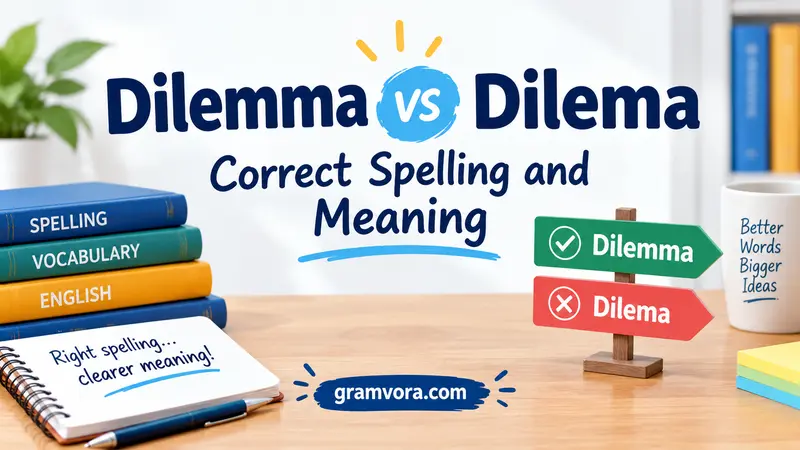
English spelling can be confusing, especially when a word contains repeated letters that are easy to overlook. One common example is dilemma vs dilema. Both forms may look familiar, and the difference between them is only one letter. However, only one is accepted as the standard spelling in modern English.
The correct spelling is dilemma, with two m’s. The spelling dilema, with one m, is a misspelling and should not be used in standard American English.
A dilemma is a difficult situation in which someone must make a choice between two or more options. Often, each option has an unwanted result, or the decision requires careful thought. For example, a student may face a dilemma when deciding whether to attend a family event or study for an important exam.
Because the word is pronounced with a relatively short, unstressed ending, it can be difficult to remember how many letters belong in the middle. Writers may accidentally leave out one m when typing quickly or writing from memory.
This guide explains the correct spelling, the meaning of dilemma, its pronunciation, and the situations in which you can use it. It also provides practical examples, common mistakes, and memory tips to help you spell the word correctly in school assignments, emails, essays, and everyday writing.
Quick Answer
Dilemma is the correct spelling. Dilema is incorrect in standard English.
The word dilemma is a noun that describes a difficult choice or a situation that requires a decision between competing possibilities.
Examples:
- Correct: I faced a dilemma when both job offers arrived.
- Incorrect: I faced a dilema when both job offers arrived.
Remember that the correct word contains two m’s: d-i-l-e-m-m-a.
If you are writing for an American audience, use dilemma in academic papers, professional emails, reports, articles, and personal messages. The spelling does not change between American and British English.
Why People Confuse Them
Several factors explain why people write dilema instead of dilemma.
1. The double m is easy to overlook
When people write quickly, they sometimes forget to repeat a letter. Since the two spellings differ by only one m, the error may go unnoticed during proofreading.
For example, someone might type, “We have a serious dilema,” without realizing that the word needs another m.
2. Pronunciation does not reveal the spelling
The word dilemma is commonly pronounced dih-LEM-uh or dye-LEM-uh, depending on the speaker. The middle consonant is not pronounced as two separate sounds.
As a result, hearing the word does not tell you whether its spelling contains one m or two. You need to remember the written form.
3. English contains many unexpected spellings
English spelling does not always follow a simple pattern. Some words contain double consonants, while similar-looking words contain only one.
For instance, common has two m’s, while coming has one. Learners may not know which pattern applies to dilemma, so they may choose the shorter spelling.
4. Familiarity can make errors seem correct
If you repeatedly see a misspelled word online or in informal messages, it may begin to look normal. This does not make the spelling correct.
The best way to avoid this problem is to learn the standard form and check a reliable dictionary when you are uncertain.
Key Differences At A Glance
The main difference is spelling, not meaning. Dilemma is the standard English word, while dilema is an incorrect spelling of that word.
| Context | Best Choice | Why |
|---|---|---|
| School assignments | Dilemma | It is the accepted spelling. |
| Business writing | Dilemma | It maintains professional accuracy. |
| Emails and messages | Dilemma | It is correct in formal and informal writing. |
| Articles and reports | Dilemma | Standard spelling helps readers understand your message. |
| Spelling tests | Dilemma | The word requires two m’s. |
| Informal drafts | Dilemma | The same spelling rule applies in every context. |
Here is a quick comparison:
- Dilemma: Correct spelling; a difficult choice or situation.
- Dilema: Misspelling; not a standard alternative.
- Part of speech: Noun.
- Plural form: Dilemmas.
- Common pronunciation: dih-LEM-uh or dye-LEM-uh.
- American or British spelling: Dilemma in both varieties.
The safest approach is simple: whenever you mean a difficult choice, write dilemma with two m’s.
Are They the Same Word?
No. Although dilemma and dilema are often intended to communicate the same meaning, they do not have the same status in standard English.
Dilemma is an established English noun. It appears in dictionaries and is widely used in education, business, journalism, literature, and everyday conversation.
Dilema, on the other hand, is a spelling error. Readers may understand what the writer intended, but the missing m makes the word incorrect.
Consider these examples:
- Correct: Choosing between two excellent universities was a difficult dilemma.
- Incorrect: Choosing between two excellent universities was a difficult dilema.
The first sentence uses the standard spelling. The second contains an error, even though its meaning remains understandable.
A useful distinction is that a misspelling can still be recognizable. Understanding the intended meaning does not make the written form acceptable.
When editing your work, correct dilema to dilemma rather than treating the two forms as interchangeable.
US vs UK Preference
American and British English sometimes use different spellings for the same word. For example, American English generally uses color, while British English commonly uses colour. Similarly, center is standard in American English, while centre is standard in British English.
However, dilemma is spelled the same way in both American and British English.
There is no standard American version with one m and a British version with two. The correct spelling remains dilemma regardless of the country.
Examples in American English:
- The company faced a dilemma over its new policy.
- I am in a dilemma about which course to choose.
- The manager had to resolve an ethical dilemma.
Examples in British English:
- The committee faced a dilemma over the proposed changes.
- She was in a dilemma about accepting the offer.
- The decision created a difficult ethical dilemma.
These examples follow the same spelling rule.
If you are writing for an American school, a British publication, or an international audience, use dilemma. Do not change the spelling to match a regional style guide.
Which Spelling Should You Use?
Choose dilemma whenever you want to describe a difficult choice or a situation that requires a decision.
The word works in many settings, including school, work, relationships, personal decisions, and public debates.
In academic writing
Students often use dilemma when discussing decisions, moral questions, or problems in literature and history.
Example: The main character faces a dilemma between telling the truth and protecting a friend.
In business writing
Professionals may use the word when discussing competing priorities or difficult decisions.
Example: The business faced a dilemma over whether to increase prices or reduce operating costs.
In everyday conversations
The word also fits casual discussions about ordinary choices.
Example: I have a dilemma: should I cook dinner or order takeout?
In ethical discussions
An ethical dilemma occurs when a person must choose between actions that involve competing moral values.
Example: The nurse faced an ethical dilemma when two patients needed urgent attention.
In each situation, the correct spelling is dilemma. The intended meaning and level of formality do not affect the spelling.
When One Spelling Looks Wrong
The spelling dilema may look reasonable because it contains the same letters as the correct word, except for one missing m. However, standard English does not recognize it as an acceptable alternative spelling.
You may encounter dilema in social media posts, comments, text messages, informal notes, or poorly edited articles. Such examples reflect spelling mistakes rather than a difference between American and British usage.
A spellchecker may flag the word, but you should still learn to recognize the error yourself. Automated corrections can be helpful, yet careful reading remains important.
Watch for these incorrect forms as well:
- Dilema: Missing one m.
- Dillemma: Contains an extra l.
- Dilemna: Incorrectly replaces the second m with n.
- Dillema: Adds an extra l while using only one m.
The standard spelling is always dilemma.
When you are unsure, break the word into letters: D-I-L-E-M-M-A. Reading each letter slowly can help you spot missing or misplaced consonants.
Common Mistakes (and Quick Fixes)
Even experienced writers sometimes misspell familiar words. The following mistakes are especially easy to make with dilemma.
Mistake 1: Leaving out one m
Incorrect: We are facing a serious dilema.
Correct: We are facing a serious dilemma.
Quick fix: Remember the double m in the middle of the word.
Mistake 2: Using n instead of the second m
Incorrect: She was in a dilemna about the decision.
Correct: She was in a dilemma about the decision.
Quick fix: The middle letters are mm, not mn.
Mistake 3: Adding an extra l
Incorrect: This is a difficult dillemma.
Correct: This is a difficult dilemma.
Quick fix: The word begins with dil, not dill.
Mistake 4: Thinking the spelling changes by country
Incorrect: Dilema is the American spelling, while dilemma is British.
Correct: Dilemma is standard in both American and British English.
Quick fix: Do not apply regional spelling rules to a word whose spelling is shared across both varieties.
Mistake 5: Forgetting the plural form
Incorrect: The students discussed several dilemas.
Correct: The students discussed several dilemmas.
Quick fix: Add s to the correct singular form, dilemma, to make dilemmas.
Mistake 6: Using the word for every ordinary problem
The word dilemma often refers to a difficult choice, particularly when the available options have drawbacks. It can also be used more broadly for a challenging situation.
However, not every minor inconvenience is necessarily a dilemma.
For example, forgetting a pencil is usually a small problem. Choosing between two jobs that each offer important benefits and drawbacks is more clearly a dilemma.
Quick fix: Consider whether the situation involves a meaningful decision or competing alternatives.
Everyday Examples
Examples make it easier to understand how dilemma works in real sentences. Notice that the spelling remains unchanged in each context.
School and education
- The student faced a dilemma when the exam date conflicted with a family wedding.
- My biggest dilemma was choosing between studying science and studying literature.
- The teacher asked the class to discuss the moral dilemma in the story.
- She had a dilemma about whether to join the debate team or the school newspaper.
- The assignment described a dilemma involving honesty and friendship.
Work and business
- The manager faced a dilemma about hiring another employee or reducing expenses.
- Our team had a dilemma because both projects needed attention.
- The company faced a financial dilemma after its costs increased.
- He was in a dilemma over whether to accept a promotion that required moving.
- The business owner had to resolve a dilemma involving customer service and limited resources.
Family and relationships
- I faced a dilemma about how to divide my time between work and family.
- She had a dilemma about telling her parents the truth.
- His dilemma was whether to forgive his friend or end the friendship.
- They faced a dilemma when two relatives planned important events on the same day.
- The couple discussed their dilemma before making a final decision.
Daily life
- My dilemma is whether to save money or buy a new laptop.
- We had a dilemma when both restaurants looked appealing.
- He faced a dilemma about taking the bus or driving through heavy traffic.
- Choosing a gift for someone who has everything can be a dilemma.
- I had a dilemma because I wanted to rest but also needed to finish my work.
Ethical and social situations
- The doctor faced an ethical dilemma involving patient privacy.
- The story explores the dilemma between personal freedom and public safety.
- The committee discussed a dilemma involving fairness and limited funding.
- The character’s dilemma became more serious as the consequences grew.
- The debate presented a dilemma with no easy solution.
These examples show that dilemma can describe personal, professional, academic, and ethical choices. In all of them, the correct spelling contains two m’s.
Dictionary-Style Word Details
Verb
Dilemma is a noun, not a verb. You cannot normally use dilemma as an action word.
Instead of saying, “The manager dilemmad the team,” use a suitable verb such as challenged, confused, or forced to choose, depending on the meaning.
Examples:
- The difficult decision challenged the manager.
- The situation forced the team to choose between two options.
- The unexpected news confused the committee.
There is no standard verb dilema or dilemma for the act of making a difficult choice.
Noun
The noun dilemma describes a difficult situation in which a person must choose between alternatives. Traditionally, the choices are often undesirable or difficult to reconcile, although everyday use also includes challenging choices with positive possibilities.
Examples:
- The family faced a dilemma about moving to another state.
- Her dilemma involved choosing between two promising careers.
- The court considered the ethical dilemma presented by the case.
The plural noun is dilemmas.
Example: The novel explores several dilemmas faced by its main characters.
Synonyms
The best synonym depends on the situation. These words may express a similar idea, but they are not always interchangeable.
- Predicament: A difficult or unpleasant situation.
- Problem: A matter that needs a solution.
- Quandary: A state of uncertainty about what to do.
- Difficulty: A challenge or obstacle.
- Conflict: A disagreement or clash between competing interests.
- Complication: Something that makes a situation harder to manage.
- Deadlock: A situation in which progress stops because opposing sides cannot agree.
For example, quandary may work well when someone feels uncertain about a decision. Predicament may be more suitable when someone is already in a difficult situation.
Choose the word that best communicates the exact meaning you intend.
Example Sentences
Here are additional examples showing different grammatical patterns:
- She faced a dilemma about accepting the scholarship.
- The dilemma was difficult because both options had serious drawbacks.
- He found himself in a dilemma after receiving two job offers.
- We discussed the dilemma before making a decision.
- The story presents a moral dilemma for its main character.
- Their financial dilemma required careful planning.
- I understand your dilemma, but you must decide what matters most.
- The committee tried to find a solution to the dilemma.
- Each choice created a new dilemma.
- The parents helped their child think through the dilemma.
Common expressions include face a dilemma, be in a dilemma, resolve a dilemma, and ethical dilemma.
Word History
The word dilemma entered English through Latin from Greek. Its historical parts are associated with the idea of two propositions or assumptions.
The word originally had a specialized role in logic and argument. Over time, its meaning expanded to describe situations in which someone must choose between competing alternatives.
Today, people use dilemma in many settings, from academic discussions to everyday conversations.
Its history can help explain why the word contains a double m. The spelling is connected to its Greek origin and the element lemma. Remembering this connection may help some learners retain the correct form.
Although the word’s historical meaning is associated with two alternatives, modern usage does not always restrict a dilemma to exactly two choices. A difficult decision involving several options can also be described as a dilemma.
Phrases Containing
Several common phrases use dilemma:
- Moral dilemma: A difficult choice involving questions of right and wrong.
- Ethical dilemma: A situation in which competing ethical principles make a decision difficult.
- Face a dilemma: To encounter a situation that requires a difficult choice.
- Be in a dilemma: To be uncertain about what decision to make.
- Resolve a dilemma: To find a way through a difficult choice.
- Create a dilemma: To produce a situation in which a difficult decision is necessary.
- A difficult dilemma: A choice that is especially challenging.
- A personal dilemma: A difficult decision affecting someone’s own life.
- A financial dilemma: A challenging decision involving money.
- A political dilemma: A difficult choice involving political goals, interests, or responsibilities.
Examples:
- The student faced a moral dilemma after discovering that a friend had cheated.
- The family was in a financial dilemma because its expenses exceeded its income.
- The manager tried to resolve the dilemma without harming the team.
- The new policy created a political dilemma for local leaders.
In each phrase, dilemma retains its standard spelling.
FAQs
Which spelling is correct: dilemma or dilema?
Dilemma is the correct spelling in standard English. Dilema is a misspelling because it leaves out one m.
What does dilemma mean?
A dilemma is a difficult situation in which someone must make a choice between two or more options. The decision may be challenging because each option has advantages and disadvantages.
Is dilema ever a correct spelling?
No. Dilema is not a standard alternative spelling in modern English. Use dilemma in academic writing, professional documents, emails, and everyday communication.
How do you spell dilemma correctly?
The correct spelling is D-I-L-E-M-M-A. Remember the two m’s in the middle to avoid the common mistake of writing dilema.
Is dilemma spelled the same in American and British English?
Yes. American and British English both use dilemma. There is no regional spelling difference between these varieties.
What is the plural of dilemma?
The plural form is dilemmas. For example: “The students discussed several dilemmas during the class.”
How do you pronounce dilemma?
Dilemma is commonly pronounced “dih-LEM-uh” or “dye-LEM-uh,” depending on the speaker. The pronunciation may vary, but the spelling remains the same.
What is an example of a dilemma in a sentence?
Example: “I faced a dilemma when I received two job offers that were equally appealing.” The sentence describes a difficult choice between competing options.
What are some synonyms for dilemma?
Common synonyms include quandary, predicament, problem, and difficulty. The best choice depends on the context and the type of situation being described.
Why do people confuse dilemma with dilema?
People often forget the second m because the pronunciation does not clearly show that the consonant is doubled. Remembering the letter pattern dilemma can help prevent this spelling error.
Conclusion
When comparing dilemma vs dilema, the correct choice is clear: dilemma is the standard English spelling, and dilema is incorrect.
A dilemma is a difficult choice or situation that requires careful thought. You can use the word in school assignments, professional documents, personal conversations, business reports, and discussions about ethical questions.
Remember three simple points:
- Spell the word with two m’s: dilemma.
- Use the same spelling in American and British English.
- Write dilemmas when you need the plural form.
If you find yourself writing dilema, pause and add the missing m. With practice, the correct spelling will become easier to recognize and use.
Whether you are writing an essay, sending an email, or explaining a difficult decision, choosing the correct spelling helps make your writing clear and accurate.