
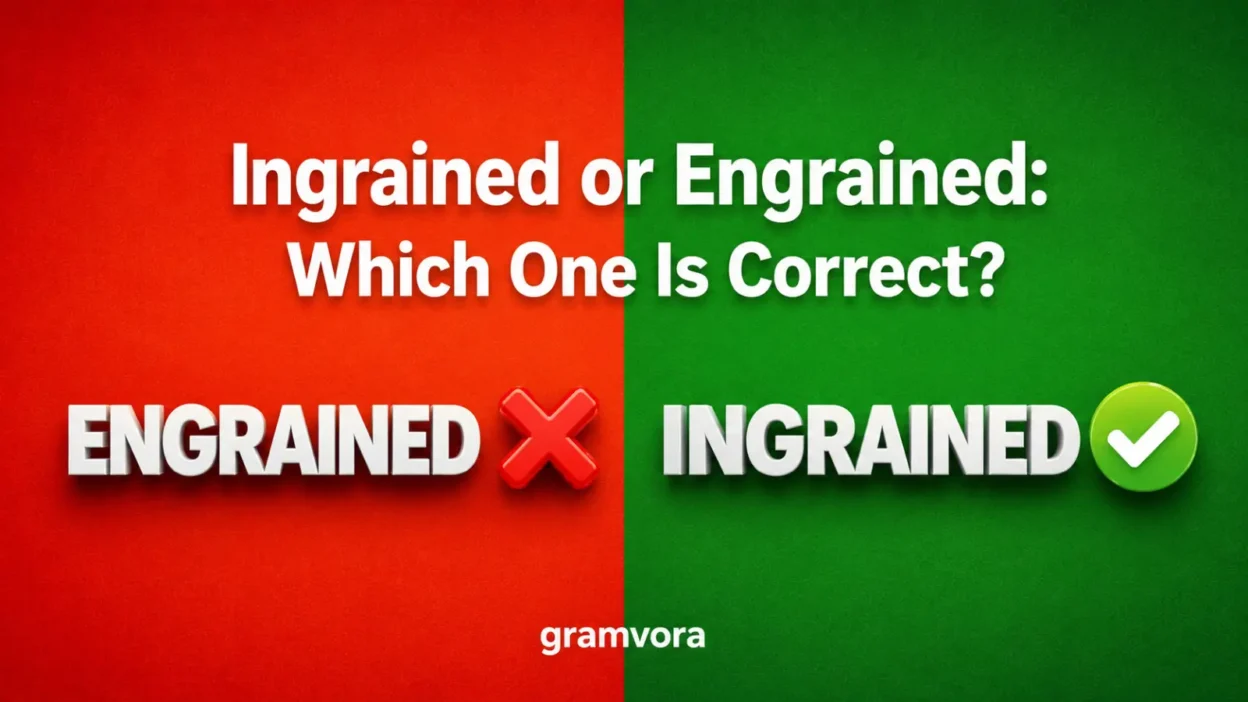
If you are choosing between ingrained or engrained, use ingrained in almost all modern US writing. It is the standard, familiar spelling for habits, beliefs, attitudes, customs, and dirt that is deeply fixed or hard to remove.
Engrained is not always impossible, but it is much less common. Most readers expect ingrained, especially in school writing, business writing, news writing, and everyday communication. The safest rule is simple: choose ingrained unless you have a specific reason to use the rarer variant.
Quick Answer
Ingrained is the better choice for modern US English. It means deeply fixed, firmly established, or worked into the surface of something. Engrained means the same thing in many dictionaries, but it is a less common variant. For clear, natural writing, write ingrained habits, ingrained beliefs, and ingrained dirt.
Why People Confuse Them
People confuse these words because they look and sound almost the same. Both are built around the idea of something being worked deeply into a grain, fiber, surface, habit, or way of thinking.
The spelling engrained also looks familiar because English has words such as engrave and engraving. That can make engrained seem like the more logical spelling. In current US English, though, ingrained is the form readers usually recognize.
The confusion grows because some dictionaries still list engrained as a variant. That does not mean both spellings are equally useful in everyday writing. It means engrained exists, while ingrained remains the preferred modern choice.
Key Differences At A Glance
Use this compact comparison to make the choice fast:
• Ingrained: preferred in modern US English; natural for habits, beliefs, customs, attitudes, and dirt.
• Engrained: a less common variant; usually unnecessary unless matching a quoted source or older wording.
• Best everyday choice: ingrained.
• Best professional choice: ingrained.
• Main warning: Do not invent a meaning difference that most modern dictionaries do not support.
The most important point is not that the two words have sharply different meanings. The real difference is reader expectation. Ingrained looks normal. Engrained may make readers pause.
Meaning and Usage Difference
Ingrained means deeply fixed, firmly established, or difficult to change. It often describes beliefs, habits, attitudes, customs, fears, biases, routines, and behaviors.
Examples:
• Her morning walk became an ingrained habit.
• The rule was ingrained in the team’s training.
• Years of practice made the movement feel ingrained.
Ingrained can also describe dirt, oil, or color that has worked into a surface, fiber, or material.
Example:
• The mechanic had ingrained grease on his hands.
Engrained can carry the same meaning, but it is less common. In modern US writing, it usually does not add clarity. It often looks like an unusual spelling of ingrained.
Tone, Context, and Formality
Ingrained sounds natural in casual, academic, workplace, and journalistic writing. It is clear without calling attention to itself.
Engrained can sound old-fashioned, uncommon, or distracting. Some readers may think it is a typo, even though dictionaries may list it as a variant. That matters because word choice is not only about technical possibility. It is also about how quickly readers understand you.
For a US audience, ingrained is the best fit in most contexts:
• college essays
• business emails
• articles
• reports
• captions
• lesson materials
• everyday conversation in writing
Pronunciation does not need much attention here. Both forms are usually said like in-GRAYND, so the confusion is mainly in spelling and usage.
Which One Should You Use?
Use ingrained when you want your sentence to sound current, clear, and natural.
| Context | Best Choice | Why |
|---|---|---|
| A habit that is hard to break | ingrained | This is the standard modern form. |
| A belief held for many years | ingrained | Readers expect this spelling. |
| Dirt worked into fabric or skin | ingrained | This is clear and widely recognized. |
| A professional email or report | ingrained | It avoids distracting the reader. |
| Quoting an older source that uses engrained | engrained | Keep the original spelling in a quote. |
| Matching a specific title or historical wording | engrained | Use it only when the original wording matters. |
For almost every normal sentence, ingrained is the better answer.
When One Choice Sounds Wrong
Engrained may sound wrong when the sentence is modern, professional, or meant for a broad US audience.
Awkward:
• Customer service is engrained in our company culture.
Better:
• Customer service is ingrained in our company culture.
Awkward:
• These routines are engrained after years of practice.
Better:
• These routines are ingrained after years of practice.
The problem is not that readers can never understand engrained. The problem is that it may pull attention away from your message. If your goal is smooth, confident writing, ingrained does that job better.
Common Mistakes (and Quick Fixes)
Mistake 1: Treating engrained as the normal spelling.
Quick fix: Use ingrained as your default.
Mistake 2: Creating a false rule that engrained is only physical and ingrained is only mental.
Quick fix: Do not force that split. Ingrained works for both beliefs and dirt.
Mistake 3: Using engrained because it looks related to engraving.
Quick fix: Remember that the common adjective is ingrained, not engraved or engrained.
Mistake 4: Repeating both forms in one article without a reason.
Quick fix: Pick ingrained and stay consistent unless quoting another source.
Mistake 5: Writing a phrase like deeply engrained habit in a formal document.
Quick fix: Change it to deeply ingrained habit.
Everyday Examples
• Saving receipts became an ingrained habit after she started freelancing.
• His respect for deadlines is ingrained from years in a busy newsroom.
• The coach wanted the safety routine ingrained before the first game.
• That belief is so ingrained that one conversation will not change it.
• The coffee stain looked ingrained in the white tablecloth.
• Good handoff notes are ingrained in the clinic’s daily process.
• Her fear of public speaking was deeply ingrained by high school.
• The company has an ingrained culture of answering customers quickly.
• After years of practice, checking the locks became ingrained.
• The old carpet had ingrained dust near the doorway.
You may see engrained in some books or older examples, but ingrained is the better choice for fresh US writing.
Dictionary-Style Word Details
Verb
• Ingrained: Can be the past tense or past participle of the verb ingrain, meaning to fix something deeply in a person, habit, memory, surface, or material.
Example: The training ingrained the safety steps in every employee.
• Engrained: Can be the past tense or past participle of engrain, a less common variant of ingrain. It is not the usual choice in modern US writing.
Example: The old manual used engrained, but most editors would choose ingrained today.
Noun
• Ingrained: Not commonly used as a noun in standard US English. It is usually an adjective or a verb form.
Example as adjective: an ingrained habit.
• Engrained: Not commonly used as a noun in standard US English. It is usually treated as a less common adjective or verb form.
A related noun exists in textile use with ingrain, but that is not the same as using ingrained as a noun.
Synonyms
• Ingrained: closest plain alternatives include deep-seated, deep-rooted, fixed, firmly established, embedded, and ingrained in.
Useful antonyms include surface-level, temporary, unfixed, and easy to change, depending on the sentence.
• Engrained: because it usually shares the same meaning as ingrained, the same closest alternatives can apply. Still, ingrained is the cleaner word to use before choosing a synonym.
Not every synonym fits every context. Deep-rooted belief works well, but deep-rooted dirt may sound odd. For dirt, use embedded, worked-in, or stubborn.
Example Sentences
• Ingrained: The habit of checking her calendar each morning was deeply ingrained.
• Ingrained: Some assumptions are so ingrained that people barely notice them.
• Ingrained: The stain was ingrained in the fabric.
• Engrained: The spelling engrained may appear as a variant, but it is less common.
• Engrained: If an older passage uses engrained, keep the spelling when quoting it exactly.
• Engrained: In most new writing, replace engrained with ingrained for clarity.
Word History
• Ingrained: The word is connected with the idea of something worked into the grain, fiber, or inner nature of something. Modern use is often figurative, especially for beliefs, habits, customs, and attitudes.
• Engrained: This form also appears as a variant, but it is less common in current writing. Some history around these forms is complex because older spellings varied more than modern spellings do.
The safe historical takeaway is simple: both forms have appeared, but ingrained is the form most readers expect today.
Phrases Containing
• Ingrained:
deeply ingrained
ingrained habit
ingrained belief
ingrained prejudice
ingrained behavior
ingrained in the culture
ingrained in daily life
ingrained dirt
• Engrained:
deeply engrained
engrained habit
engrained belief
engrained in tradition
These engrained phrases may be understandable, but they are not the best choice for most modern US writing. Use the ingrained versions unless you are preserving original wording.
FAQs
Is “ingrained” or “engrained” correct?
Both exist, but ingrained is the standard and preferred spelling in modern US English. “Engrained” is considered a less common variant and is usually avoided in everyday writing.
What does “ingrained” mean?
“Ingrained” means something is deeply fixed or firmly established, such as a habit, belief, attitude, or behavior. It can also refer to something embedded in a surface, like dirt or stain.
Is “engrained” wrong?
No, it is not strictly wrong, but it is rare and often seen as an alternative spelling. In most cases, readers expect “ingrained,” so using “engrained” may look unusual.
Can I use “engrained” in formal writing?
It is better to avoid it. In formal writing like essays, reports, or business communication, “ingrained” is the safer and more accepted choice.
Do “ingrained” and “engrained” have different meanings?
No clear difference in meaning is widely supported. They generally refer to the same idea, but usage preference strongly favors “ingrained.”
Which one should I use in exams or academic writing?
Use “ingrained.” It is the widely accepted form and will be recognized as correct in academic contexts.
Is “deeply ingrained” correct?
Yes. “Deeply ingrained” is a very common and natural phrase used to emphasize how strong or permanent a habit, belief, or behavior is.
Why do both spellings exist?
Both forms developed historically in English, but over time “ingrained” became the dominant modern spelling, while “engrained” remained as a less common variant.
What is a simple example sentence?
- Her fear of public speaking is deeply ingrained.
- The company’s values are ingrained in its culture.
If you want, I can also give you SEO-friendly FAQ schema (JSON-LD) for this page.
Conclusion
Choose ingrained for clear, modern US English. It is the standard choice for something deeply fixed, firmly established, or hard to remove, whether you mean a habit, belief, attitude, practice, or stain.
Engrained exists as a less common variant, but it rarely improves a sentence. When your goal is natural writing that readers trust immediately, ingrained is the better word.


