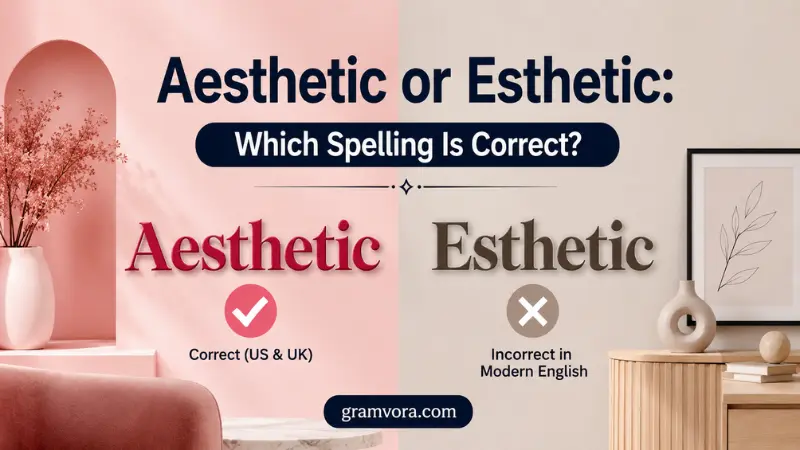
Aesthetic and esthetic are accepted spellings of the same word. Both can describe beauty, artistic taste, visual style, or choices made to improve appearance. They can also work as nouns for a particular style or set of artistic principles.
The difference is preference, not meaning. Aesthetic is the standard and more familiar spelling in modern American English. It is also the normal British spelling. Esthetic is a recognized American variant, but it appears less often and may look unusual outside certain professional or branded contexts.
For most writing, choose aesthetic. Use esthetic when an official name or required house style follows that spelling.
Quick Answer
Both aesthetic and esthetic are correct. They have the same meanings and can function as adjectives or nouns. In modern US English, aesthetic is the safer and more common choice. Esthetic is an accepted American variant, but it is less familiar. British English normally uses aesthetic.
Why People Confuse Them
The confusion begins with the opening letters. English kept the ae spelling in aesthetic, even though the word is usually pronounced with a simple vowel sound at the beginning. American English sometimes shortens ae to e in words with Greek or Latin roots, which helps explain why esthetic exists.
Readers may also notice esthetic in skincare, dentistry, spas, and appearance-related services. That pattern can make the shorter spelling seem specialized. However, it does not create a separate definition.
Key Differences At A Glance
| Context | Best Choice | Why |
|---|---|---|
| General US writing | Aesthetic | It is the most familiar and widely preferred spelling. |
| British English | Aesthetic | It is the standard form. |
| Academic, art, and philosophy writing | Aesthetic | It is established and broadly recognized. |
| A brand or official title using esthetic | Esthetic | Preserve the organization’s chosen spelling. |
| A document with an established house style | Follow that style | Consistency matters more than switching between accepted variants. |
The practical rule is simple: aesthetic works almost everywhere. Esthetic is valid, but it is a less common American choice.
Are They the Same Word?
Yes. Aesthetic and esthetic are spelling variants of the same lexical item. They share the same core meanings, pronunciation, and grammatical roles.
| Feature | Aesthetic | Esthetic |
| Meaning | Related to beauty, art, taste, style, or appearance | The same |
| Common roles | Adjective and noun | Adjective and noun |
| US status | Standard and preferred | Accepted but less common |
| UK status | Standard | Uncommon |
| Pronunciation | Usually “es-THET-ik” in US speech | Usually “es-THET-ik” |
The spelling does not change the idea. Aesthetic design and esthetic design refer to the same concern with appearance or artistic effect.
US vs UK Preference
American dictionaries recognize esthetic as a variant, but aesthetic remains the dominant spelling in general US use. It appears across education, art, design, medicine, advertising, and everyday writing.
British English strongly favors aesthetic. A British reader may understand esthetic, but the shorter form can look distinctly American or nonstandard for the document.
Avoid the rigid formula “esthetic is American and aesthetic is British.” American writers regularly use aesthetic, and it is usually the better default.
Which Spelling Should You Use?
Use aesthetic for school papers, articles, business copy, social posts, design descriptions, art discussions, and general communication. It gives readers the spelling they are most likely to recognize.
Use esthetic when preserving an official name, such as the name of a clinic, course, association, service, or product. It may also suit an employer or publication that has adopted it as house style.
Do not alternate between the spellings without a reason. Consistent spelling makes the writing look deliberate.
When One Spelling Looks Wrong
Esthetic may look wrong in a general article because many readers rarely see it. That reaction reflects familiarity, not an actual spelling error.
Aesthetic can be inappropriate when it changes an official name. If a business calls itself an “Esthetic Center,” rewriting it as “Aesthetic Center” would be inaccurate.
Choose the standard form for ordinary prose, but preserve the spelling used in names, quotations, and required terminology.
Common Mistakes (and Quick Fixes)
One mistake is claiming that esthetic relates only to skincare while aesthetic relates to art. Treat them as spelling variants with the same meanings.
Another is calling esthetic incorrect. It is accepted in American English, although it is less common than aesthetic.
Writers also mix forms in one document. Pick one spelling and keep it unless you are reproducing an official name.
Both begin with a vowel sound. Write an aesthetic choice and an esthetic choice, not a aesthetic choice.
Everyday Examples
The architect balanced practical needs with aesthetic concerns.
Her apartment has a warm, minimalist aesthetic.
The clinic offers esthetic treatments for clients who want to improve skin appearance.
The dentist discussed the esthetic result of the restoration.
Our editorial style prefers aesthetic throughout the publication.
The company kept Esthetic in its official brand name.
Both spellings work grammatically. Aesthetic usually feels more natural to a broad US audience, while esthetic may reflect a professional preference or official label.
Dictionary-Style Word Details
Verb
Aesthetic: Not commonly used as a verb in standard American English.
Esthetic: Not commonly used as a verb in standard American English.
Both forms normally function as adjectives or nouns.
Noun
Aesthetic: A particular artistic style, visual character, or set of ideas about beauty and taste. Example: “The café has a relaxed coastal aesthetic.”
Esthetic: The same noun, written with the less common American variant. Example: “The studio developed a clean industrial esthetic.”
The plural forms follow the same pattern: aesthetics is preferred, while esthetics is accepted in American English.
Synonyms
For the adjective sense, close alternatives include artistic, attractive, pleasing, tasteful, and stylish. They are not exact replacements in every sentence.
For the noun sense, the closest plain alternatives include style, look, design character, and artistic approach.
There is no single antonym for every meaning. In appearance-based contexts, unattractive or ugly may work.
Example Sentences
Aesthetic: “The renovation improved the building’s aesthetic appeal.”
Esthetic: “The dental team considered both function and esthetic appearance.”
Aesthetic: “Her photographs share a bright, nostalgic aesthetic.”
Esthetic: “The program teaches practical and esthetic principles.”
Word History
Aesthetic entered English through European philosophical writing and ultimately traces to a Greek word connected with perception by the senses. The traditional spelling kept the ae letter pair.
Esthetic developed as a shortened American variant. The simpler spelling follows a wider tendency to reduce ae to e in some words. Even so, aesthetic remained the more common form.
Phrases Containing
Common phrases include aesthetic appeal, aesthetic value, aesthetic choice, aesthetic design, aesthetic sense, aesthetic experience, and aesthetic medicine.
The same phrases can use esthetic where that spelling is established, including esthetic appeal, esthetic design, esthetic treatment, and esthetic dentistry. The meaning remains unchanged.
FAQs
Is aesthetic or esthetic correct?
Both aesthetic and esthetic are correct spellings of the same word. Aesthetic is more common and is usually the best choice in modern American English. Esthetic is an accepted US variant, but readers may see it less often.
Which spelling is preferred in American English?
Aesthetic is generally preferred in American English. It appears more often in everyday writing, education, art, design, medicine, and publishing. Esthetic remains acceptable, especially in certain professional names or established house styles.
Is esthetic the American spelling of aesthetic?
Esthetic is an American variant, but it is not the only American spelling. US writers commonly use aesthetic, and it is usually the safer default. Therefore, it is misleading to say that Americans use only esthetic.
Do aesthetic and esthetic have different meanings?
No. They have the same meanings. Both can describe beauty, visual appeal, artistic taste, or appearance. They can also work as nouns for a particular visual style, such as a minimalist aesthetic or minimalist esthetic.
Should I use aesthetic or esthetic for beauty treatments?
Both spellings can appear in beauty, skincare, dentistry, and cosmetic services. Aesthetic is the broader and more familiar choice. Use esthetic when it is part of an official business name, course title, professional label, or required style.
Are aesthetic and esthetic pronounced differently?
No. They are normally pronounced the same way: “es-THET-ik.” The spelling changes, but the pronunciation and meaning remain the same.
Conclusion
Aesthetic and esthetic are both correct spellings of the same adjective and noun. They do not have separate meanings, and esthetic is not limited to beauty services or medical settings.
For modern American English, aesthetic is the strongest default because it is more common and widely recognized. Esthetic remains an accepted US variant and should be kept when an official name or required style uses it. Whichever form you choose, stay consistent.