
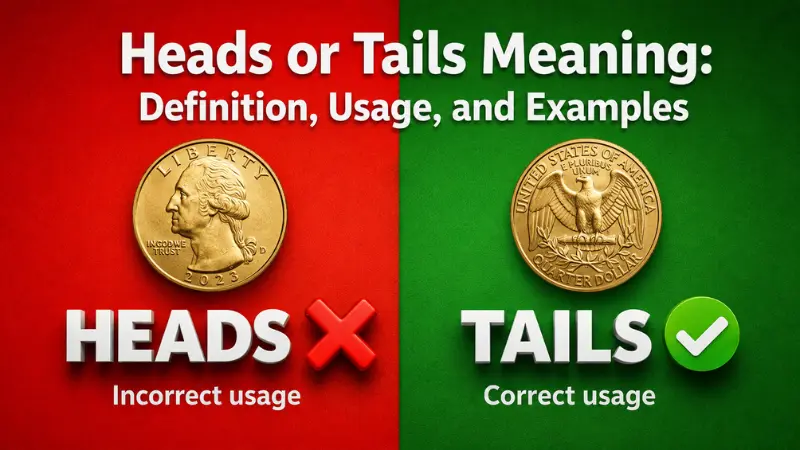
You may hear “heads or tails?” before a coin flip, game, sports event, or simple everyday decision. The speaker is asking another person to choose one of a coin’s two sides.
The phrase is common in American English and is easy to use once you know the pattern. It can describe both the choice and the coin-toss activity itself.
However, a related expression has a very different meaning. “Can’t make heads or tails of something” means that something is confusing.
This guide explains the basic meaning, pronunciation, grammar, history, and natural usage. You will also see examples from conversations, games, and everyday choices.
By the end, you will know when the phrase sounds natural. You will also know which similar expressions should not be confused with it.
Quick Answer
Heads or tails means choosing between the two sides of a coin before it is flipped. The result can decide between two choices.
If someone asks, “Heads or tails?” simply answer “Heads” or “Tails.”
TL;DR
• “Heads or tails?” asks you to choose a coin side.
• Heads is the front, or obverse, side.
• Tails is the back, or reverse, side.
• The phrase is common in games and decisions.
• “Can’t make heads or tails” has another meaning.
• “Flip a coin” is a closely related expression.
What Does Heads or Tails Mean?
The phrase refers to the two sides used in a coin toss. It often appears as a short question before someone flips a coin.
Imagine two friends cannot decide who should drive. One friend takes out a coin and asks, “Heads or tails?”
The other friend might answer, “Heads.” If the coin lands heads up, that person wins the toss.
The result can then determine the original choice.
For example:
• “Heads or tails? Winner chooses the movie.”
• “I’ll take tails.”
• “Call heads or tails before I flip it.”
• “We settled the decision with heads or tails.”
The phrase does not mean that the coin must show a human head and an animal tail. These are simply conventional names for its two sides.
It also does not usually express slang. It is a standard, familiar English expression.
How Heads or Tails Works
A basic coin toss involves two possible calls. One participant chooses heads, while the other side becomes tails.
The usual process is simple:
• Two people have a choice to settle.
• Someone holds a coin.
• One person calls heads or tails.
• The coin is flipped into the air.
• The upward-facing side determines the result.
For example, Mia and Jordan both want the window seat.
Mia says, “Let’s flip a coin.”
Jordan agrees, and Mia asks, “Heads or tails?”
Jordan answers, “Tails.”
If tails appears, Jordan gets the window seat.
People commonly treat an ordinary fair coin as giving two equally likely outcomes. However, real physical flips can involve small variations.
For everyday language, that technical detail rarely matters. The phrase still represents a simple choice between two possibilities.
What Heads and Tails Mean on a Coin
In everyday American English, heads means the front side of a coin. The formal coin-collecting term for this side is obverse.
On many U.S. coins, this side displays a portrait. That makes the name “heads” especially easy to remember.
Tails means the back side of the coin. Its formal name is reverse.
The tails side does not need to display an actual tail. The word simply identifies the opposite side in ordinary coin-toss language.
For example, a U.S. coin may have a person on the obverse. Its reverse may show a building, animal, shield, or another design.
In a casual coin toss, people still call those sides heads and tails.
| Context | Best Choice | Why |
|---|---|---|
| Casual coin flip | heads / tails | Normal everyday wording |
| Coin collecting | obverse / reverse | More precise terminology |
| Describing the activity | coin toss | Names the whole action |
| Choosing randomly | flip a coin | Natural conversational wording |
Part of Speech and Pronunciation
“Heads or tails” works mainly as a fixed expression or phrase. It commonly appears as a complete question.
For example:
“Heads or tails?”
The full meaning is understood as, “Do you choose heads or tails?”
Some dictionaries also treat heads or tails as a noun expression. In that use, it names the coin-toss game or method.
For example:
“We decided it with a quick game of heads or tails.”
Pronunciation
A simple American pronunciation is:
heads or tails → hedz-er-taylz
In careful speech, you may hear the word “or” more clearly. In fast conversation, it often becomes a short “er” sound.
The stress normally falls naturally on heads and tails.
You do not need any special pronunciation for the phrase.
How to Use Heads or Tails in Everyday English
The most natural use is a direct question before flipping a coin.
“Heads or tails?”
A person usually answers with only one word:
“Heads.”
or:
“Tails.”
You can also put the phrase inside a longer sentence.
“Choose heads or tails before I flip the coin.”
“Do you want heads or tails?”
“She called tails before the coin landed.”
“We used heads or tails to decide who went first.”
In casual American conversation, flip a coin is also very common.
For example:
“We can’t decide. Let’s flip a coin.”
After that, someone may ask:
“Heads or tails?”
This sequence sounds natural and clear.
Avoid giving both answers. If someone asks you to call the toss, choose only one side.
Common Contexts and Examples
The expression appears anywhere a coin toss helps make a simple decision. Some contexts are more common than others.
Everyday decisions
Friends may use a coin when neither person has a strong preference.
“Who gets the last slice?”
“Heads or tails?”
“Heads.”
A coin can also decide who performs a small task.
“Heads, you wash the dishes. Tails, I do them.”
Sports
Coin tosses are common before some sporting events. The result may determine an opening choice or possession.
In these situations, a player or team representative may call one side.
“Tails.”
The official then flips the coin and announces the result.
Games
Children and adults can use coin tossing to choose who starts a game.
“Let’s do heads or tails for first turn.”
“Okay. I call heads.”
Simple random choices
People may also flip a coin when two choices seem equally acceptable.
“Pizza or tacos?”
“Let’s flip for it.”
“Fine. Heads for pizza, tails for tacos.”
The phrase works best when there are two clearly defined outcomes.
Heads or Tails vs. Can’t Make Heads or Tails
These expressions contain similar words, but their meanings are different.
Heads or tails? asks someone to choose one side of a coin.
Example:
“Before I flip it, heads or tails?”
By contrast, can’t make heads or tails of something means you cannot understand something.
Example:
“I can’t make heads or tails of these instructions.”
That sentence has nothing to do with flipping a coin. It means the instructions seem confusing.
Another example is:
“I looked at the map, but I couldn’t make heads or tails of it.”
Here, the speaker could not understand the map.
A common mistake is treating these two expressions as interchangeable.
Incorrect meaning:
“I can’t make heads or tails” = “I cannot choose a coin side.”
“I can’t make heads or tails of it” = “I cannot understand it.”
Context usually makes the difference obvious.
Origin and History
Coin tossing existed long before the modern English expression became established. Older cultures also used two-sided objects for games and decisions.
Ancient Romans had a related coin-toss tradition sometimes described as “ship or head.” The names reflected recognizable designs on their coins.
English records of heads or tails date to the late 1600s. By then, the terms were being associated with tossing coins and choosing outcomes.
The portrait side naturally became associated with the word heads. The opposite side came to be called tails.
Importantly, tails does not require a picture of a tail. It became the conventional opposite of heads.
The practice remained useful because it offered a quick way to settle two-way choices.
Today, the same basic expression remains common. You can hear it in homes, playgrounds, games, and sporting events.
Common Mistakes and Related Terms
Several expressions are connected with coin tossing, but they are not identical.
“Head or tails”
In modern American usage, the familiar question is:
“Heads or tails?”
Using heads is the normal form in this expression.
“Heads and tails”
Do not normally replace or with and when asking someone to choose.
Natural:
“Heads or tails?”
Unnatural for a choice:
“Heads and tails?”
The word or matters because the person must choose one side.
“Flip a coin”
This means to toss a coin to make a random choice.
Example:
“We can flip a coin to decide.”
It is closely related but names the action rather than the two calls.
“Coin toss”
This is the noun for the event or method.
Example:
“The coin toss will decide who goes first.”
“Call it”
During a coin flip, someone may say:
“Call it!”
This means:
“Choose heads or tails.”
Synonyms
There is no perfect synonym for the exact question.
Close alternatives include:
• “Pick a side.”
• “Call it.”
• “Choose heads or tails.”
• “Flip a coin” for the broader action.
There is also no useful direct antonym. The phrase names a choice rather than a quality with an opposite.
Mini Quiz and FAQs
Mini Quiz
1. Someone asks, “Heads or tails?” What should you do?
A. Name both sides
B. Choose one side
C. Explain the coin
D. Refuse to flip it
2. What is the formal name for the heads side?
A. Reverse
B. Edge
C. Obverse
D. Rim
3. What does “I can’t make heads or tails of it” mean?
A. I lost a coin
B. I cannot understand it
C. I chose tails
D. I want another flip
4. Which sentence sounds natural?
A. “Heads and tails? Choose one.”
B. “Heads or tails?”
C. “Head and tail you want?”
D. “Which coin head?”
Answer Key
- B — Choose one side.
- C — Obverse.
- B — You cannot understand it.
- B — “Heads or tails?” is the standard expression.
FAQs
What does “heads or tails?” mean?
It asks you to choose one side of a coin. The coin is then flipped to determine the result.
People often use the result to settle a simple decision.
Which side of a coin is heads?
Heads is the front, or obverse, side of a coin. On many U.S. coins, it shows a portrait.
In casual conversation, people simply call this side “heads.”
Which side of a coin is tails?
Tails is the back, or reverse, side. It does not need to show an actual animal tail.
The name is simply the conventional opposite of heads.
Is heads or tails always 50/50?
For ordinary decisions, a fair coin is treated as having equally likely heads and tails outcomes. Real physical flips can have small practical variations.
For normal conversation, people usually describe the choice as fifty-fifty.
Why do people say heads or tails?
The words give simple names to the two sides of a coin. This makes it easy to call a result before flipping.
The expression has been used in English for centuries.
What does “can’t make heads or tails” mean?
It means you cannot understand something.
For example, “I can’t make heads or tails of this form” means the form is confusing.
Conclusion
Heads or tails is a simple phrase used to choose one side before a coin flip. Heads means the obverse, while tails means the reverse.
Remember the basic pattern: choose one side, flip the coin, and check the result.


[…] breech position means the baby is positioned with the buttocks or feet toward the birth canal rather than the […]