
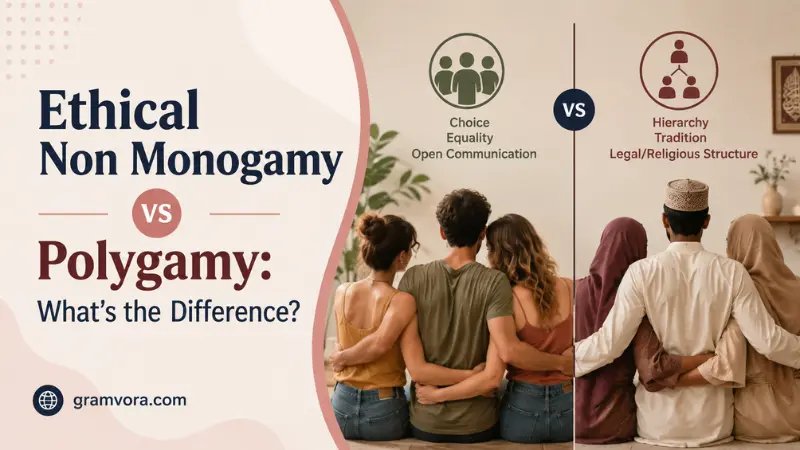
Ethical non monogamy and polygamy both involve relationships that move beyond a strictly one-partner structure, but they do not mean the same thing.
The most important difference is what each term describes. Ethical non monogamy focuses on consensual romantic or sexual non-exclusivity. Polygamy specifically focuses on having more than one spouse.
That distinction matters because a relationship can be ethical non monogamy without involving multiple marriages at all. Likewise, calling something polygamy tells you about its marital structure, but the word alone does not tell you how the people involved handle consent, communication, or relationship agreements.
Quick Answer
Both terms are correct, but they fit different situations.
Use ethical non monogamy when you mean a relationship structure in which people knowingly and consensually allow romantic or sexual relationships beyond one exclusive partner.
Use polygamy when you specifically mean a marital arrangement in which a person has more than one spouse at the same time.
The terms can sometimes overlap, but they are not interchangeable.
Why People Confuse Them
The confusion comes from one obvious similarity: both terms can describe relationships involving more than two people.
That similarity is only the starting point, though.
Ethical non monogamy is concerned with non-exclusivity by agreement. Marriage is not required. People may be dating, partnered, married, or in another agreed relationship arrangement.
Polygamy is concerned with multiple spouses. Marriage is therefore central to the meaning.
Another source of confusion is that discussions about nontraditional relationships often place several different relationship structures together. Readers may then assume that every multi-partner arrangement has the same name.
It does not.
Key Differences At A Glance
| Feature | ethical non monogamy | polygamy |
|---|---|---|
| Core meaning | Consensually agreed romantic or sexual non-exclusivity | Having more than one spouse |
| Marriage required? | No | Yes, as part of the term’s basic meaning |
| Consent emphasized by the term? | Yes | Not specifically |
| Main focus | Relationship agreements and non-exclusivity | Marital structure |
| Typical modern context | Dating, relationships, counseling, personal identity | Marriage, culture, religion, history, law |
| Can involve only two primary partners? | Yes, if agreed outside relationships are allowed | No; multiple spouses are required |
Meaning and Usage Difference
Ethical non monogamy is a broad relationship phrase. The important ideas are that the relationship is not fully exclusive and that the people involved know about and agree to that arrangement.
The additional relationships may be romantic, sexual, or both. The exact boundaries depend on what the people involved have agreed to.
Marriage is not built into the meaning.
Polygamy, by contrast, is a noun referring to a multiple-spouse arrangement. If nobody has or is understood to have multiple spouses, polygamy is usually the wrong word.
This creates a useful distinction:
A married couple that mutually agrees that each partner may date other people could practice ethical non monogamy without practicing polygamy.
A person described as practicing polygamy has multiple spouses or participates in a plural-marriage structure.
Neither term is simply a more formal version of the other.
Tone, Context, and Formality
Ethical non monogamy sounds most natural in modern discussions about dating, relationship agreements, sexuality, counseling, and personal relationship preferences.
For example:
“Jordan said ethical non monogamy works for them because everyone discusses boundaries openly.”
Polygamy has a more marriage-centered and institutional feel. It commonly appears in discussions involving marriage customs, cultural practices, religion, history, or law.
For example:
“The class discussed how different societies have viewed polygamy.”
This does not make polygamy inherently more formal. The difference comes mainly from subject matter.
Ethical non monogamy usually describes how people organize exclusivity and consent.
Polygamy describes how many spouses are involved.
Which One Should You Use?
Choose the term according to what you actually need to describe.
| Context | Best Choice | Why |
| Partners agree that they can date other people | ethical non monogamy | The focus is consensual non-exclusivity |
| A married couple allows outside romantic relationships | ethical non monogamy | Multiple spouses are not required |
| A discussion concerns one person having several spouses | polygamy | The defining feature is multiple spouses |
| A history class discusses plural marriage customs | polygamy | Marriage is the central subject |
| Someone describes an agreed nonexclusive dating style | ethical non monogamy | The term covers relationships beyond marriage |
| A discussion focuses specifically on plural-spouse marriage | polygamy | The marital structure determines the word |
A simple test can help:
Are you talking about agreed non-exclusivity generally? Choose ethical non monogamy.
Are you specifically talking about multiple spouses? Choose polygamy.
When One Choice Sounds Wrong
Using polygamy for every relationship involving several romantic or sexual partners is inaccurate because polygamy is marriage-specific.
For example:
“Alex and Morgan date other people with each other’s knowledge, so they practice polygamy.”
That wording does not work unless multiple spouses are actually involved.
Better:
“Alex and Morgan practice ethical non monogamy.”
The opposite mistake can also remove useful precision.
Suppose a discussion specifically concerns a social system in which one person has multiple spouses. Calling it only ethical non monogamy may be too broad because it leaves out the defining marital feature.
In that context, polygamy is the more precise word.
Common Mistakes (and Quick Fixes)
Mistake: Treating the two terms as synonyms
They overlap only in certain circumstances. Ethical non monogamy is broader; polygamy specifically concerns spouses.
Quick fix: Ask whether marriage is essential to what you are describing.
Mistake: Assuming every multi-partner relationship is polygamy
Dating or having additional consensual partners does not automatically create a multiple-spouse arrangement.
Quick fix: Use ethical non monogamy when marriage is not the defining feature.
Mistake: Assuming polygamy means only a man with several wives
That is too narrow for the general word polygamy. The broader term refers to having more than one spouse.
Quick fix: Use polygamy as the general multiple-spouse term.
Mistake: Assuming the word polygamy automatically tells you whether everyone freely consented
It does not. The word identifies a relationship’s marital structure rather than giving a complete judgment about how that relationship operates.
Quick fix: Describe consent separately when it matters.
Everyday Examples
Here are natural examples showing the difference.
- “They practice ethical non monogamy and openly discuss who they are dating.”
- “Ethical non monogamy works only within the agreements the people involved have made.”
- “Being married does not prevent a couple from describing their relationship as ethical non monogamy.”
- “The documentary examines the history of polygamy in several communities.”
- “The discussion was about polygamy as a form of plural marriage.”
- “Dating two people with everyone’s agreement does not automatically make someone a practitioner of polygamy.”
- “Her article compares modern ethical non monogamy with traditional discussions of polygamy.”
- “The word polygamy was appropriate because the issue involved multiple spouses rather than simply multiple dating partners.”
Dictionary-Style Word Details
Verb
ethical non monogamy: Not commonly used as a verb in standard US English. It functions as a noun phrase. People usually say they practice ethical non monogamy or are in an ethical non monogamy relationship.
polygamy: Not used as a verb in standard US English. It is a noun. A sentence normally uses wording such as practice polygamy.
Noun
ethical non monogamy: A noun phrase referring to consensually agreed romantic or sexual non-exclusivity. The phrase describes a relationship approach or structure rather than a specific marital status.
Example: “Ethical non monogamy requires clear agreements among the people involved.”
polygamy: A noun referring to the practice or state of having more than one spouse.
Example: “The course examined polygamy from a historical perspective.”
Synonyms
ethical non monogamy: An exact one-word synonym is difficult to give. Consensual non-monogamy is the closest widely used alternative because both emphasize agreed non-exclusivity, though wording preferences can differ by context.
Closest plain alternatives:
- consensual non-monogamy
- consensual nonexclusive relationships
A useful broad contrast is monogamy.
polygamy: Plural marriage is the closest plain alternative when referring to human marriage.
Closest plain alternative:
- plural marriage
A standard opposite is:
- monogamy
Example Sentences
ethical non monogamy:
- “They discussed ethical non monogamy before changing the boundaries of their relationship.”
- “Her dating profile says she practices ethical non monogamy.”
- “The couple views communication as central to ethical non monogamy.”
polygamy:
- “The lecture covered the history of polygamy.”
- “The book examines polygamy as a marital institution.”
- “The discussion used polygamy specifically for relationships involving multiple spouses.”
Word History
ethical non monogamy: This is a modern descriptive compound phrase combining ethical with non-monogamy. Its wording highlights the difference between openly agreed non-exclusivity and undisclosed violations of relationship agreements. Closely related modern discussions also use consensual non-monogamy.
Because terminology has developed across relationship communities, counseling, popular writing, and academic research, it is safer not to assign one simple origin date to the full phrase without a dedicated historical study.
polygamy: The word has much older roots. Its elements ultimately come from Greek components associated with many and marriage, which reflects its marriage-specific meaning.
That history also helps explain why polygamy is narrower than a general term for having several romantic or sexual partners.
Phrases Containing
ethical non monogamy:
- practice ethical non monogamy
- ethical non monogamy relationship
- ethical non monogamy agreement
- discussing ethical non monogamy
- exploring ethical non monogamy
polygamy:
- practice of polygamy
- history of polygamy
- laws concerning polygamy
- discussion of polygamy
- attitudes toward polygamy
FAQs About Ethical Non Monogamy vs Polygamy
Is ethical non monogamy the same as polygamy?
No. Ethical non-monogamy refers to consensual romantic or sexual relationships outside strict exclusivity. Polygamy specifically refers to having more than one spouse. Marriage is not required for ethical non-monogamy.
What is the main difference between ethical non monogamy and polygamy?
The main difference is relationship agreement versus marital structure. Ethical non-monogamy focuses on agreed non-exclusivity, while polygamy focuses on having multiple spouses.
Does ethical non monogamy involve marriage?
Not necessarily. People practicing ethical non-monogamy may be single, dating, partnered, or married. The defining feature is that everyone involved understands and agrees to the nonexclusive arrangement.
Is polygamy a type of ethical non monogamy?
They can overlap, but they are not automatically the same. A plural marriage could also be consensually non-monogamous, but the word polygamy itself describes multiple spouses rather than the quality of consent or communication.
Can a married couple practice ethical non monogamy without being polygamous?
Yes. A married couple may agree that one or both partners can date or have relationships with other people. If they do not have multiple spouses, the arrangement is not polygamy.
Which term should I use: ethical non monogamy or polygamy?
Use ethical non-monogamy when discussing consensual nonexclusive relationships in general. Use polygamy when the situation specifically involves one person having more than one spouse.
Conclusion
Ethical non monogamy and polygamy are both valid terms, but they answer different questions.
Ethical non monogamy asks whether romantic or sexual non-exclusivity is openly agreed to. Polygamy asks whether the relationship involves multiple spouses.
That means ethical non monogamy is the better choice for most discussions of consensual open or nonexclusive relationships that are not based on multiple marriages.
Use polygamy when marriage itself is central and one person has more than one spouse.
The two ideas can overlap in some situations, but neither term should automatically replace the other. Keeping the difference between consent-based non-exclusivity and multiple-spouse marriage in mind makes the word choice much clearer.


