
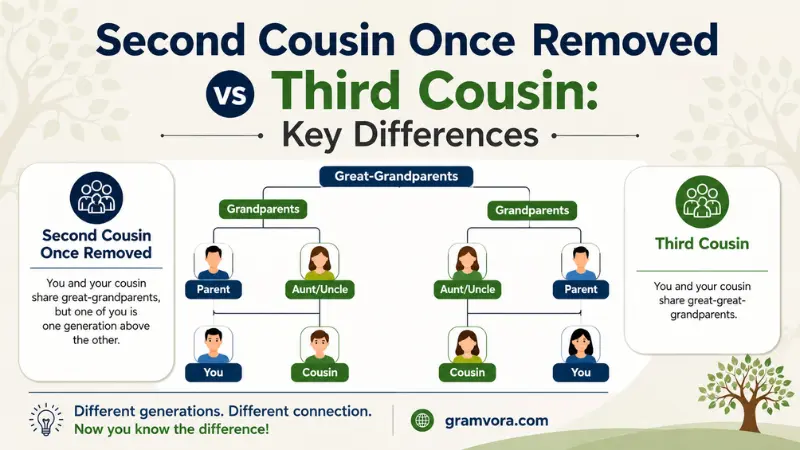
Second cousin once removed and third cousin are related family-tree terms, but they do not describe the same relationship.
The key difference is simple: second cousin once removed means the two people are one generation apart, while third cousin normally means the two people are in the same generation and share great-great-grandparents.
That difference in generations is what makes the two terms distinct.
Quick Answer
A second cousin once removed is one generation above or below your second cousin level. For example, your second cousin’s child is your second cousin once removed. Your parent’s second cousin is also your second cousin once removed.
A third cousin is generally someone in your same generation who shares your great-great-grandparents.
So, if you are asking, “Is my second cousin’s child my third cousin?” the answer is no. Your second cousin’s child is your second cousin once removed.
Why People Confuse Them
The confusion comes from the fact that both terms involve distant family relationships.
The word second in “second cousin once removed” describes the cousin degree. The phrase once removed describes a one-generation difference.
By contrast, third cousin describes a cousin degree without a generational removal. Two third cousins are normally at the same generational level relative to their shared ancestors.
A useful way to think about it is:
- Cousin number tells you the relationship level.
- Removed tells you the generation gap.
Key Differences At A Glance
| Context | Best Choice | Why |
|---|---|---|
| Your second cousin’s child | Second cousin once removed | The child is one generation below you |
| Your parent’s second cousin | Second cousin once removed | Your parent’s cousin is one generation above you |
| Someone in your generation who shares your great-great-grandparents | Third cousin | You are at the same cousin level |
| You and another person are both great-grandchildren of the same great-grandparents | Second cousin | There is no generational removal |
| You and another person are both great-great-grandchildren of the same great-great-grandparents | Third cousin | You share great-great-grandparents at the same generation |
The important point is that “third” and “once removed” measure different things.
Meaning and Usage Difference
A second cousin once removed has two parts.
Second cousin identifies the cousin relationship. Once removed tells you that the two people are separated by one generation.
For example, suppose you and your second cousin are both grandchildren of two siblings. Your second cousin has a child. That child is one generation below you, so the child is your second cousin once removed.
A third cousin is different. Third cousins share great-great-grandparents and are generally in the same generation relative to those ancestors.
This distinction matters when you are building a family tree. You cannot determine the relationship simply by counting how distant someone feels from you. You need to consider both the shared ancestor and the generations separating the two people.
Tone, Context, and Formality
There is no major difference in tone between the two expressions. Both are standard terms used when describing family relationships.
The difference is about accuracy, not formality.
In everyday conversation, people may simply call either person a “cousin,” especially when the exact relationship is complicated. But when you are describing a family tree, genealogy research, or a documented family relationship, the more precise term is useful.
For example:
“Sarah is my cousin” is casual and broad.
“Sarah is my second cousin once removed” gives the exact relationship.
“James is my third cousin” identifies a different exact relationship.
Which One Should You Use?
Use second cousin once removed when the person is one generation above or below your second-cousin relationship.
Use third cousin when you and the other person are third cousins in the same generation.
A quick test can help:
- Find the closest shared ancestor.
- Count the generations from that ancestor to each person.
- If both people are at the same level, there is no “removed” label.
- If their levels differ by one generation, the relationship is “once removed.”
This method is more reliable than guessing from ages. Two relatives can be the same age and still have different genealogical relationships, while relatives with a large age difference can sometimes be in the same genealogical generation.
When One Choice Sounds Wrong
Calling your second cousin’s child your third cousin is a common mistake.
The child is one generation below your second cousin relationship, so the correct term is second cousin once removed.
Likewise, calling your parent’s second cousin your third cousin is incorrect. That person is your second cousin once removed, because the relationship is one generation above you.
A third cousin requires a different family-tree position. The two people normally share great-great-grandparents and are at the same generational level.
Common Mistakes (and Quick Fixes)
Mistake: “My second cousin had a baby, so the baby is my third cousin.”
Fix: The baby is your second cousin once removed.
Mistake: “Removed means we are less closely related.”
Fix: “Removed” specifically describes a generation difference. It does not simply mean “more distant.”
Mistake: “Third cousin means three generations apart.”
Fix: The word third identifies the cousin degree. It does not mean three generations separate the two people.
Mistake: “Second cousin once removed and third cousin are basically the same.”
Fix: They are different genealogical relationships, even though both are relatively distant family connections.
Everyday Examples
Imagine that your great-grandparents had two children. Their children became siblings, and those siblings later had families.
If you and another person are both descendants at the appropriate same generation and share those great-grandparents, you can be second cousins.
Now imagine your second cousin has a daughter. That daughter is one generation below you. She is your second cousin once removed.
For a third-cousin example, move the shared ancestor one generation farther back. If you and another person share great-great-grandparents and are at the same generational level, you are third cousins.
Here is the second comparison element to remember:
- Second cousin once removed: second-cousin relationship + one-generation difference.
- Third cousin: third-cousin relationship + normally no generational difference.
Dictionary-Style Word Details
Verb
- Second cousin once removed: Not commonly used as a verb in standard US English. It is a noun phrase describing a family relationship.
- Third cousin: Not commonly used as a verb. It is a noun phrase describing a family relationship.
Noun
- Second cousin once removed: A person who is one generation above or below your second-cousin relationship.
- Third cousin: A person who shares great-great-grandparents with you and is normally in the same generation.
Synonyms
- Second cousin once removed: There is no exact everyday synonym that preserves the full genealogical meaning. Cousin is a broader, less precise alternative.
- Third cousin: Cousin is a broader alternative, but it does not identify the exact degree.
- Antonyms: Neither term has a true direct antonym. A different cousin degree is not an antonym.
Example Sentences
- Second cousin once removed: “My second cousin once removed lives in another state.”
- Second cousin once removed: “My grandfather’s family tree helped me identify her as my second cousin once removed.”
- Third cousin: “I discovered that Mark is my third cousin while researching our family tree.”
- Third cousin: “We share great-great-grandparents, so we are third cousins.”
Word History
The terms belong to the established vocabulary used to describe family relationships and genealogy.
The important structure is the combination of a cousin degree with a removal. “Once removed” describes a one-generation difference between relatives. The exact terminology is more useful than trying to replace it with an informal label when a precise family-tree relationship matters.
Phrases Containing
- Second cousin once removed: “my second cousin once removed,” “your second cousin once removed,” “a second cousin once removed”
- Third cousin: “my third cousin,” “your third cousin,” “a third cousin”
FAQs
1. What is a second cousin once removed?
A second cousin once removed is someone who is one generation above or below your second cousin. For example, your second cousin’s child is your second cousin once removed.
2. What is a third cousin?
A third cousin is someone who shares your great-great-grandparents with you and is normally in the same generation.
3. Is a second cousin once removed the same as a third cousin?
No. They are different relationships. A second cousin once removed is separated by one generation, while third cousins are normally in the same generation.
4. Is my second cousin’s child my third cousin?
No. Your second cousin’s child is your second cousin once removed. The child does not automatically become your third cousin.
5. Is my parent’s second cousin my second cousin once removed?
Yes. Your parent’s second cousin is generally your second cousin once removed because that person is one generation above you.
6. What does “once removed” mean?
“Once removed” means that two relatives are one generation apart. It does not simply mean that they are more distantly related.
7. Do third cousins share the same great-great-grandparents?
Yes. Third cousins generally share great-great-grandparents as their most recent common ancestors.
8. Are second cousins once removed closely related?
They are extended family members, but the relationship is more distant than a first or second cousin. The exact degree depends on the family-tree structure.
9. How can I tell whether someone is my third cousin or second cousin once removed?
First, identify the closest shared ancestor. Then count how many generations separate each person from that ancestor. If you are at the same generational level, you may be third cousins. If you are one generation apart at the second-cousin level, the relationship is second cousin once removed.
10. Why do people confuse second cousins once removed with third cousins?
The terms can be confusing because both describe relatively distant family relationships. The key is that “second” and “third” describe cousin degree, while “once removed” describes a one-generation difference.
Conclusion
Second cousin once removed and third cousin are not interchangeable.
A second cousin once removed is one generation above or below the second-cousin level. A third cousin is normally in the same generation and shares great-great-grandparents with you.
The easiest way to avoid confusion is to remember that the cousin number identifies the relationship level, while “removed” identifies the generation gap.
So if you are choosing between second cousin once removed vs third cousin, check the shared ancestor and then compare the generations. That will give you the correct term.


[…] second cousin’s child is your second cousin once removed because that person is one generation below […]