
Many people confuse polygamy and polyamory because both words describe relationships involving more than two people. However, they refer to different ideas, and using the wrong word can change the meaning of a conversation.
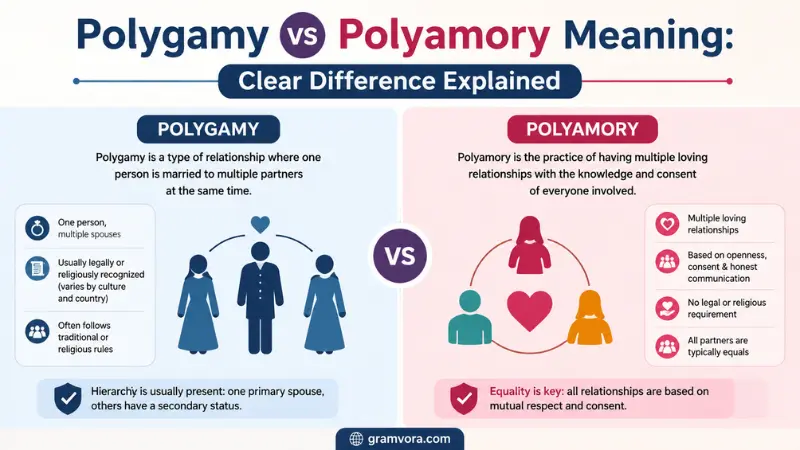
The main difference is simple: polygamy involves being married to multiple spouses, while polyamory involves having multiple consensual romantic relationships that may or may not include marriage.
Although both terms describe forms of non-monogamous relationships, they focus on different aspects. Polygamy centers on the legal or social structure of marriage, while polyamory focuses on the ability to maintain multiple romantic connections with honesty and agreement.
Understanding the difference helps you choose the correct word when discussing relationships, culture, or personal choices.
Quick Answer
Polygamy means having more than one spouse at the same time, usually referring to a marriage arrangement involving multiple partners.
Polyamory means having multiple romantic relationships at the same time with the knowledge and consent of everyone involved.
The key difference is that polygamy is based on multiple marriages, while polyamory is based on multiple consensual romantic relationships.
Why People Confuse Them
People often mix up these terms because both involve relationships with more than two people. In everyday conversations, they may appear similar because neither word describes a traditional one-partner relationship.
However, the words focus on different elements.
Polygamy comes from the idea of having multiple spouses. The relationship structure is connected to marriage.
Polyamory focuses on emotional and romantic connections. A person in a polyamorous relationship may have multiple partners without being married to them.
Another reason for confusion is that some people assume every relationship involving multiple partners is polygamy. That is not always correct. Marriage status is the important distinction.
Key Differences At A Glance
| Context | Best Choice | Why |
|---|---|---|
| Multiple legal spouses | Polygamy | The term specifically relates to having more than one spouse |
| Multiple romantic relationships with consent | Polyamory | The focus is on emotional and romantic relationships |
| Discussing marriage systems | Polygamy | Marriage structure is the central idea |
| Discussing relationship agreements | Polyamory | Consent and communication are central concepts |
Feature Comparison
| Feature | Polygamy | Polyamory |
| Main focus | Multiple spouses | Multiple romantic relationships |
| Requires marriage? | Yes, by definition | No |
| Main idea | Marriage structure | Relationship structure |
| Common context | Legal, cultural, social discussions | Personal relationship discussions |
Meaning and Usage Difference
Polygamy
Polygamy is a noun that refers to the practice or condition of having more than one spouse at the same time.
The word is usually used when discussing marriage systems, laws, cultural practices, or social structures.
Examples:
- The article discussed the history of polygamy in different societies.
- Some countries have laws that restrict polygamy.
Polyamory
Polyamory is a noun that refers to having multiple romantic relationships at the same time with the agreement of everyone involved.
The word is commonly used in discussions about relationship styles, communication, and personal choices.
Examples:
- She explained that polyamory requires honesty and communication.
- They learned about polyamory before deciding what relationship structure worked for them.
The biggest usage difference is that polygamy describes multiple marriages, while polyamory describes multiple romantic partnerships.
Tone, Context, and Formality
Both terms are relatively formal words and are commonly used in academic, social, and informational discussions.
Polygamy often appears in contexts involving:
- Marriage laws
- Religion
- Anthropology
- History
- Cultural studies
Because marriage systems vary around the world, the word may carry cultural or legal meanings depending on the discussion.
Polyamory is more commonly used in modern conversations about:
- Relationship choices
- Personal identity
- Communication between partners
- Contemporary relationship structures
Neither term is automatically positive or negative. The meaning depends on the context in which the word is used.
Which One Should You Use?
Choose polygamy when you are specifically talking about multiple spouses or a marriage system involving more than one person.
Use polyamory when you are talking about multiple romantic relationships where everyone involved knows and agrees.
Examples:
- “The documentary explores polygamy in different cultures.”
Correct because the topic is marriage. - “They discussed whether polyamory was the right relationship style for them.”
Correct because the topic is romantic relationships.
If marriage is the main focus, polygamy is usually the better word. If emotional or romantic relationships are the focus, polyamory is usually more accurate.
When One Choice Sounds Wrong
Using polygamy for every relationship involving multiple partners can create confusion because the word specifically relates to marriage.
Incorrect:
- “They practice polygamy because they are dating multiple people.”
Better:
- “They practice polyamory because they have multiple romantic relationships.”
Using polyamory when discussing multiple spouses can also be unclear.
Less accurate:
- “The law discusses polyamory between multiple spouses.”
Better:
- “The law discusses polygamy involving multiple spouses.”
The correct choice depends on whether marriage or romantic relationships are the main point.
Common Mistakes (and Quick Fixes)
Mistake 1: Treating the words as exact synonyms
Although related, these words are not interchangeable.
Fix: Ask whether the situation involves marriage or romantic relationships.
Mistake 2: Assuming polyamory always involves marriage
Polyamory does not require spouses or legal marriage.
Fix: Remember that the focus is multiple consensual romantic relationships.
Mistake 3: Assuming polygamy means any relationship with multiple partners
Polygamy specifically refers to multiple spouses.
Fix: Use polyamory for non-marriage romantic relationships.
Everyday Examples
Talking About Marriage
- The researcher studied polygamy as a marriage practice.
- The documentary explored different views of polygamy.
Talking About Relationships
- They talked openly about whether polyamory matched their values.
- Communication is an important part of many polyamorous relationships.
Workplace or Academic Discussion
- The class examined polygamy from a cultural perspective.
- The article compared different approaches to polyamory and relationships.
Dictionary-Style Word Details
Verb
Polygamy: Not commonly used as a verb in standard US English. The noun form is used to describe the practice.
Polyamory: Not commonly used as a verb in standard US English. The noun form is used to describe the relationship structure.
Related verbs may describe actions connected to these concepts, but the terms themselves are generally nouns.
Noun
Polygamy: A noun meaning the practice of having more than one spouse at the same time.
Example:
- The study examined polygamy and marriage traditions.
Polyamory: A noun meaning the practice of having multiple romantic relationships with mutual agreement.
Example:
- Polyamory involves communication and consent among partners.
Synonyms
Exact synonyms do not fully match either term.
Polygamy:
- Closest plain alternative: multiple-spouse marriage
Polyamory:
- Closest plain alternative: consensual multiple-partner relationships
These alternatives explain the meanings but do not always replace the original terms.
Example Sentences
Polygamy:
- The book discusses polygamy as a social and legal topic.
- Researchers examined how polygamy appears in different cultures.
Polyamory:
- The couple learned about polyamory before discussing their relationship goals.
- Polyamory requires clear communication between all partners.
Word History
Both terms come from Greek-based word elements related to marriage and relationships.
Polygamy combines elements meaning “many” and “marriage.”
Polyamory combines elements meaning “many” and “love.”
The words developed with different focuses: one on marriage arrangements and the other on multiple romantic connections.
Phrases Containing
Polygamy:
- polygamous marriage
- practice of polygamy
- polygamy laws
Polyamory:
- polyamorous relationship
- polyamory community
- practicing polyamory
FAQs
1. What is the main difference between polygamy and polyamory?
The main difference is that polygamy involves having multiple spouses, while polyamory involves having multiple romantic relationships with the knowledge and consent of everyone involved. Polygamy focuses on marriage, whereas polyamory focuses on romantic connections and relationship agreements.
2. Are polygamy and polyamory the same thing?
No, polygamy and polyamory are not the same. They are related because both involve more than two people, but they describe different relationship structures. Polygamy specifically involves multiple marriages, while polyamory does not require marriage.
3. Can a polyamorous relationship include marriage?
Yes, a polyamorous relationship can include people who are married, but marriage is not required. Polyamory is defined by having multiple consensual romantic relationships, not by the number of legal spouses a person has.
4. Is polygamy legal in the United States?
In the United States, legal marriage generally allows only two spouses. Laws regarding marriage and relationships vary by location, but having multiple legal spouses at the same time is not recognized as a valid marriage arrangement.
5. Does polyamory mean someone is cheating?
No. Polyamory is based on honesty, communication, and agreement among all involved partners. Cheating involves breaking an agreement or hiding a relationship, while polyamory requires openness and consent.
6. What word should I use for someone dating multiple people?
The more accurate term is usually polyamory if the relationships are open, consensual, and known by everyone involved. Polygamy would only be correct if the situation involves multiple spouses.
7. Are polygamy and polyamory formal words?
Yes. Both terms are formal nouns commonly used in academic, cultural, legal, and social discussions. However, they are usually used in different contexts because they describe different relationship structures.
Conclusion
The difference between polygamy and polyamory comes down to the type of relationship being described.
Polygamy refers to having multiple spouses and is connected to marriage structures. Polyamory refers to having multiple romantic relationships with everyone’s knowledge and agreement.
If marriage is the focus, choose polygamy. If the focus is multiple consensual romantic relationships, choose polyamory.
Using the right term makes conversations about relationships clearer and avoids confusion.


