
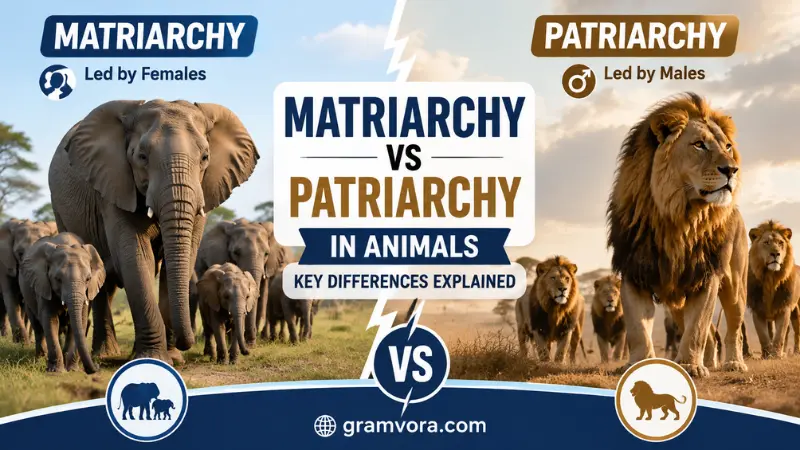
When people compare matriarchy vs patriarchy in animals, they are usually asking which word describes female-led or male-led animal groups.
The basic distinction is straightforward: matriarchy refers to a social system centered on female authority or leadership, while patriarchy refers to a social system centered on male authority or control.
However, animal behavior makes the comparison more complicated than a simple “female versus male” rule. Scientists often use terms such as female dominance or male-biased dominance when describing animal social hierarchies.
Quick Answer
Matriarchy is the better choice when an animal group is organized around female leadership, authority, or dominance.
Patriarchy refers to male-centered authority or control. The word is standard English, but it is generally less useful as a technical label for animal societies than more specific descriptions of male dominance.
For example:
- An African elephant herd can be described as matriarchal because an older female typically leads the family group.
- Spotted hyena clans show strong female dominance and are sometimes described as matriarchal.
- Bonobos are often described as female-dominated or matriarchal, although the exact balance of power varies between communities.
- A group in which males consistently hold higher social rank may be described more precisely as male-dominant rather than simply “patriarchal.”
So, if your sentence is about a female-led animal society, matriarchy is the natural choice. If you are describing male control, patriarchy can work in a broad sense, but male dominance is often clearer in animal-behavior writing.
Why People Confuse Them
The two words look like direct opposites.
Both end in -archy, a form associated with rule or authority. The first part points toward the person or sex associated with that authority: matri- relates to the mother, while patri- relates to the father.
That makes it tempting to assume that every animal society must be either matriarchal or patriarchal.
Animal social behavior is not always that simple.
A female may lead a group without controlling every social interaction. In some species, females may dominate males in certain situations while males still play important roles in movement, defense, mating, or group protection.
This is why matriarchy and patriarchy should not automatically be treated as perfect scientific opposites.
Key Differences At A Glance
| Feature | Matriarchy | Patriarchy |
|---|---|---|
| Basic idea | Female-centered authority or leadership | Male-centered authority or control |
| Grammatical role | Noun | Noun |
| Animal use | Used for some female-led societies | Less common as a precise animal-behavior label |
| Related adjective | Matriarchal | Patriarchal |
| Common animal wording | Female-led, female-dominant, matriarchal | Male-led, male-dominant, patriarchal |
| Example | A matriarch leads an elephant family group | A male-dominant hierarchy favors males in social rank |
The biggest practical difference is precision. In animal behavior, matriarchy can describe a female-led social structure, but patriarchy may sound broader or more human-centered than the evidence supports.
Meaning and Usage Difference
Matriarchy
Matriarchy is a noun for a social organization in which women or females hold most of the authority or power.
In animal contexts, the word is often used for groups in which females occupy the highest social positions or provide important leadership.
African elephants are a familiar example. Family herds are led by older females, and their experience can influence movement and responses to danger.
Spotted hyenas provide another strong example. Females hold higher social ranks than males, and rank can be connected to maternal social position.
Bonobos also show substantial female influence. Research published in 2025 found that female coalitions can help females gain and maintain higher social rank relative to males.
Patriarchy
Patriarchy is a noun describing a social organization in which fathers or males hold authority or a disproportionately large share of power.
The word works naturally when discussing human social structures. In animal behavior, however, researchers often use more specific descriptions such as male dominance or male-biased dominance.
That distinction matters because animal groups can have complex power relationships. A male may dominate females in some interactions without controlling the entire social group.
The key point
Use matriarchy when female authority or leadership is the central feature you are describing.
Use patriarchy when male authority or control is genuinely the feature being described.
For scientific writing about animals, choose the more specific wording when possible.
Tone, Context, and Formality
Both words are standard nouns, but their typical contexts differ.
Matriarchy is common in discussions of social organization, anthropology, history, and animal behavior. In popular animal writing, it can describe groups led or strongly influenced by females.
Patriarchy is especially common in discussions of human social organization, institutions, family structures, and unequal distributions of power.
In an animal-science context, male-dominant or male-biased may sound more precise than patriarchal.
Compare:
- The elephant herd is matriarchal. — Natural and clear.
- The hyena clan has female-dominant social ranks. — Precise.
- The primate group is patriarchal. — Possible in a broad description, but it may need more explanation.
- The primate group has male-biased dominance. — More specific about what researchers observed.
Neither word is inherently casual or slangy. The important issue is whether the word accurately describes the social structure.
Which One Should You Use?
Choose matriarchy when:
- females hold the highest social positions;
- an older female leads a family or group;
- female authority is a defining feature of the society;
- you are discussing a recognized female-led animal social structure.
Choose patriarchy when:
- males clearly hold most of the authority;
- male control is the central feature of the social structure;
- you are making a broader comparison with a female-centered system.
For animal behavior, consider whether male dominance says exactly what you mean. If your evidence concerns rank between males and females rather than overall group leadership, that wording can prevent overstatement.
When One Choice Sounds Wrong
Matriarchy can sound wrong when a female animal is merely the oldest individual but does not actually have a meaningful leadership or dominant role.
For example:
The oldest female happens to be in the group, so the group is automatically a matriarchy.
That conclusion is too broad.
Likewise, patriarchy can sound too strong when researchers have only found that males win more aggressive encounters.
A better description might focus directly on male-biased dominance.
Another common mistake is treating every female-led group as a complete mirror image of a human political system. Animal societies can have female leadership without reproducing every feature associated with human matriarchy.
Common Mistakes (and Quick Fixes)
Mistake: “Matriarchy means every female is dominant.”
Fix: Matriarchy refers to female-centered authority or organization. Individual females can still have different ranks.
Mistake: “Patriarchy is the scientific term for any animal group led by a male.”
Fix: A single male leader does not automatically establish a patriarchal social system. Describe the actual pattern of male authority or dominance.
Mistake: “Matriarchy and female dominance always mean exactly the same thing.”
Fix: They overlap, but female dominance can describe a narrower pattern of rank or power between females and males.
Mistake: “If elephants are matriarchal, males have no important social role.”
Fix: Female leadership does not mean males are socially irrelevant. Animal groups can divide social roles in complex ways.
Everyday Examples
Here are natural US-English examples showing how the terms work:
- African elephant families are often described as matriarchal because older females lead the herd.
- The elephant matriarch may guide the group toward water or away from danger.
- Spotted hyenas have a strongly female-dominant social hierarchy.
- Researchers study female dominance in bonobos to understand how social power develops.
- Calling an animal group patriarchal requires evidence of substantial male authority or dominance.
- The researchers avoided calling the species patriarchal and instead described its social hierarchy as male-biased.
- A matriarchal group can still include important roles for males.
- Not every animal society fits neatly into a matriarchy-or-patriarchy model.
These examples show an important usage point: the words describe social organization and power, not simply whether a species contains more males or females.
Dictionary-Style Word Details
Verb
- Matriarchy: Not commonly used as a verb in standard US English.
- Patriarchy: Not commonly used as a verb in standard US English.
The related adjectives are matriarchal and patriarchal, but those are separate words rather than verb forms.
Noun
- Matriarchy: A noun meaning a social organization or group governed or strongly organized around female authority. In animal contexts, it can describe female-led or female-dominant societies.
- Patriarchy: A noun meaning a social organization in which fathers or males hold authority or a disproportionately large share of power.
Both can be used as countable or uncountable nouns depending on the sentence.
Examples:
- A matriarchy can have complex social ranks.
- The researchers debated whether the group should be described as a matriarchy.
- Patriarchy is often discussed in relation to human institutions.
- The novel imagines several different patriarchies.
Synonyms
- Matriarchy: Closest plain alternatives include female-led society, female-dominant social system, or female-centered social structure, depending on the exact meaning.
- Patriarchy: Closest plain alternatives include male-dominant society, male-led social system, or male-centered social structure, depending on context.
These alternatives are not always exact synonyms. For animal behavior, female dominance or male dominance may be more precise when the evidence concerns social rank rather than overall leadership.
Example Sentences
- The elephant herd has a matriarchal social structure.
- Female bonobos can form alliances that increase their social power.
- The spotted hyena clan has a strong female-dominant hierarchy.
- The term patriarchy describes male-centered authority, but it may be too broad for some animal-behavior studies.
- Researchers may use male-biased dominance when they want to describe observed differences in rank more precisely.
Word History
Matriarchy is a standard English noun. Merriam-Webster records its first known use as 1885.
Patriarchy is also a standard English noun. Merriam-Webster records its first known use as 1632.
The historical development of these words is not the main issue in animal usage. For this comparison, their current meanings and how precisely they describe animal social structures matter more.
Phrases Containing
- matriarchy: a matriarchy, a matriarchal society, matriarchal social structure, animal matriarchy
- patriarchy: a patriarchy, a patriarchal society, patriarchal social structure, animal patriarchy
In animal writing, phrases such as matriarchal society and female-dominant social structure are often useful when the evidence specifically concerns female leadership or rank.
FAQs
Does matriarchy mean that all females dominate all males?
No. Matriarchy does not necessarily mean that every female dominates every male. It refers more broadly to female-centered authority, leadership, or social organization.
Is patriarchy the opposite of matriarchy?
In general usage, the two words describe contrasting forms of male-centered and female-centered authority. However, animal societies do not always fit neatly into one category or the other.
Which term is better for animal behavior: matriarchy or female dominance?
It depends on what you are describing. Matriarchy works for a broader female-centered social structure, while female dominance is often more precise when discussing differences in social rank between females and males.
Can an animal group be female-led without being matriarchal?
Yes. A female may lead a group without the entire social structure being female-centered. In that situation, female-led may be more precise than matriarchal.
Can an animal group be male-dominant without being patriarchal?
Yes. Male dominance can describe a specific pattern of social rank without meaning that males control the entire social organization. This is one reason animal behavior research often uses more specific language.
What is an example of a matriarchal animal society?
African elephants are one of the clearest examples. Family groups are led by older females, with the matriarch playing an important role in group movement and decision-making.
Is “matriarchy vs patriarchy in animals” scientifically accurate?
The comparison is useful for general discussion, but it can oversimplify animal social behavior. Scientific descriptions often focus more specifically on female or male dominance, leadership, rank, and social organization.
Conclusion
Matriarchy and patriarchy are both correct English words, but they are not equally precise in every discussion of animals.
Matriarchy describes female-centered authority or leadership and is commonly used for certain animal societies, including descriptions of elephant, hyena, and bonobo social structures.
Patriarchy describes male-centered authority or control. It can be used for animal societies when that broader meaning is genuinely supported, but male dominance or male-biased dominance may provide a clearer description of the specific behavior being studied.
The safest rule is simple: use matriarchy for a genuinely female-centered social structure, and use patriarchy for genuine male-centered authority. When discussing animal behavior, choose the more specific description whenever the evidence allows it.


