
Polygamy and monogamy are both standard English nouns, but they describe different marriage structures.
The important question is not which word is grammatically correct. Both are correct. The harder question is whether polygamous marriages have higher divorce rates than monogamous marriages.
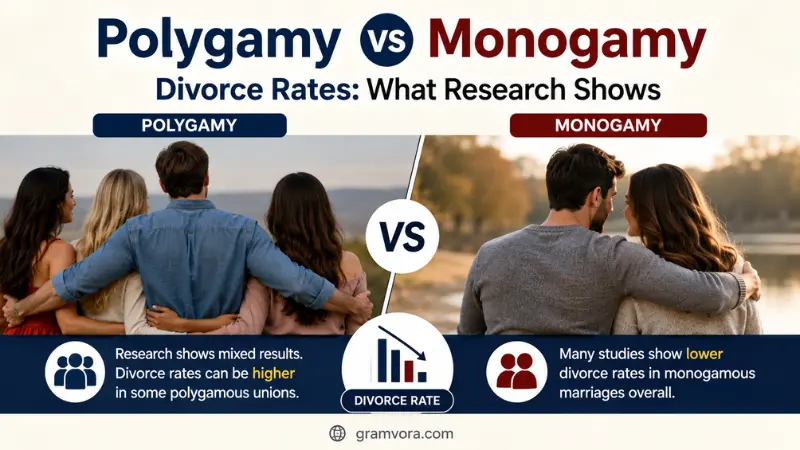
The evidence does not support one universal divorce-rate number for the two arrangements. Research from countries where polygyny is practiced has sometimes found greater marital disruption, but the results vary by setting, number of spouses, and other social factors.
For the United States, a direct national comparison is especially difficult because marriages involving more than two spouses are not legally recognized.
Why Divorce Rates Are Hard to Compare
A divorce rate only makes sense when researchers have a clearly defined population to measure.
That creates a problem when comparing polygamy and monogamy in the United States. National divorce statistics are based on legally recognized marriages, while plural marriages do not have an equivalent national category.
As a result, readers should be careful with simple claims that one marriage structure has a specific percentage of divorces.
Quick Answer
Polygamy means marriage involving more than one spouse at the same time. Monogamy means marriage to one spouse at a time.
There is no reliable U.S. national statistic showing a simple polygamy-versus-monogamy divorce rate.
What Research Suggests
Some international studies of polygynous marriages have found higher levels of marital disruption. However, those findings do not prove that every polygamous marriage is more likely to end in divorce.
The results can vary according to the population studied, social conditions, economic circumstances, and the number of spouses involved.
The safest conclusion is that some research has found an association between polygyny and greater marital disruption, but there is no universal divorce-rate rule.
Why People Confuse Them
The words look similar because they share the ending -gamy, which relates to marriage.
The prefixes create the main contrast. Mono- indicates one, while poly- indicates many.
The Basic Difference
- Monogamy: one spouse at a time.
- Polygamy: more than one spouse at the same time.
Confusion begins when people treat these definitions as though they automatically provide a divorce statistic.
They do not. A marriage structure and a divorce rate are different concepts.
Marriage Structure vs. Divorce
The word describing a marriage tells you how the relationship is structured.
A divorce rate tells you how often marriages in a particular population end in divorce or another measured form of marital dissolution.
These are separate ideas, so one cannot be used as a direct substitute for the other.
Key Differences At A Glance
| Feature | Polygamy | Monogamy |
|---|---|---|
| Basic meaning | More than one spouse at the same time | One spouse at a time |
| Word class | Noun | Noun |
| Marriage structure | Plural-spouse marriage | One-spouse marriage |
| U.S. legal recognition | Multiple-spouse marriages are not legally recognized | Standard legal marriage structure |
| Divorce comparison | No reliable U.S. national rate for direct comparison | Extensive U.S. divorce data exists |
| Research finding | Some settings show greater marital disruption | Results vary by population and marriage history |
Meaning and Usage Difference
Polygamy describes a marriage arrangement in which a person has more than one spouse at the same time.
In research, the term is sometimes used broadly, although polygyny specifically describes one man having multiple wives and polyandry describes one woman having multiple husbands.
Why the Research Term Matters
This distinction matters when reading divorce research. A study about polygyny is not automatically a study about every possible form of polygamy.
Likewise, a study of monogamy may include people who later divorce and remarry.
That pattern can still be called serial monogamy because the person has one spouse at a time, even across multiple marriages.
Tone, Context, and Formality
Both words are neutral, established terms in formal American English.
Polygamy is commonly used in discussions of marriage, law, religion, anthropology, and family structure.
Monogamy is used in everyday relationship discussions as well as academic writing about marriage and human behavior.
Choosing the More Precise Term
Neither word is inherently informal.
The context does matter, though. When discussing research about a specific form of plural marriage, polygyny may be more precise than the broader term polygamy.
Which One Should You Use?
Use monogamy when you mean having one spouse at a time.
“They chose monogamy when they got married.”
Use polygamy when you mean having multiple spouses at the same time.
“The study examined communities where polygamy is practiced.”
When Discussing Divorce Research
If you are discussing divorce research, be more specific about what the research actually measured.
Instead of saying:
“Polygamy has a 30% divorce rate.”
say:
“Some studies of polygynous marriages have found higher levels of marital disruption.”
That wording avoids presenting one study from one population as a universal statistic.
When One Choice Sounds Wrong
Calling a conventional one-spouse marriage polygamous is incorrect.
For example:
“They have a polygamous marriage because they have been married twice.”
That does not describe polygamy. If the first marriage ended before the second began, the person had two marriages at different times.
Divorce Does Not Automatically Mean Polygamy
Similarly, calling a marriage monogamous does not necessarily mean the person will marry only once in a lifetime.
The word concerns having one spouse at a time.
A person can therefore experience divorce, remarry, and still have practiced monogamy in each marriage.
Common Mistakes (and Quick Fixes)
Mistake: Treating every divorce as evidence against monogamy.
Fix: Divorce can occur within a monogamous marriage, but that does not change the definition of monogamy.
Mistake: Assuming every polygamous marriage has a higher chance of divorce.
Fix: Research findings vary across populations and circumstances.
Mistake: Using U.S. divorce statistics as a direct measure of polygamous divorce.
Fix: U.S. national divorce statistics do not provide a comparable population of legally recognized plural marriages.
Mistake: Assuming “more spouses” automatically means “more divorces.”
Fix: Some research suggests the number of spouses can matter, but the relationship is not that simple.
A Better Way to Read Divorce Statistics
When you see a divorce statistic, check what population the number describes.
Ask whether the study measured legal divorce, separation, marital dissolution, or another outcome.
Also consider the country, culture, family structure, and period studied before applying the result to a different population.
Everyday Examples
Here are natural examples in modern American English:
- “The couple agreed that they wanted a monogamous marriage.”
- “Monogamy means having one spouse at a time.”
- “The researcher studied polygamy in a community where plural marriage is permitted.”
- “The study focused specifically on polygyny rather than every form of polygamy.”
- “Divorce rates cannot be compared between U.S. monogamous marriages and legally recognized polygamous marriages because the latter are not part of the U.S. legal marriage system.”
- “She divorced her first husband and later remarried, so her marriages occurred sequentially rather than simultaneously.”
Examples in Context
“Monogamy involves one spouse at a time.”
For a research discussion, write:
“The researchers examined marital dissolution among polygynous families.”
For a U.S. comparison, write:
“There is no simple national divorce-rate comparison between polygamous and monogamous marriages.”
Dictionary-Style Word Details
Verb
- Polygamy: Primarily a noun. Polygamy itself is not normally used as a verb in standard American English.
- Monogamy: A noun and not commonly used as a verb in standard American English.
The related adjective forms are polygamous and monogamous.
Noun
- Polygamy: The practice or condition of having more than one spouse at the same time.
- Monogamy: The practice or condition of having one spouse or sexual partner at a time.
Both are normally used as nouns.
Synonyms
- Polygamy: There is no perfect everyday synonym. Plural marriage is a close plain alternative when referring specifically to marriage involving multiple spouses.
- Monogamy: One-spouse marriage is a close plain alternative when the discussion is specifically about marriage.
These alternatives should not automatically be treated as exact replacements in every context.
Example Sentences
- Polygamy: “The researchers examined the effects of polygamy on family structure.”
- Polygamy: “Polygamy is not legally recognized as a multi-spouse marriage in the United States.”
- Monogamy: “The couple chose monogamy because they wanted an exclusive marriage.”
- Monogamy: “Monogamy does not mean a person can never divorce and remarry.”
Word History
Both words have Greek roots connected with marriage.
Monogamy comes through French and Late Latin from Greek forms built from mono-, meaning one, and a marriage-related root.
Polygamy comes from Greek polygamia, built from poly-, meaning many, and the same marriage-related root.
The shared ending helps explain why the words look and sound related.
Phrases Containing
Common expressions include:
- monogamous marriage
- monogamous relationship
- serial monogamy
- polygamous marriage
- polygamous family
- polygamous society
In research writing, phrases such as polygynous marriage and marital dissolution may also appear when researchers are describing a specific population or outcome.
Conclusion
Polygamy and monogamy are both correct English words, but they describe different marriage structures.
Polygamy involves more than one spouse at the same time, while monogamy involves one spouse at a time.
The Main Takeaway
When it comes to divorce rates, there is no dependable U.S. national figure that directly compares legally recognized polygamous and monogamous marriages.
Some international studies have found greater marital disruption in certain polygynous populations, but the findings vary.
The best conclusion is not that polygamy always has a higher divorce rate. A more accurate statement is that some research has found an association between polygyny and greater marital disruption, while the available evidence does not establish one universal divorce-rate difference.


