
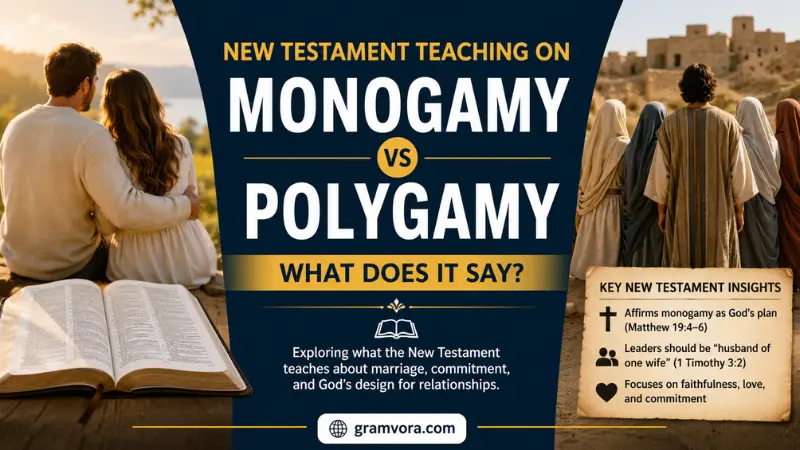
What does the New Testament teach about monogamy vs polygamy? This question often creates confusion because the Bible contains different accounts of marriage across different periods.
Some people point to Old Testament figures who had multiple wives. Others focus on Jesus’ teaching about marriage and Paul’s instructions to Christians. To understand the New Testament view, readers need to look closely at what its writers actually say about husbands, wives, and marriage.
The clearest overall pattern favors monogamy. Jesus describes marriage by referring to two people becoming one flesh. Paul also speaks about each man having his own wife and each woman having her own husband. These passages describe marriage through a one-to-one framework.
At the same time, the New Testament does not contain one short sentence that says, “Polygamy is forbidden for every Christian.” Because of that, careful readers should distinguish between an explicit command and the broader marriage pattern that the New Testament presents.
Quick Answer
Monogamy means having one spouse at a time. Polygamy means having more than one spouse at the same time.
When it comes to New Testament teaching, monogamy fits the overall pattern more clearly. Jesus describes a husband and wife as two people who become one flesh. Paul also uses singular language when discussing husbands and wives.
In addition, Paul tells church leaders to be the “husband of one wife.” Christians have debated the exact meaning of that phrase, but its wording clearly supports a one-wife model.
So, which term best fits the New Testament pattern of marriage? Monogamy.
Why People Confuse Them
Much of the confusion comes from mixing biblical stories with biblical instructions.
The Old Testament records several men who had multiple wives. Those stories show what happened in the lives of certain people, but a biblical account does not automatically serve as a command for every reader.
Jesus takes a different approach when he discusses marriage. Rather than using the marriages of famous biblical figures as his main model, he points back to creation. His teaching focuses on a man and a woman becoming one flesh.
Paul also describes marriage in singular terms. He speaks of a man and his wife and a woman and her husband. That wording gives readers another reason to connect New Testament marriage teaching with monogamy.
The phrase “husband of one wife” creates another area of debate. Some Christians understand it as a direct rejection of polygamy. Others believe Paul mainly stresses marital faithfulness. Because interpreters disagree, a careful article should acknowledge the debate instead of claiming that every detail has one universally accepted meaning.
Key Differences At A Glance
| Feature | Monogamy | Polygamy |
|---|---|---|
| Basic meaning | Marriage to one spouse at a time | Marriage to multiple spouses at the same time |
| Number of spouses | One | More than one |
| New Testament marriage pattern | Fits the overall one-to-one framework | Does not appear as the normal marriage model |
| Jesus’ teaching | Fits “the two become one flesh” | Does not match the straightforward two-person description |
| Paul’s general wording | Uses singular terms for husband and wife | Does not present multiple spouses as the normal pattern |
| Church leadership language | Fits “husband of one wife” | Conflicts with the most straightforward reading of one-wife language |
The basic difference is simple. Monogamy involves one spouse at a time, while polygamy involves multiple spouses at the same time.
However, the New Testament discussion requires more than a dictionary definition. Readers also need to consider how Jesus and Paul describe marriage.
Meaning and Usage Difference
Monogamy is a noun. It describes a marriage or relationship arrangement involving one spouse or partner at a time.
For example:
The church teaches monogamy as the standard model for marriage.
Polygamy is also a noun. It describes marriage involving more than one spouse at the same time.
For example:
The student asked whether the New Testament directly prohibits polygamy.
The two words describe different arrangements. You should not use them interchangeably.
In a New Testament discussion, monogamy describes the marriage pattern that most closely matches the language of Jesus and Paul. Jesus refers to “the two” becoming one flesh when discussing marriage. That description centers on two people joining together.
Paul follows a similar pattern in his marriage instructions. He speaks of each man having his own wife and each woman having her own husband. The singular language on both sides naturally fits monogamous marriage.
By contrast, polygamy describes a person having multiple spouses at the same time. The New Testament does not present that arrangement as its normal model for Christian marriage.
Tone, Context, and Formality
Both monogamy and polygamy are standard English nouns. Writers can use them in religious discussions, academic writing, historical articles, and everyday conversations.
Neither word sounds especially informal or slang-like. Instead, the context determines which term you need.
Use monogamy when discussing one-to-one marriage or an exclusive relationship with one partner at a time.
Use polygamy when discussing marriage involving multiple spouses.
In Christian writing, context matters even more. A writer should separate three related questions.
First, what does the New Testament directly say?
Second, what marriage pattern does the New Testament consistently describe?
Third, how do modern churches interpret and apply those teachings?
These questions can lead to related answers, but they are not identical. Keeping them separate makes the comparison more accurate.
Which One Should You Use?
Choose monogamy when you mean marriage with one spouse at a time.
For example:
Many Christians believe the New Testament presents monogamy as the ideal pattern for marriage.
Choose polygamy when you mean marriage with multiple spouses at the same time.
For example:
The discussion examined whether early Christians accepted polygamy.
If you are describing the general marriage framework found in the New Testament, monogamy is usually the better choice.
Jesus speaks about two people becoming one flesh. Paul discusses husbands and wives in singular terms. Church leadership qualifications also mention one wife.
Together, these passages create a strong one-to-one marriage pattern.
Still, careful wording matters. Saying that the New Testament presents monogamy as its normal model is more precise than claiming that every passage offers the same type of direct prohibition against polygamy.
When One Choice Sounds Wrong
Using polygamy to describe a marriage involving only one spouse is incorrect.
For example:
Incorrect: They practiced polygamy because they were married to each other.
Correct: They practiced monogamy because each had one spouse.
Likewise, you should not call a one-to-one marriage polygamous simply because the Bible contains stories about people who had multiple wives.
Another mistake occurs when writers treat every Old Testament marriage account as a direct model for New Testament Christians. The New Testament discusses marriage through its own teachings and instructions.
Jesus points readers back to creation when he explains marriage. Paul provides additional guidance for Christian relationships and church leadership. These passages deserve careful attention on their own terms.
A final problem comes from overstating the phrase “husband of one wife.” The phrase clearly appears in leadership qualifications, but Christians have debated exactly what Paul intended by it.
Therefore, strong writing should explain the major point without pretending that no interpretive questions exist.
Common Mistakes (and Quick Fixes)
Mistake: Monogamy and polygamy mean the same thing.
Quick Fix: They describe different marital arrangements. Monogamy involves one spouse at a time, while polygamy involves multiple spouses.
Mistake: The New Testament uses one direct sentence to ban polygamy for every Christian.
Quick Fix: The New Testament does not use that exact wording. Instead, its teachings about marriage strongly support a one-to-one pattern.
Mistake: Every example in the Old Testament becomes a rule for Christian marriage.
Quick Fix: Biblical narratives can describe what people did without commanding readers to copy every action.
Mistake: “Husband of one wife” has only one possible interpretation.
Quick Fix: Christians and scholars have debated the phrase. Some focus on monogamy, while others emphasize marital faithfulness.
Mistake: Polygamy means any relationship with multiple romantic partners.
Quick Fix: Polygamy specifically involves marriage to multiple spouses. Not every nonexclusive relationship falls under that definition.
Mistake: Jesus never discussed a marriage pattern.
Quick Fix: Jesus directly discusses marriage and refers to two people becoming one flesh.
Everyday Examples
Here are some natural examples that show how to use both words correctly.
Monogamy: “The couple chose monogamy and committed themselves to one another.”
Polygamy: “The history class discussed societies where polygamy formed part of the marriage system.”
Monogamy: “Many Christians connect Jesus’ teaching about two becoming one flesh with monogamy.”
Polygamy: “The Bible study group asked whether the New Testament directly addresses polygamy.”
Monogamy: “Paul’s language about a husband and wife supports a monogamous marriage framework.”
Polygamy: “The article explained why polygamy differs from a marriage involving only one husband and one wife.”
Monogamy: “Her essay examined why many churches support monogamy.”
Polygamy: “Their discussion focused on how different religious traditions view polygamy.”
Each example uses the correct word according to the number of spouses involved.
Dictionary-Style Word Details
Verb
Monogamy: Standard US English does not commonly use this word as a verb. It normally functions as a noun.
Polygamy: Standard US English does not commonly use this word as a verb. It also normally functions as a noun.
Use related forms only when the sentence requires them. For example, monogamous and polygamous can function as adjectives.
Noun
Monogamy: A noun describing marriage or a relationship involving one spouse or partner at a time.
Example:
Monogamy remains the central marriage model in their church.
Polygamy: A noun describing marriage involving more than one spouse at the same time.
Example:
The professor explained the historical meaning of polygamy.
Both words name a type of marital arrangement. The number of spouses creates the main difference between them.
Synonyms
Monogamy: No perfect everyday synonym exists. One-spouse marriage or exclusive marriage can serve as plain descriptive alternatives in the right context.
Polygamy: No single substitute matches every context. Multiple-spouse marriage works as a plain descriptive alternative.
The best choice depends on what you want to describe. Do not treat these alternatives as perfect replacements in every sentence.
Example Sentences
Monogamy: “The writer argues that the New Testament presents monogamy as the normal model for Christian marriage.”
Polygamy: “The reader wanted to know whether the New Testament permits polygamy.”
Monogamy: “Jesus’ description of two becoming one flesh plays an important role in Christian discussions of monogamy.”
Polygamy: “Paul’s one-wife language often appears in debates about polygamy and church leadership.”
These examples show the central difference clearly: one spouse versus multiple spouses.
Word History
Both words come into English through Greek-based forms connected with marriage.
Monogamy contains an element associated with “one” or “single.”
Polygamy contains an element associated with “many.”
Their word history helps explain the basic contrast, but word origins alone do not settle theological questions. To understand New Testament teaching, readers should focus on how the New Testament itself describes marriage.
Phrases Containing
Common phrases with monogamy include:
- Christian monogamy
- lifelong monogamy
- practice monogamy
- monogamous marriage
Common phrases with polygamy include:
- practice polygamy
- polygamous marriage
- history of polygamy
- biblical polygamy
For this topic, phrases such as New Testament teaching on monogamy and New Testament teaching on polygamy clearly identify the subject.
FAQs
Does the New Testament teach monogamy?
Yes. The New Testament presents marriage through a one-husband-and-one-wife framework.
Does the New Testament forbid polygamy?
It does not give one direct sentence banning polygamy for every Christian, but its marriage teaching strongly favors monogamy.
What did Jesus say about monogamy?
Jesus described marriage as two people becoming “one flesh,” which supports a one-to-one marriage pattern.
What does “husband of one wife” mean?
Paul uses this phrase when describing qualifications for church leaders. Many interpret it as requiring one wife or emphasizing marital faithfulness.
Does 1 Corinthians 7 support monogamy?
Yes. Paul tells each man to have his own wife and each woman her own husband, using singular language.
What is the difference between monogamy and polygamy?
Monogamy means having one spouse at a time. Polygamy means having multiple spouses at the same time.
Does the Bible allow multiple wives?
The Bible records cases of men with multiple wives, but the New Testament presents marriage through a one-to-one framework.
Is polygamy the same as having multiple partners?
No. Polygamy specifically refers to marriage involving multiple spouses.
Which does the New Testament favor: monogamy or polygamy?
The New Testament more clearly supports monogamy through Jesus’ teaching and Paul’s instructions about marriage.
Is “monogamy vs polygamy” the correct comparison?
Yes. The terms describe opposite marriage structures based on the number of spouses.
Conclusion
The difference between monogamy vs polygamy is straightforward at the word level.
Monogamy means having one spouse at a time. Polygamy means having multiple spouses at the same time.
The New Testament presents marriage through a strongly one-to-one framework. Jesus refers to two people becoming one flesh when he discusses marriage. Paul also speaks about a husband and wife in singular terms.
Church leadership qualifications add another important detail by requiring a leader to be the “husband of one wife.” Readers continue to debate the exact meaning of that phrase, so careful writers should avoid overstating what every interpreter agrees on.
Even with that debate, the broader pattern remains clear. The New Testament describes marriage in a way that aligns much more closely with monogamy than polygamy.
For that reason, use monogamy when describing the one-to-one marriage pattern emphasized in New Testament teaching. Use polygamy when discussing marriage involving multiple spouses at the same time.


