
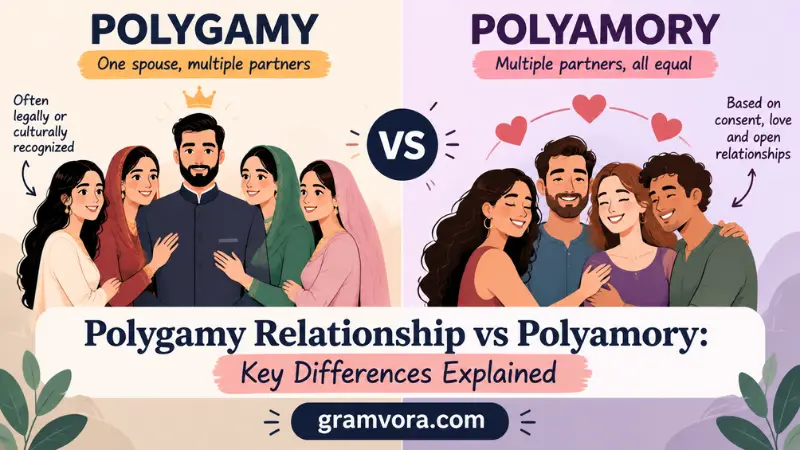
Polygamy relationship vs polyamory can be confusing because both expressions describe relationships involving more than two people. However, they do not mean the same thing.
The key difference is marriage.
A polygamous relationship involves one person having more than one spouse at the same time. Polyamory describes having multiple romantic or intimate relationships with the knowledge and consent of the people involved. Marriage is not required for polyamory.
There is also an important wording point: “polygamy relationship” is a descriptive phrase, while polygamy is the standard noun. In natural English, you will usually see phrases such as “a polygamous relationship” or “a relationship involving polygamy.”
Quick Answer
Use polygamy when the subject is having multiple spouses or plural marriage.
Use polyamory when the subject is multiple romantic or intimate relationships conducted with the knowledge and consent of everyone involved.
For example:
- “The documentary examines polygamy.” — Correct when the topic is plural marriage.
- “They practice polyamory.” — Correct when the topic is multiple consensual romantic relationships.
- “They are in a polygamous relationship.” — Natural when describing a relationship involving multiple spouses.
- “They are in a polyamorous relationship.” — Natural when describing multiple consensual romantic relationships.
So, the terms are not interchangeable.
| Context | Best Choice | Why |
|---|---|---|
| More than one spouse | Polygamy | Marriage is central |
| Multiple romantic relationships | Polyamory | Marriage is not required |
| Plural marriage | Polygamy | The word specifically describes multiple spouses |
| Multiple consensual romantic partners | Polyamory | The focus is on relationship structure |
| Describing a relationship with multiple spouses | Polygamous relationship | This is the natural adjective form |
| Describing multiple consensual romantic connections | Polyamorous relationship | This is the natural adjective form |
Why People Confuse Them
The confusion is understandable because both words begin with poly-, meaning “many.” Both can also involve more than two people.
The important part comes after that shared beginning.
Polygamy is centered on marriage. Polyamory is centered on having multiple romantic or intimate relationships.
Another source of confusion is that a person can be married and also practice polyamory. Marriage does not automatically make a relationship polygamous.
For instance, someone could be married to one person while also having another consensual romantic relationship. Calling that situation polygamy would suggest multiple spouses, which may not be what the speaker means.
The wording therefore matters.
Key Differences At A Glance
| Feature | Polygamy Relationship | Polyamory |
|---|---|---|
| Main focus | Multiple spouses | Multiple romantic or intimate relationships |
| Marriage required | Yes, by the core definition | No |
| Consent | Can vary by the particular marriage system | Contemporary definitions generally emphasize knowledge and consent |
| Relationship structure | Plural marriage | Multiple consensual relationships |
| Common adjective | Polygamous | Polyamorous |
| Typical context | Marriage, culture, history, law | Dating, relationships, consensual nonmonogamy |
The simplest memory aid is:
Polygamy = multiple spouses.
Polyamory = multiple consensual romantic relationships.
That distinction is more reliable than focusing only on the number of people involved.
Meaning and Usage Difference
Polygamy is a noun. It refers to the practice or condition of having more than one spouse at the same time.
A natural sentence is:
“The book examines the history of polygamy.”
When describing the relationship itself, polygamous is normally the adjective:
“They discussed a polygamous marriage.”
The phrase “polygamy relationship” can be understood, but it is less natural than “polygamous relationship.”
Polyamory is also a noun. It refers to a relationship practice involving multiple romantic or intimate relationships, generally with the knowledge and consent of everyone involved.
For example:
“They talked about polyamory before beginning a relationship.”
The adjective is polyamorous:
“They are in a polyamorous relationship.”
The central difference is therefore not simply “many people versus many people.” Both may involve multiple people. Instead, polygamy describes plural marriage, while polyamory describes multiple consensual romantic or intimate relationships.
Tone, Context, and Formality
Both terms are standard English, but they commonly appear in different contexts.
Polygamy often appears when people are discussing marriage systems, cultural practices, history, religion, anthropology, or law. The word places attention on the marital structure.
Polyamory is more common in conversations about modern relationship structures, dating, intimacy, and consensual nonmonogamy. The focus is on multiple relationships rather than multiple legal spouses.
Neither word is simply a more formal version of the other.
Consider these examples:
“The article discusses polygamy in different marriage systems.”
This works because the subject is plural marriage.
“The couple discussed polyamory before changing their relationship.”
This works because the subject is a consensual relationship structure involving more than one romantic connection.
Choosing between the words should depend on what you are describing, not on which word sounds more sophisticated.
Which One Should You Use?
Choose polygamy when marriage is the defining feature.
Use it for statements such as:
- “The history book discusses polygamy.”
- “The documentary examines polygamous marriages.”
- “The discussion focused on laws concerning polygamy.”
Choose polyamory when the defining feature is multiple consensual romantic or intimate relationships.
Use it for statements such as:
- “She identifies with polyamory.”
- “They talked about whether polyamory would work for them.”
- “The article explores communication in polyamorous relationships.”
If you are describing the adjective rather than naming the practice, use polygamous or polyamorous.
A useful pattern is:
polygamy → polygamous relationship
polyamory → polyamorous relationship
When One Choice Sounds Wrong
Suppose someone says:
“They are in a polyamorous relationship because they are married to three people.”
If the intended meaning is specifically that one person has multiple spouses, polygamous relationship is more precise.
Now consider:
“They practice polygamy because they have two romantic partners.”
That statement may be inaccurate if the people are not married to both partners. Polyamory may be the appropriate word instead.
Another common problem is using polygamy as a general label for every relationship involving three or more people.
That is too broad.
Having several romantic partners does not automatically mean having several spouses.
Likewise, polyamory should not automatically be used to mean plural marriage. A relationship can be polyamorous without involving marriage at all.
Common Mistakes (and Quick Fixes)
Mistake 1: Treating polygamy and polyamory as synonyms
Fix: Use polygamy for multiple spouses and polyamory for multiple consensual romantic or intimate relationships.
Mistake 2: Saying “polygamy relationship” when “polygamous relationship” is intended
Fix: Use the adjective polygamous before the noun.
Better:
“They described it as a polygamous relationship.”
Mistake 3: Assuming polyamory requires marriage
Fix: It does not. Multiple romantic relationships can be polyamorous without multiple marriages.
Mistake 4: Assuming every polygamous relationship means one husband and several wives
Fix: That is one specific form of polygamy. The broader word refers to having multiple spouses.
Mistake 5: Assuming multiple partners automatically means polygamy
Fix: Ask whether the people are spouses. If not, polyamory may be the more accurate term when the relationships are romantic and consensual.
Everyday Examples
Here are natural US-English examples showing the difference.
Polygamy
“The documentary focused on the history of polygamy.”
“The class discussed polygamy as a form of plural marriage.”
“The novel includes a family living in a polygamous marriage.”
“The article examines how different societies have approached polygamy.”
Polyamory
“Alex told their partner that they were interested in polyamory.”
“They talked openly about whether a polyamorous relationship would work for them.”
“Her podcast often discusses communication in polyamory.”
“The couple decided that polyamory was not right for their relationship.”
Notice how the wording changes according to the subject. Marriage and spouses point toward polygamy; multiple consensual romantic relationships point toward polyamory.
Dictionary-Style Word Details
Verb
Polygamy: Not commonly used as a verb in standard US English. You would normally say that someone practices polygamy or is in a polygamous marriage.
Polyamory: Not commonly used as a verb in standard US English. Natural wording includes practice polyamory, be polyamorous, or have a polyamorous relationship.
Noun
Polygamy: A noun referring to the practice or condition of having more than one spouse at the same time.
Polyamory: A noun referring to multiple romantic or intimate relationships, generally with the knowledge and consent of everyone involved.
Both nouns are generally treated as uncountable when naming the general practice.
Synonyms
Polygamy: There is no perfect everyday synonym. Plural marriage is a close plain alternative when marriage to multiple spouses is specifically meant.
Polyamory: There is no exact one-word synonym. Consensual nonmonogamy can be a broader related term, but it should not automatically be treated as identical because it can include relationship structures beyond polyamory.
Neither word should be replaced with the other as though they had exactly the same meaning.
Example Sentences
Polygamy: “The researcher examined the history of polygamy.”
Polygamous: “The documentary described a polygamous marriage.”
Polyamory: “They discussed polyamory openly.”
Polyamorous: “She is exploring whether a polyamorous relationship fits her values.”
These examples show why the adjective forms are often more natural when the word directly modifies relationship or marriage.
Word History
Both words contain the element poly-, meaning “many,” which helps explain their similar appearance.
Polygamy is built around the idea of marriage to multiple spouses.
Polyamory is a much more recent term connected with the idea of multiple romantic or intimate relationships. Its modern dictionary treatment emphasizes relationship openness and, in many definitions, the knowledge or consent of the people involved.
The history of the words supports the modern difference, but the safest usage guide is their current meaning rather than an assumed historical distinction.
Phrases Containing
Polygamy:
- practice of polygamy
- polygamous marriage
- polygamous relationship
- history of polygamy
Polyamory:
- practice of polyamory
- polyamorous relationship
- polyamorous partnership
- discuss polyamory
For natural English, “polygamous relationship” is generally preferable to “polygamy relationship.”
FAQs
What is the difference between a polygamy relationship and polyamory?
The main difference is marriage. Polygamy refers to having more than one spouse at the same time, while polyamory refers to having multiple romantic or intimate relationships with the knowledge and consent of the people involved. Marriage is not required for polyamory.
Is polygamy the same as polyamory?
No. The terms are related but have different meanings. Polygamy specifically centers on multiple spouses or plural marriage. Polyamory centers on multiple consensual romantic or intimate relationships and does not require multiple marriages.
Is a polygamous relationship always a marriage?
Polygamy, by definition, involves having multiple spouses, so marriage is central to the term. If several people have romantic relationships without being married to multiple spouses, polyamory may be the more accurate term.
Can someone be married and polyamorous?
Yes. A person can be married to one person while also having other consensual romantic relationships. Being married does not automatically make a relationship polygamous.
What is a polygamous relationship?
A polygamous relationship is a relationship structure involving more than one spouse at the same time. The adjective polygamous is generally more natural than saying “polygamy relationship.”
What is a polyamorous relationship?
A polyamorous relationship involves multiple romantic or intimate relationships with the knowledge and consent of the people involved. The relationships do not necessarily involve marriage.
Is “polygamy relationship” grammatically correct?
It can be understood, but “polygamous relationship” is the more natural phrase in standard US English. Polygamy is a noun, while polygamous is the adjective used to describe a relationship or marriage.
Does polyamory always mean having multiple partners?
Polyamory refers to the possibility or practice of having multiple romantic or intimate relationships with openness and consent. The exact structure can vary from one polyamorous relationship to another.
Does polygamy mean one man with multiple wives?
Not necessarily. Polygamy is the broader term for having multiple spouses. One specific form involves one man having multiple wives, but that should not be treated as the only possible meaning of the broader word.
Which word should I use: polygamy or polyamory?
Use polygamy when you mean multiple spouses or plural marriage. Use polyamory when you mean multiple consensual romantic or intimate relationships without making multiple marriage the defining feature.
Quick rule:
Polygamy = multiple spouses.
Polyamory = multiple consensual romantic relationships.
Conclusion
The difference between polygamy relationship vs polyamory becomes much easier when you focus on what the relationship involves.
Polygamy centers on having multiple spouses. When describing the relationship, polygamous relationship is the more natural phrase.
Polyamory centers on multiple romantic or intimate relationships, generally with the knowledge and consent of everyone involved. Marriage is not required.
So, use polygamy/polygamous when plural marriage is the point. Use polyamory/polyamorous when multiple consensual romantic relationships are the point.
The two words are related, but they are not interchangeable.


[…] polygamy sounds wrong when a person has had several relationships one after another but only one spouse at a […]