
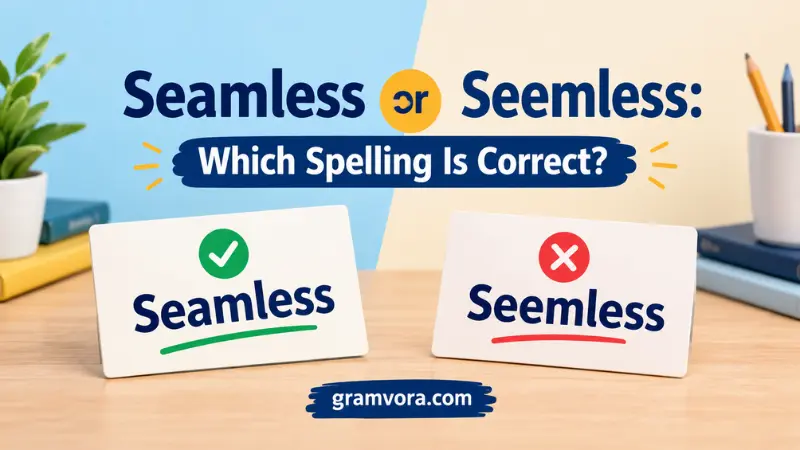
If you are unsure whether the correct spelling is seamless or seemless, you are not alone. The two words look very similar, but only one is the standard English spelling.
The correct word is seamless. It means something that has no visible seams or joins, or something that happens smoothly without interruption, difficulty, or an obvious break.
Seemless is generally a misspelling when you want to use the adjective meaning “smooth” or “without seams.”
For example:
- Correct: The new software provides a seamless user experience.
- Incorrect: The new software provides a seemless user experience.
Although seamless and seemless sound similar, they are formed from different ideas. Understanding the word seam makes the correct spelling much easier to remember.
Quick Answer: Seamless or Seemless?
Seamless is the correct standard spelling.
Seamless is an adjective formed from seam + -less. A seam is a line where two pieces of material are joined, especially in clothing or fabric. The suffix -less means “without.”
Therefore, seamless literally means “without a seam.”
The word also has a common figurative meaning: something that works or happens smoothly, without interruptions, awkward transitions, or noticeable gaps.
Seemless is usually a spelling mistake caused by confusing seam with seem.
Examples
- We had a seamless transition to the new system.
- The two departments worked together in a seamless way.
- The dress has a seamless design.
- The app offers a seamless shopping experience.
What Does Seamless Mean?
Seamless has both a literal and a figurative meaning.
In its literal sense, it describes something made without visible seams or joins. The word is especially useful when talking about clothing, fabric, construction, design, or manufacturing.
For example:
She wore a seamless garment under her dress.
Here, seamless refers to the physical construction of the garment.
The word is also widely used in a figurative sense. In this meaning, seamless describes something that happens smoothly, naturally, and without noticeable interruption.
For example:
The company created a seamless transition between its old and new systems.
The transition is not literally made of fabric. Instead, seamless means that the change happened smoothly, without obvious problems or breaks.
This figurative meaning is extremely common in modern American English, particularly in business, technology, customer service, education, and everyday communication.
Why Is “Seemless” Incorrect?
The confusion comes from the similarity between seamless and seemless.
English speakers already know the word seem, as in:
You seem tired.
Because seemless looks like seem + less, it may appear logical at first glance. However, that is not the word used for something smooth or without seams.
The correct construction is:
seam + less = seamless
The noun seam refers to a line where two pieces of material are joined.
Examples include:
- a shirt seam
- a side seam
- a shoulder seam
- a visible seam
- a hidden seam
When -less is added, the result is seamless, meaning “without a seam.”
By contrast, seem is a verb meaning to appear or give a particular impression.
For example:
You seem happy today.
The word seemless does not normally function as the adjective people intend when they write phrases such as “seemless transition” or “seemless experience.”
Seamless vs. Seemless at a Glance
| Feature | Seamless | Seemless |
|---|---|---|
| Standard spelling | Yes | No, in this intended sense |
| Part of speech | Adjective | Usually a misspelling |
| Base word | Seam | Seem |
| Meaning | Without seams; smooth or uninterrupted | Not the standard adjective for this meaning |
| Common use | seamless transition, seamless experience | Usually incorrect |
| Example | We need a seamless process. | We need a seemless process. |
The key distinction is simple: seamless comes from seam, not seem.
The Meaning of “Seam”
Learning the base word can help you remember the spelling.
A seam is a line where two pieces of material are joined together. The word is commonly associated with sewing and clothing.
For example:
The seam on my jacket is coming loose.
A seam can also refer to a joining line in other materials or structures.
When the suffix -less is added, it creates an adjective meaning “without.”
Compare these examples:
- care + less = careless
- hope + less = hopeless
- home + less = homeless
- seam + less = seamless
This pattern makes seamless easier to remember.
Literal Meaning of Seamless
The original and literal sense of seamless relates to something that has no seams.
For example:
The manufacturer designed a seamless piece of fabric.
The idea is that there is no visible joining line.
You might also encounter the word in descriptions of clothing:
These seamless leggings are designed for comfort.
Here, seamless describes the construction of the garment.
The literal meaning remains useful today, but the figurative meaning has become extremely common.
Figurative Meaning of Seamless
In everyday and professional English, seamless often means smooth, continuous, and without noticeable interruption.
For example:
The team made the transition to remote work seamless.
This does not mean that the transition literally had no seams. Instead, it suggests that the change happened smoothly.
Other common expressions include:
- seamless transition
- seamless experience
- seamless integration
- seamless process
- seamless connection
- seamless communication
- seamless service
- seamless interaction
- seamless workflow
- seamless collaboration
Example
The new payment system provides a seamless checkout experience.
This means customers can complete their purchases easily, without unnecessary complications.
Seamless in Business English
Seamless is especially common in business writing.
Companies often use the word to describe processes that are designed to work smoothly.
For example:
Our goal is to create a seamless customer experience.
This means the company wants customers to move through different stages of the service without unnecessary interruptions.
Another example is:
The merger required a seamless transition between the two teams.
Here, seamless suggests that the transition should appear organized and smooth.
Although the word is common in professional writing, it should still be used accurately. Not every process needs to be described as seamless. If something actually has delays, interruptions, or problems, a more precise adjective may be better.
Seamless in Technology
Technology is another area where seamless appears frequently.
Software, websites, mobile apps, and digital services are often described as providing a seamless experience.
For example:
The app allows users to move seamlessly between devices.
This means users can switch from one device to another without experiencing a major interruption.
You might also see:
The software seamlessly integrates with existing tools.
Here, seamlessly is the adverbial form of seamless and means “in a smooth or uninterrupted way.”
Common technology examples
- seamless integration
- seamless connectivity
- seamless synchronization
- seamless navigation
- seamless user experience
- seamless data transfer
Seamless vs. Seamlessly
These words are related but have different grammatical roles.
Seamless is an adjective.
The process was seamless.
Seamlessly is an adverb.
The process worked seamlessly.
Use seamless to describe a noun.
Use seamlessly to describe an action or how something happens.
Compare
We had a seamless transition.
The team seamlessly transitioned to the new system.
Both sentences are correct, but their grammatical structures are different.
Common Mistakes With Seamless
One of the most common errors is replacing seam with seem.
Incorrect
The website offers a seemless experience.
Correct
The website offers a seamless experience.
Another common mistake is using seamless when the intended meaning is simply “easy.”
For example, these words are related but not always interchangeable:
- smooth
- easy
- effortless
- uninterrupted
- seamless
- continuous
A seamless process is generally one that works smoothly without noticeable breaks or difficulties. Depending on the sentence, smooth or effortless may be more precise.
How to Remember the Correct Spelling
A simple memory trick is to connect seamless with seam.
Think:
SEAM + LESS = SEAMLESS
A seam is a joining line in fabric. Something seamless has no seam.
Do not think:
SEEM + LESS
The word seem belongs to a completely different family of words.
For example:
She seems happy.
But:
The transition was seamless.
Remembering the base word usually prevents the spelling mistake.
Everyday Examples of Seamless
Here are several natural examples of seamless in American English:
- The new employee had a seamless transition into the team.
- The hotel provided a seamless check-in experience.
- The software allows seamless communication between departments.
- We want to create a seamless shopping experience.
- The design creates a seamless connection between the rooms.
- Her presentation made the transition between topics seem seamless.
- The app offers seamless synchronization across devices.
- The two systems were integrated into a seamless workflow.
- The customer experienced a seamless payment process.
- The jacket has a seamless construction.
These examples show that seamless can describe both physical objects and abstract experiences.
When Should You Use Seamless?
Use seamless when you mean:
- without a seam
- without a visible joining line
- smooth
- uninterrupted
- continuous
- without noticeable difficulty
- without an awkward transition
For example:
The designer created a seamless pattern.
Here, the pattern has no obvious break.
Or:
The teacher made a seamless transition from one lesson to the next.
Here, the transition happened smoothly.
When Does Seamless Sound Less Appropriate?
Although seamless is a useful word, it can sometimes sound overly promotional or vague.
For example:
Our company provides a seamless solution for every problem.
This is a broad marketing statement. It does not explain what makes the solution smooth or effective.
A more specific sentence may be clearer:
The new system automatically transfers customer information between the two departments.
The second version tells the reader exactly what happens.
For professional or academic writing, consider whether seamless adds useful information. If it does, use it. If a more specific word explains the situation better, choose the specific wording.
Seamless Synonyms
Depending on the context, possible synonyms include:
- smooth
- uninterrupted
- continuous
- effortless
- fluid
- integrated
- connected
- consistent
- cohesive
- unbroken
These words are not always exact substitutes.
For example, uninterrupted emphasizes the absence of breaks, while effortless emphasizes the lack of difficulty.
Seamless often combines both ideas: something works so smoothly that the transition or connection is barely noticeable.
“Seamless” in a Sentence
Here are some additional examples:
The two systems now work together seamlessly.
We experienced a seamless transition to the new software.
The architect created a seamless connection between the indoor and outdoor spaces.
Her explanation provided a seamless transition between the two topics.
The company aims to provide seamless customer support.
The fabric has a seamless finish.
The application offers a seamless experience across multiple devices.
Notice that seamless can describe physical design, technology, communication, service, and transitions.
Dictionary-Style Word Details
Word
Seamless
Part of Speech
Adjective
Pronunciation
SEAM-ləs
Basic Meaning
Without a seam; smooth, continuous, or without an obvious break or interruption.
Base Word
Seam
Suffix
-less, meaning “without.”
Related Adverb
Seamlessly
Common Phrases
- seamless transition
- seamless experience
- seamless integration
- seamless process
- seamless connection
- seamless service
- seamless communication
- seamless workflow
Is “Seemless” Ever Correct?
For the ordinary meaning discussed in this article, seemless is not the standard spelling.
If you want to describe something as smooth, uninterrupted, or without seams, write seamless.
The confusion is understandable because seem is a real English word. However, seemless does not replace seamless in standard phrases such as “seamless transition” or “seamless experience.”
Therefore, if you are writing an email, essay, article, report, website, or professional document, use seamless for this meaning.
Seamless or Seemless: Which One Should You Use?
When you mean “smooth,” “without interruption,” or literally “without seams,” choose seamless.
Seemless is generally a spelling error in this context.
The easiest way to remember the difference is to identify the base word:
SEAM → SEAMLESS
A seam is where two pieces are joined. Something seamless has no obvious seam.
On the other hand:
SEEM → seems, seemed, seeming
The verb seem means “to appear” or “to give a particular impression.”
These are two separate words with different meanings.
FAQs
1. Is it seamless or seemless?
Seamless is the correct spelling when you mean smooth, uninterrupted, or without seams. Seemless is generally a misspelling in this context.
2. What does seamless mean?
Seamless means without a seam or, figuratively, smooth and without noticeable interruptions or breaks.
3. Is seemless a word?
Seemless is not the standard spelling for the meaning usually intended by writers. If you mean smooth or uninterrupted, use seamless.
4. What is an example of seamless?
An example is: “The new software provides a seamless user experience.” This means the software works smoothly without noticeable interruptions.
Why do people spell seamless as seemless?
The mistake usually happens because seem is a familiar English word and looks similar to seam. However, seamless comes from the noun seam.
What is the opposite of seamless?
Depending on the context, possible opposites include interrupted, disconnected, broken, uneven, awkward, or disjointed.
Is seamless one word?
Yes. Seamless is normally written as one word.
What is the difference between seamless and smoothly?
Seamless is an adjective, while smoothly is an adverb. For example, “a seamless transition” uses the adjective, while “the transition happened smoothly” uses the adverb.
What is the adverb of seamless?
The adverb is seamlessly.
Example:
The new system seamlessly connects the two databases.
How can I remember the spelling of seamless?
Remember the formula seam + less = seamless. A seam is a joining line, so something without a seam is seamless.
Conclusion
The correct spelling is seamless, not seemless.
Use seamless when describing something that has no visible seam or something that happens smoothly without interruption.
For example:
The company created a seamless customer experience.
The transition to the new system was seamless.
The fabric has a seamless design.
If you are trying to write “seamless transition,” “seamless experience,” “seamless integration,” or a similar phrase, always use seamless.
Quick memory tip:
SEAM + LESS = SEAMLESS.
Once you connect the word to seam, the spelling becomes much easier to remember.


