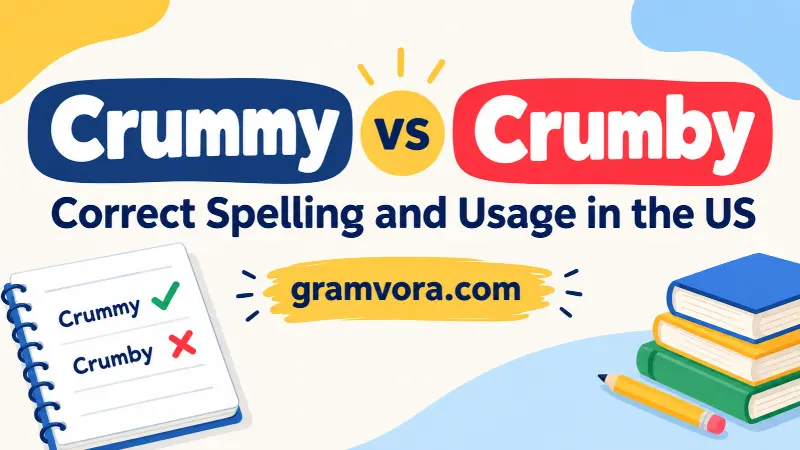
Crummy and crumby look almost identical, and both are accepted English spellings. However, choosing between them can depend on what you want to describe.
In everyday American English, crummy is the clearest choice when you mean something is bad, unpleasant, shabby, or poor in quality. For example, you might describe a disappointing meal, a poorly maintained apartment, or an unpleasant day as crummy.
Crumby is commonly used for something full of crumbs or covered with small pieces of food. A kitchen counter after breakfast, for instance, might be described as crumby.
There is some overlap: dictionaries also recognize crumby as a variant spelling of crummy in its informal sense. Therefore, it would be inaccurate to call crumby universally incorrect.
The key is to consider the sentence. If you mean “bad,” crummy is the clearest everyday choice. If you mean “covered with crumbs,” crumby communicates the literal meaning more directly.
Quick Answer
Both crummy and crumby are recognized spellings, but they are most useful in different contexts.
- Crummy: The usual choice for something bad, unpleasant, shabby, or poor in quality.
- Crumby: Commonly describes something full of crumbs, although it is also recognized as a variant spelling of crummy.
Examples:
- “We had a crummy experience at the hotel.” The experience was unpleasant.
- “The kitchen counter was crumby after the kids ate cookies.” The counter was covered with crumbs.
For clear American English, use crummy for poor quality and crumby for a surface or food containing crumbs. Remember that the second spelling can also carry the informal meaning of crummy.
Why People Confuse Them
The confusion comes from their nearly identical appearance and pronunciation. Both words are commonly pronounced like “KRUM-ee,” so hearing the word does not necessarily tell you which spelling the speaker intends.
They also have a connection through the word crumb. A crumb is a small piece of bread, cake, cookie, or another food. Something described as crumby may contain or be covered with such pieces.
The informal adjective crummy, meanwhile, can describe something unpleasant or inferior. A crummy hotel might be poorly maintained, while a crummy customer experience might involve bad service.
Because dictionaries recognize crumby as an alternative spelling in some uses of crummy, the distinction is not an absolute spelling rule. Context makes the intended meaning clearer.
Compare these sentences:
- “The restaurant gave us crummy service.” The service was poor.
- “The restaurant table was crumby.” Crumbs were scattered across the table.
The setting is similar, but each adjective describes a different quality. In the first sentence, the problem is the service. In the second, the problem is the mess.
Key Differences At A Glance
The most practical distinction is the meaning you want readers to understand.
| Context | Best Choice | Why |
|---|---|---|
| Poor customer service | Crummy | Clearly means bad or unsatisfactory |
| An unpleasant day | Crummy | Expresses a negative experience |
| A shabby apartment | Crummy | Describes poor condition or quality |
| A table covered with cookie crumbs | Crumby | Emphasizes the presence of crumbs |
| A cake with a crumb-related texture | Crumby | Can describe a crumb-filled or soft texture |
| An informal statement meaning “bad” | Crummy is clearest | Crumby is also recorded as a variant, but may be less clear |
Keep these points in mind:
- Meaning: Crummy usually communicates poor quality; crumby often communicates the presence of crumbs.
- Acceptance: Both spellings are recognized in dictionaries.
- Pronunciation: They are generally pronounced alike in American English.
- Writing choice: Use the form that communicates your intended meaning most clearly.
Are They the Same Word?
They are closely related, and dictionaries recognize crumby as a variant spelling of crummy in an informal sense. However, the two spellings also have distinct practical uses.
When crumby means “full of crumbs,” it has a direct, literal meaning. For example, a child might leave a crumby seat after eating crackers in the car.
When crummy describes quality, it has a negative, informal meaning. A crummy seat, by contrast, might be uncomfortable, damaged, or poorly made.
Consider these examples:
- “This is a crummy chair.” The chair is uncomfortable or poorly made.
- “This chair is crumby.” The chair has crumbs on it.
The second sentence may sound unusual without context, but it can make sense if food has been eaten there.
The words are not pronounced differently to signal these meanings. Instead, the surrounding sentence helps readers understand the intended use. If the context does not make your meaning obvious, consider rewriting the sentence for clarity.
For instance, “The chair was covered with cookie crumbs” is more precise than “The chair was crumby.” Similarly, “The chair was uncomfortable and poorly made” is clearer than an unexplained use of crummy.
US vs UK Preference
Both spellings appear in English dictionaries that cover American and British usage. The evidence does not support a simple rule that crummy belongs to the United States while crumby belongs to the United Kingdom.
In American English, crummy is a familiar informal adjective for something unpleasant, inferior, or poor in quality. Common examples include a crummy job, a crummy hotel, and crummy weather.
Crumby is also recognized in American English. Its literal use is particularly straightforward when describing something containing crumbs. Dictionaries also record it as an informal variant of crummy.
British dictionaries recognize both forms as well, including the use of crummy to mean inferior or unpleasant and crumby to describe something full of crumbs. The exact preference can vary with meaning and context.
For a US-focused article, the practical advice is simple: choose crummy when you mean “bad” or “poor quality,” and choose crumby when you want to emphasize crumbs. This is a clarity recommendation, not a claim that one spelling is prohibited in a particular country.
Which Spelling Should You Use?
Choose the spelling that best communicates what you mean.
Use crummy when describing a disappointing experience, poor service, a shabby place, or an inferior product. The word is informal, so it is usually more suitable for conversation, casual writing, reviews, and everyday messages than for highly formal prose.
Examples include:
- “The airline gave us crummy customer service.”
- “I had a crummy day at work.”
- “They rented a crummy apartment with broken windows.”
- “That was a crummy excuse for missing the meeting.”
Use crumby when you are describing crumbs or a crumb-related quality.
Examples include:
- “The table was crumby after the birthday party.”
- “My black sweater got crumby while I ate a muffin.”
- “The high chair was crumby after lunch.”
If you use crumby to mean “bad,” readers may still understand you because dictionaries recognize that variant use. However, crummy is the clearer default for most everyday American writing.
For school assignments, professional messages, and published articles, prioritize clarity over trying to enforce a spelling distinction that dictionaries do not treat as absolute.
When One Spelling Looks Wrong
Neither spelling is automatically wrong in every context. The problem usually arises when a reader expects one meaning but encounters the other spelling.
For example, “The hotel was crumby” might confuse a reader who expects crummy to describe poor quality. If you mean the hotel was unpleasant, writing “The hotel was crummy” removes that uncertainty.
Likewise, “The counter was crummy” may suggest that the counter was shabby or in poor condition. If you mean it had food crumbs on it, crumby makes the intended meaning easier to recognize.
A spelling may also look unusual because one form is more familiar in a particular context. That does not make the less familiar form invalid.
When editing, ask yourself:
- Does the adjective describe poor quality or an unpleasant experience?
- Does it describe actual crumbs or a crumb-related texture?
- Could a reader misunderstand the intended meaning?
- Would a more direct phrase make the sentence clearer?
If the sentence concerns poor quality, crummy is generally the safest choice. If it concerns crumbs, crumby is often more informative. When precision matters, a phrase such as “covered with crumbs” may be clearer still.
Common Mistakes (and Quick Fixes)
A few simple corrections can help you use these words confidently.
Mistake 1: Treating crumby as a nonexistent word
Incorrect assumption: “Crumby is never a real word.”
Quick fix: Recognize that dictionaries list crumby for crumb-related meanings and also record it as a variant of crummy.
Mistake 2: Using crummy when you mean a surface has crumbs
Less clear: “The desk is crummy after lunch.”
Clearer: “The desk is crumby after lunch.”
You could also write, “The desk is covered with crumbs.”
Mistake 3: Using crumby when poor quality is the intended meaning
Less clear: “We received crumby service at the store.”
Clearer: “We received crummy service at the store.”
The second sentence gives readers the familiar informal meaning of poor or unsatisfactory service.
Mistake 4: Assuming pronunciation determines spelling
Both words are commonly pronounced alike. You cannot reliably choose the spelling based on sound alone.
Quick fix: Think about the meaning before writing the word.
Mistake 5: Assuming American and British English have completely separate rules
Both spellings are documented in major dictionaries covering these varieties of English.
Quick fix: Focus on meaning and clarity rather than assuming that geography alone determines the spelling.
Everyday Examples
These examples show how the words work in natural American English.
Examples with crummy:
- “We had a crummy experience at the rental car counter.”
- “The hotel looked nice online, but the room was crummy.”
- “I felt crummy after staying up all night.”
- “The team played well, but the field was in crummy condition.”
- “She quit because the job offered crummy pay and unpredictable hours.”
- “That was a crummy thing to say to your friend.”
- “The old headphones had crummy sound quality.”
- “We canceled our plans because of the crummy weather.”
In these sentences, crummy expresses something unpleasant, inferior, or disappointing. In “I felt crummy,” it can refer to feeling unwell or generally bad.
Examples with crumby:
- “The kitchen floor was crumby after the kids ate breakfast.”
- “Please wipe the crumby table before the next guests arrive.”
- “My shirt became crumby while I ate a chocolate chip cookie.”
- “The baby’s high chair was crumby after snack time.”
- “The car seat was crumby because someone ate crackers in the back.”
- “I brushed the crumby crumbs off my lap before getting out of the car.”
The final example is unnecessarily repetitive because crumby already refers to crumbs. A clearer version is: “I brushed the crumbs off my lap before getting out of the car.”
Side-by-side comparison:
- “The restaurant was crummy.” The restaurant was unpleasant or poor in quality.
- “The restaurant table was crumby.” The table had crumbs on it.
- “I had a crummy morning.” The morning was disappointing.
- “The kitchen was crumby after breakfast.” Crumbs were scattered around the kitchen.
The examples demonstrate why context matters more than the small spelling difference.
Dictionary-Style Word Details
Verb
- Crummy: Not commonly used as a verb in standard American English. Its relevant everyday use is as an adjective.
- Crumby: Not commonly used as a verb in standard American English. Its relevant uses are also adjectival.
Neither spelling normally functions as a verb in the comparison discussed here.
Noun
- Crummy: Primarily an adjective in everyday American English. Dictionaries also record specialized or regional noun uses, but those are not the usual meaning in ordinary conversation.
- Crumby: Primarily an adjective meaning full of crumbs or, in informal usage, a variant of crummy. It is not normally used as a noun in everyday American English.
For ordinary writing, treat both as adjectives.
Synonyms
The best alternatives depend on the intended meaning.
- Crummy: Closest plain alternatives include bad, poor, shabby, inferior, lousy, and unpleasant. The best choice depends on the sentence.
- Crumby: For the literal crumb-related sense, useful alternatives include covered with crumbs, crumb-covered, or full of crumbs. These phrases may be clearer than the adjective.
There is no single synonym that replaces both words correctly in every context. Poor-quality may replace crummy in a review, but it does not describe a counter scattered with crumbs.
Clear antonyms for crummy can include excellent, good, or high-quality, depending on context. A direct antonym for crumby is less useful because the word describes the presence of crumbs rather than a simple scale of quality.
Example Sentences
- Crummy: “The customer received crummy service and asked to speak with the manager.”
- Crummy: “We found a better apartment after spending a month in a crummy one.”
- Crumby: “The kitchen table was crumby after everyone finished eating.”
- Crumby: “He cleaned the crumby seat before putting the baby in the car.”
Each example uses the spelling that most clearly expresses the intended idea.
Word History
Both spellings are associated with crumb and the adjective-forming ending -y. The word crumby has long been used for something full of crumbs or resembling the soft interior of bread.
The figurative use of crummy for something poor, shabby, or unpleasant is also established in English. Dictionary entries connect the forms and record crumby as a variant spelling in some senses.
The useful historical point is that these forms are related, rather than unrelated words invented to express entirely different ideas. Their present-day uses overlap, which helps explain why both spellings remain recognized.
Phrases Containing
Common phrases with crummy include:
- crummy service
- crummy weather
- crummy job
- crummy excuse
- crummy hotel
- crummy quality
These usually describe something bad, disappointing, shabby, or inferior.
Common uses of crumby include:
- crumby table
- crumby counter
- crumby shirt
- crumby car seat
- crumby kitchen floor
These examples usually refer to places or objects with crumbs on them. The phrasing is informal, and in some sentences “covered with crumbs” will sound more natural.
FAQs
Is it crummy or crumby?
Both crummy and crumby are recognized spellings. Use crummy for something bad or poor in quality, and crumby for something covered with crumbs.
Is crumby a real word?
Yes. Crumby is a real English word. It commonly describes something full of crumbs and is also recognized as a variant spelling of crummy in some informal uses.
What does crummy mean?
Crummy is an informal adjective meaning bad, unpleasant, shabby, or poor in quality. For example, “We received crummy service at the restaurant.”
What does crumby mean?
Crumby usually means full of crumbs or covered with small pieces of food. For example, “The kitchen counter was crumby after breakfast.”
Are crummy and crumby interchangeable?
Sometimes. Dictionaries recognize crumby as a variant of crummy in certain informal uses. However, crummy is clearer when describing poor quality, while crumby often suggests actual crumbs.
Which spelling is correct in American English?
Both spellings are recognized in American English. For the meaning “bad” or “poor quality,” crummy is the clearest everyday choice. For something covered with crumbs, crumby is often more precise.
Are crummy and crumby pronounced the same?
Yes, they are generally pronounced alike in American English, approximately “KRUM-ee.” Their pronunciation does not reliably tell you which spelling to use.
Is crummy a formal or informal word?
Crummy is informal. It works well in conversations, casual messages, and everyday reviews. In formal writing, alternatives such as poor, unsatisfactory, or inferior may be more appropriate.
What are some synonyms for crummy?
Depending on the context, synonyms include bad, poor, lousy, shabby, inferior, and unpleasant. For example, “crummy service” can be rewritten as “poor service.”
What is the opposite of crummy?
Depending on the sentence, possible opposites include good, excellent, and high-quality. For example, “crummy service” contrasts with “excellent service.”
Conclusion
Crummy and crumby are both recognized spellings, but their clearest everyday uses differ.
Use crummy when you mean bad, unpleasant, shabby, or poor in quality. Use crumby when you mean full of crumbs or covered with crumbs. Remember that dictionaries also accept crumby as a variant of crummy in some informal uses, so it is not universally incorrect.
For American English, the simplest approach is to let the meaning guide the spelling. If you mean poor service, a disappointing day, or a shabby hotel, choose crummy. If you mean a table scattered with cookie crumbs, crumby makes the literal meaning clearer.
When the meaning could be misunderstood, use a direct phrase such as “poor quality” or “covered with crumbs.” Clear wording is more important than treating these two spellings as if one were always wrong.