
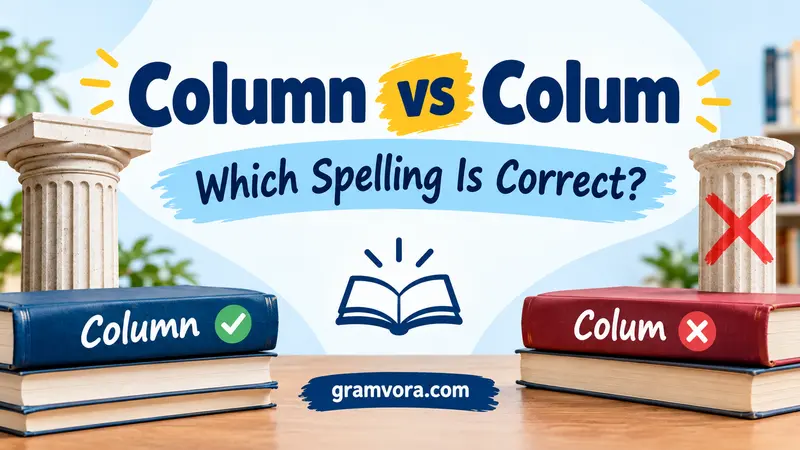
English spelling can be confusing when a word contains a letter that people do not pronounce. The word column is a common example. It ends with the letter n, but that letter is silent in ordinary pronunciation. Because the final n is not heard, some writers leave it out and spell the word as colum.
However, standard American English uses column, not colum. The final n is an essential part of the written word, even though speakers do not pronounce it separately.
This distinction matters in school assignments, business reports, spreadsheets, newspapers, online articles, and everyday communication. A spelling mistake can make otherwise clear writing look less polished, especially when it appears repeatedly in a document.
The good news is that the correction is simple. Once you understand the spelling and learn to recognize the word in different contexts, you can avoid this mistake with confidence.
This guide explains why column is correct, what the word means, how to use it in natural sentences, and how to remember its spelling. It also covers common errors, practical examples, related word forms, and frequently confused uses.
Quick Answer
Column is the correct spelling. Colum is generally an incorrect spelling when you mean a vertical section of text or numbers, a newspaper feature, or an upright architectural support.
The word column is used in American and British English. There is no standard US-versus-UK spelling difference between these two forms.
Examples:
- Correct: Please add another column to the spreadsheet.
- Incorrect: Please add another colum to the spreadsheet.
- Correct: The marble column supports the roof.
- Incorrect: The marble colum supports the roof.
Remember to write the final n, even though it is silent in the usual pronunciation.
Why People Confuse Them
The main reason people confuse column and colum is pronunciation.
In everyday American English, column is commonly pronounced approximately like “KAH-lum.” The final n does not produce a separate sound. As a result, someone hearing the word may believe that it ends with the letter m.
This is an understandable mistake. English spelling does not always match pronunciation exactly. Some words contain silent letters, while others preserve spellings that cannot be predicted simply by listening.
For example, a learner may hear column in a classroom and later write colum in an assignment. The spoken word may sound right to the learner, but the written form is still incorrect.
Another reason is typing speed. When people write quickly, they may spell a familiar word according to the sound they remember instead of checking its standard form. This is especially common in notes, messages, drafts, and spreadsheets.
Students may also encounter the word while learning about rows and columns. If they have not memorized its spelling, they may leave off the silent letter.
The solution is not to pronounce the final n artificially. Instead, learn the complete spelling as a single unit: c-o-l-u-m-n.
Key Differences At A Glance
The two forms look similar, but they do not have the same status in standard English.
| Context | Best Choice | Why |
|---|---|---|
| School assignments | Column | This is the standard spelling. |
| Spreadsheets | Column | A vertical series of cells is called a column. |
| Newspaper writing | Column | A recurring article or feature is a column. |
| Architecture | Column | An upright structural or decorative support is a column. |
| American English | Column | The final n is required in standard spelling. |
| British English | Column | British English uses the same spelling. |
| Informal drafts | Column | Informal writing does not make colum a standard variant. |
A simple comparison makes the distinction clear:
- Column: Correct standard spelling; used for structures, vertical lists, and written features.
- Colum: Generally a misspelling when intended to represent the ordinary English word column.
The important point is that the difference is not a matter of regional preference. It is a spelling error, not a choice between two accepted English variants.
Are They the Same Word?
The forms column and colum are often compared because they look almost identical. However, they are not two accepted spellings of the same standard English word.
Column is an established English noun with several related uses. It can describe a pillar, a vertical arrangement of information, a section of printed text, or a regular newspaper or magazine feature.
The word can also describe something with a tall, narrow shape, such as a column of smoke.
Consider these examples:
- The building has six stone columns.
- Enter each student’s name in the first column.
- I read her weekly column about personal finance.
- A column of smoke rose above the trees.
In every example, the correct spelling includes the final n.
By contrast, colum is generally treated as a misspelling when the writer intends the ordinary noun. It should not be presented as an alternative that readers can freely choose.
The distinction is particularly important for English learners. A word may sound as if it ends in one letter while its standard spelling contains another. Learning the accepted written form helps prevent repeated mistakes.
There is also no meaningful difference in definition between the two forms that would justify using them for separate purposes. In ordinary writing, replace colum with column.
US vs UK Preference
American and British English sometimes use different spellings for the same word. For instance, certain words use different vowel combinations or endings depending on the regional convention.
However, column is not one of those cases.
Both American and British English use column for the standard noun. The spelling does not change simply because the writer lives in the United States or the United Kingdom.
Here are examples that work in both varieties of English:
- The column contains the latest figures.
- The newspaper published a new opinion column.
- A stone column stands at the entrance.
- Add a column to the table before printing it.
The same principle applies to professional and academic writing. A US school, a British newspaper, and an international business may follow different editorial conventions for some words, but the standard spelling of this noun remains column.
Writing colum is not a British alternative, an American alternative, or a recognized regional preference. If you are unsure which form to use, choose column.
Which Spelling Should You Use?
Use column whenever you refer to the standard English noun.
The right spelling applies across several common situations.
1. When working with spreadsheets
A spreadsheet organizes information into rows and columns. Each column contains cells arranged vertically.
Example: Please place the invoice numbers in column B.
2. When formatting a document
A page may contain two or more vertical sections of text. Each section is called a column.
Example: The designer divided the newsletter into three columns.
3. When discussing journalism
A column is a newspaper or magazine feature, often written regularly by the same author or focused on a particular topic.
Example: The editor asked Maya to write a weekly column about education.
4. When describing a building
A column may be a structural or decorative pillar.
Example: The entrance is framed by two tall stone columns.
5. When describing a narrow formation
The word can also refer to a long, narrow arrangement of people, vehicles, smoke, or other things.
Example: A column of emergency vehicles moved slowly down the street.
In all these contexts, the spelling remains unchanged. Do not remove the final n because it is silent.
A useful proofreading habit is to search for colum in your draft when you intend the ordinary noun. Correct each occurrence to column before publishing or submitting your work.
When One Spelling Looks Wrong
The spelling colum may look reasonable to someone who relies on pronunciation, but it is not the accepted form for the ordinary noun in standard modern English.
It can be especially easy to miss the error because the two forms are visually similar. A reader may understand the intended meaning immediately, yet the missing letter remains a spelling mistake.
In a school assignment, the error may affect the quality of written work. In a professional report, it can make a spreadsheet instruction or a financial summary look less carefully prepared. In a published article, repeated misspellings may distract readers.
For example:
Incorrect: The second colum shows the total cost.
Correct: The second column shows the total cost.
Incorrect: She writes a colum about local news.
Correct: She writes a column about local news.
Incorrect: The stone colum was damaged during the storm.
Correct: The stone column was damaged during the storm.
Notice that the meaning does not need to change when you correct the spelling. Only the written form needs to be fixed.
If you encounter colum in an old document, quotation, or historical text, consider the context before editing it. Historical spellings and transcription choices may require special treatment. For ordinary modern writing, however, use column.
Common Mistakes (and Quick Fixes)
Learning the correct spelling also means recognizing errors that commonly appear in drafts.
Mistake 1: Leaving out the final n
Incorrect: Enter the address in the next colum.
Correct: Enter the address in the next column.
Quick fix: Memorize the complete sequence c-o-l-u-m-n.
Mistake 2: Trusting pronunciation alone
Incorrect: I wrote the word as colum because that is how it sounds.
Correct: I wrote the word as column because that is its standard spelling.
Quick fix: Remember that the final n is silent. Silent letters can still be required in writing.
Mistake 3: Assuming the spelling changes by country
Incorrect: Colum is the British spelling, while column is American.
Correct: Column is the standard spelling in both American and British English.
Quick fix: Do not apply regional spelling rules to a word without evidence that a regional difference exists.
Mistake 4: Repeating the error in a spreadsheet
Incorrect: Check the last colum for the total.
Correct: Check the last column for the total.
Quick fix: Use your document’s spelling checker and review the word manually when necessary.
Mistake 5: Confusing columns with rows
A column runs vertically through a table or spreadsheet, while a row runs horizontally.
Incorrect: Put the names in the first colum, even though the writer means the first horizontal line.
Better: Put the names in the first row.
Quick fix: Check both spelling and intended meaning. Correct spelling alone cannot fix a word used for the wrong direction.
Mistake 6: Forgetting the n in repeated references
Incorrect: The first colum is narrow, but the second colum is wider.
Correct: The first column is narrow, but the second column is wider.
Quick fix: After correcting the first occurrence, review the entire document for repeated errors.
Everyday Examples
Examples make the spelling easier to remember because they show how the word works in ordinary situations.
School and education
- The teacher wrote the grades in a separate column.
- Each column on the worksheet contains a different type of information.
- Please label every column before submitting your assignment.
- The student accidentally entered the answer in the wrong column.
Office and business
- The sales figures appear in the final column.
- Add a column for the payment date.
- Our report includes a column showing monthly expenses.
- The manager asked the team to review the last column before the meeting.
Newspapers and magazines
- I enjoy reading her weekly column about family life.
- The newspaper added a new column about technology.
- His column discusses changes in the local economy.
- The editor shortened the column to fit the page.
Buildings and architecture
- A tall marble column stands near the entrance.
- The porch has four wooden columns.
- Workers repaired the damaged column beside the main doorway.
- The museum displays a carved stone column from an older building.
Nature and everyday observations
- A column of smoke appeared above the distant hills.
- The fountain sent a column of water into the air.
- The marching group moved in a long column.
- Dust rose in a narrow column as the truck passed.
Digital writing and data
- Freeze the first column so that the labels remain visible.
- The new column contains the customers’ email addresses.
- I moved the date column next to the order number.
- The chart displays one column for each month.
These examples demonstrate that column has several uses, but its spelling stays the same. Whether you are describing a building, a newspaper feature, or a spreadsheet, the final n remains part of the word.
Dictionary-Style Word Details
Verb
Column: In ordinary standard American English, column is primarily used as a noun, not a verb. Writers generally say that they arrange information in columns or divide a page into columns.
Colum: This is not the standard spelling of the noun and is not a standard verb form for the intended meaning.
Example: The designer arranged the text in two columns.
Noun
Column: A countable noun with several common meanings:
- An upright pillar used for support or decoration.
- A vertical line of information in a spreadsheet or table.
- A vertical section of text on a printed or digital page.
- A recurring article or feature in a newspaper or magazine.
- A long, narrow arrangement of smoke, vehicles, people, or similar things.
Example: The final column lists each product’s price.
Colum: Not the standard spelling of this noun in ordinary modern English.
The plural of column is columns.
Example: The old building has twelve decorative columns.
Synonyms
Column: Suitable synonyms depend on the meaning.
When referring to a structural support, pillar is a close alternative. Depending on the structure, post or support may also fit.
When referring to information arranged vertically, vertical section or vertical list may describe the idea clearly. In a newspaper context, feature or article may work, although these words do not match every use of column exactly.
Colum: No separate synonym list is needed because this spelling is not an accepted alternative for the standard noun.
There is no single synonym that fits every meaning of column. Choose a replacement according to the sentence.
Example Sentences
Column:
- Please add the customer’s phone number to the final column.
- The architect designed a tall column for the entrance.
- I read an interesting column about healthy study habits.
- A column of dark smoke rose above the factory.
- The table contains a separate column for each month.
- The newspaper’s opinion column received many responses.
- The students lined up in a long column outside the hall.
- She widened the first column to make the headings easier to read.
Colum:
The following examples show the correction needed when the word is misspelled.
- Incorrect: Please check the last colum.
- Correct: Please check the last column.
- Incorrect: The newspaper published his colum.
- Correct: The newspaper published his column.
- Incorrect: The building has a damaged colum.
- Correct: The building has a damaged column.
Word History
The word column entered English through historical forms related to Latin columna. Its spelling changed over time before the modern form became established.
The silent final n can seem unusual because it is written but not pronounced in the ordinary noun. Historical spelling helps explain why the written form is not a simple reflection of its modern pronunciation.
The key point for today’s writers is straightforward: although older forms of a word may appear in historical records, column is the established modern spelling. The historical background does not make colum an acceptable alternative in ordinary contemporary English.
Phrases Containing
Column: Common expressions include:
- A column of numbers: A vertical arrangement of numerical values.
- A newspaper column: A regular feature in a newspaper.
- A spinal column: The series of bones forming the backbone.
- A column of smoke: A tall, narrow mass of smoke.
- A left-hand column: A vertical section positioned on the left side of a page or table.
- A supporting column: A structure that helps support a building.
- A column heading: A label at the top of a table or spreadsheet column.
- A column chart: A chart that uses vertical rectangular bars to display values.
Colum: These expressions require the spelling column. Writing colum of numbers or newspaper colum is incorrect in standard modern English.
FAQs
Is it column or colum?
Column is the correct spelling in standard English. Colum is generally a misspelling when referring to a vertical section of information, a newspaper feature, or a structural pillar.
Why is column spelled with an n?
The spelling of column reflects its established written form. Although the final n is silent in ordinary pronunciation, it remains necessary when writing the word.
Is colum ever correct?
Colum is not the standard spelling of the ordinary English noun column. Unless it appears as a proper name or in a specific historical context, use column.
How do you pronounce column?
In American English, column is commonly pronounced KAH-lum. The final n is silent, which can make the spelling confusing for English learners.
What does the word column mean?
A column can mean an upright pillar, a vertical section of information in a table, a section of text on a page, or a regular newspaper or magazine feature.
Is column the correct American English spelling?
Yes. Column is the standard spelling in American English and is used in schools, businesses, newspapers, and everyday writing.
Is column the British English spelling too?
Yes. British English also uses column. The spelling does not change between American and British English.
What is the plural of column?
The plural of column is columns. For example: “The spreadsheet contains five columns.”
What is an example of column in a sentence?
Example: “Please enter the total cost in the last column of the spreadsheet.”
What is the difference between a row and a column?
A row usually runs horizontally across a table, while a column runs vertically. Both terms are commonly used in spreadsheets and tables.
Why do people misspell column as colum?
People may leave out the final n because it is silent. Since the word sounds similar to “KAH-lum,” some writers spell it according to pronunciation rather than its standard written form.
Conclusion
The correct spelling is column, not colum. The difference comes down to one silent letter: n.
Use column when writing about a vertical section of information, a newspaper feature, a structural pillar, or a narrow formation such as a column of smoke. The spelling remains the same in American and British English.
To avoid the mistake, remember the complete spelling—c-o-l-u-m-n—and check your writing for the missing n. Reading examples, using a spelling checker, and proofreading repeated words can help you build the habit.
For students, professionals, and English learners, the most useful rule is simple: always write column when you mean the standard English noun.
Correct spelling makes your writing clearer, more polished, and easier to trust.