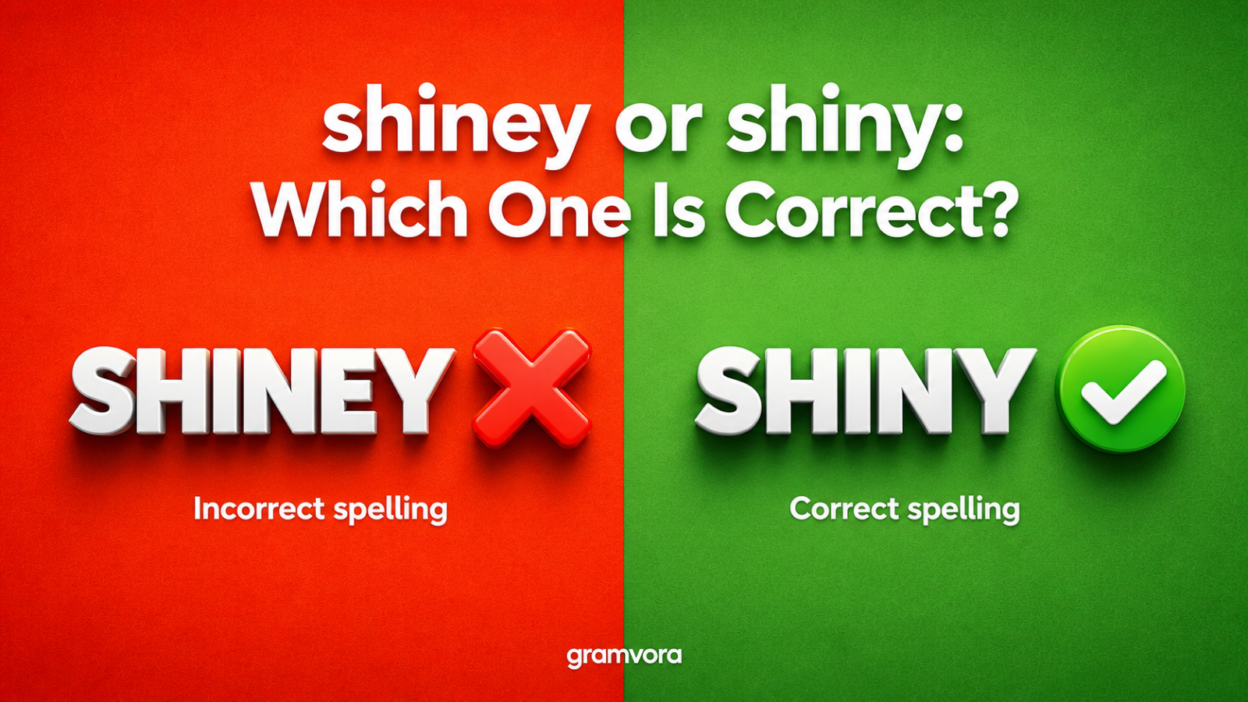
If you are choosing between shiney or shiny, use shiny.
Shiny is the correct standard spelling in US English. Shiney is a misspelling. It is not a separate word with a different meaning.
Use shiny when you mean bright, smooth, glossy, or reflecting light. For example, you can write about a shiny car, shiny hair, shiny shoes, or a shiny phone screen.
Quick Answer
Shiny is correct.
Shiney is not standard English. Avoid it in schoolwork, business writing, product descriptions, emails, captions, and everyday messages.
Correct: The floor looked shiny after we cleaned it.
Incorrect: The floor looked shiney after we cleaned it.
The simple memory trick is this: shine loses the final e before adding y. That gives you shiny, not shiney.
Why People Confuse Them
People often write shiney because the base word is shine. Since shine ends in e, it feels natural to keep that e when adding y.
But English often drops a silent final e before adding a suffix that begins with a vowel sound or vowel letter. In this case:
shine + y = shiny
The same pattern appears in other common words:
• ice + y = icy
• grease + y = greasy
• haze + y = hazy
That pattern is why shiny looks shorter than some people expect.
Key Differences At A Glance
| Context | Best Choice | Why |
|---|---|---|
| Describing a polished car | shiny | It means bright or glossy. |
| Describing clean hair | shiny | It is the standard adjective. |
| Writing a product listing | shiny | It looks professional and correct. |
| Writing a school paper | shiny | It is the accepted spelling. |
| Texting a friend | shiny | Casual writing still needs the correct spelling. |
| Using “shiney” in any normal sentence | shiny | “Shiney” is a misspelling, not a separate choice. |
Meaning and Usage Difference
Shiny means bright, smooth, or glossy because something reflects light. It is usually an adjective.
You can use shiny for objects, surfaces, hair, clothes, shoes, cars, jewelry, screens, and new things that look bright or polished.
Examples:
• Her shiny black boots looked brand new.
• The new laptop has a shiny screen.
• He waxed the car until it looked shiny.
• The dog’s coat was healthy and shiny.
Shiney does not have a separate standard meaning. In normal US English, it is treated as a spelling error for shiny.
Pronunciation is not a major issue here. The useful point is that shiny is pronounced like SHY-nee. Since shiney is not the standard spelling, there is no need to treat it as a separate pronounced word.
Tone, Context, and Formality
Shiny is neutral. It works in casual, formal, school, business, and creative writing.
You can use it in a simple text:
• Your new bike looks shiny.
You can also use it in a professional product description:
• This case has a shiny finish and a smooth feel.
Shiney looks like a typo. It can make otherwise good writing look careless. That matters most in places where accuracy counts, such as resumes, reports, ads, online store listings, and classroom assignments.
There is no useful formality difference between the two. The issue is not that one is casual and the other is formal. The issue is that shiny is correct and shiney is not standard.
Extra comparison:
• shiney: nonstandard spelling; avoid it
• shiny: correct adjective; use it for bright or glossy things
Which One Should You Use?
Use shiny every time.
Choose shiny when you describe something that reflects light or has a bright, smooth surface.
Use it for:
• shiny jewelry
• shiny hair
• shiny shoes
• shiny paint
• shiny wrapping paper
• shiny new tools
• shiny metal
• shiny countertops
Do not use shiney unless you are showing an error on purpose, such as in a spelling lesson or correction note.
Correct: The kitchen counters are clean and shiny.
Incorrect: The kitchen counters are clean and shiney.
When One Choice Sounds Wrong
Shiney sounds wrong in writing because readers expect shiny. Even if the sentence is clear, the spelling can distract the reader.
Wrong: I bought a shiney silver watch.
Right: I bought a shiny silver watch.
Wrong: The cake had a shiney glaze.
Right: The cake had a shiny glaze.
Wrong: Her hair looked shiney after the treatment.
Right: Her hair looked shiny after the treatment.
The meaning does not change. The spelling changes whether the sentence looks correct.
Common Mistakes (and Quick Fixes)
Mistake 1: Keeping the final e from shine
Wrong: shiney
Right: shiny
Quick fix: Drop the e before adding y.
Mistake 2: Thinking shiney is a British or alternate spelling
Wrong idea: “Maybe shiney is another accepted version.”
Right idea: In standard English, use shiny.
Mistake 3: Using shiney in product descriptions
Wrong: shiney gold finish
Right: shiny gold finish
Quick fix: Before publishing, search your text for shiney and replace it with shiny.
Mistake 4: Confusing shiny with the verb shine
Shine is a verb.
Shiny is usually an adjective.
Correct: The stars shine at night.
Correct: The table has a shiny finish.
Everyday Examples
• The car looked shiny after the wash.
• She wore shiny earrings to dinner.
• The phone screen was too shiny in direct sunlight.
• His shoes were shiny enough for the interview.
• The bakery used a shiny glaze on the donuts.
• The kids picked the shiny stickers first.
• I do not want shiny paint; I want a matte finish.
• The dog’s coat looked shiny and healthy.
• The new pan has a shiny stainless steel surface.
• That shiny wrapping paper is perfect for the gift.
In all of these sentences, shiney would be incorrect.
Dictionary-Style Word Details
Verb
• shiney: Not commonly used as a verb in standard US English. It is usually a misspelling of shiny, which is not a verb.
• shiny: Not commonly used as a verb in standard US English. Shiny is mainly an adjective. Use shine as the verb.
Example with the verb shine: The lights shine through the window.
Noun
• shiney: Not commonly used as a noun in standard US English.
• shiny: Not commonly used as a regular noun in standard US English. In everyday writing, it is normally an adjective.
Example as an adjective: The shiny ring caught her eye.
Synonyms
• shiney: No true synonyms as a standard word, because shiney is a misspelling.
• shiny: Closest plain alternatives include glossy, bright, gleaming, polished, lustrous, and glistening.
Useful antonyms for shiny include dull, matte, flat, and lackluster, depending on the sentence.
Example: Use matte when you mean the opposite of a shiny finish.
Example Sentences
• shiney: Not recommended in standard writing.
Incorrect: The sink looked shiney after cleaning.
• shiny: Correct in standard writing.
Correct: The sink looked shiny after cleaning.
More examples:
• The bracelet was shiny but not expensive.
• I like the color, but the shiny fabric is too bright for me.
• The freshly painted door had a shiny finish.
• His shiny shoes matched his suit.
Word History
• shiney: No separate standard word history is needed for normal usage. It is best understood as a misspelling of shiny.
• shiny: The word comes from shine plus the adjective ending -y. The final e in shine is dropped before adding y. That spelling pattern gives English the standard form shiny.
Avoid making more of the history than necessary. For this choice, the practical point is the spelling pattern: shine becomes shiny.
Phrases Containing “Shiny”
The phrase shiny object can also be used in everyday speech for something that grabs attention because it seems new or exciting. Still, the spelling remains shiny.
FAQs
1. Is “shiney” or “shiny” the correct spelling?
Shiny is the correct spelling. It is the standard English adjective used to describe something that reflects light, looks bright, or has a polished appearance. Shiney is a common misspelling and is not accepted in standard English.
2. Why do people spell “shiny” as “shiney”?
People often write shiney because the word comes from shine, which contains an “e.” However, when adding the suffix -y to create an adjective, English usually removes the extra “e,” making the correct spelling shiny.
3. What does “shiny” mean?
Shiny means having a bright, smooth, or reflective surface. It can describe objects like jewelry, cars, shoes, or anything that appears glossy or polished.
Example: She bought a shiny new laptop.
4. Is “shiney” ever correct in English?
No. Shiney is considered an incorrect spelling in modern English. The correct word is always shiny.
5. What is the difference between “shiny” and “shining”?
Shiny describes a quality or appearance, while shining usually describes something that is producing light.
- The table has a shiny surface. (appearance)
- The sun is shining brightly. (giving off light)
6. How can I remember the correct spelling: shiny or shiney?
Remember that when shine + y becomes an adjective, the final e is removed:
shine → shiny ✅
shine → shiney ❌
7. Can “shiny” describe people?
Yes, but usually in a figurative or humorous way. It can describe someone’s appearance, such as shiny hair or skin.
Example: Her shiny hair looked healthy and smooth.
8. Is “shiny” used in American English?
Yes. Shiny is the standard spelling used in American English and other varieties of English, including British English.
Conclusion
For shiney or shiny, the correct choice is shiny.
Shiny is the standard adjective for something bright, smooth, glossy, or light-reflecting. Shiney is a misspelling, not a separate word with its own meaning or tone.