
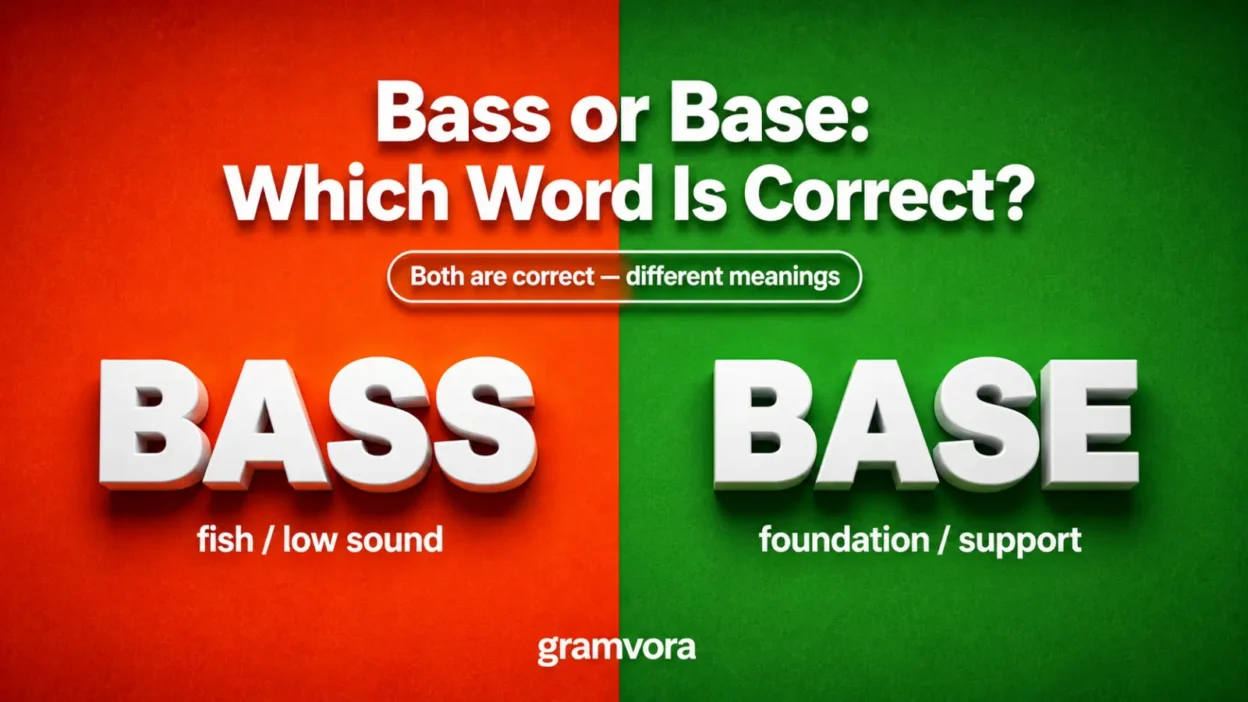
Bass and base are commonly confused words because they can sound exactly the same in some contexts. However, they have completely different meanings and uses. The correct spelling depends on what you are trying to say.
Use bass when you are talking about low musical sounds, a low musical instrument or voice, or a type of fish. Use base when you mean a foundation, bottom, support, starting point, main location, or the basis for something.
The confusion becomes even greater because bass has two different pronunciations. In music, bass is usually pronounced like “base.” When referring to the fish, bass is usually pronounced like “mass.”
So, if you are wondering whether to write bass or base, do not rely only on pronunciation. Instead, look at the meaning and context.
Quick Answer
Use bass for:
- Low musical sounds
- Bass instruments
- Bass guitar
- Bass drums
- A low singing voice
- Bass lines in music
- A type of fish
Use base for:
- A foundation
- The bottom or supporting part of something
- A starting point
- A main location
- A group of customers or fans
- A fixed starting amount
- The basis of an idea
- The verb meaning “to build or establish something on”
Bass vs. Base at a Glance
| Context | Best Choice | Why |
|---|---|---|
| Low notes in a song | bass | It refers to low musical sound. |
| A guitar that plays low notes | bass | The correct term is bass guitar. |
| A deep musical line | bass | Bass refers to the low part of music. |
| A fish caught in a lake | bass | Bass is a type of fish. |
| Bottom of a lamp | base | Base means the supporting bottom part. |
| Starting pay amount | base | Base means the fixed starting amount. |
| Main office location | base | Base can mean a central or home location. |
| Group of customers | base | Customer base means the group of customers. |
| Build an argument on facts | base | Base means to ground something in something else. |
Why Do People Confuse Bass and Base?
The main reason people confuse these words is that musical bass and base are pronounced the same way in standard American English.
For example:
- bass guitar
- bass line
- base salary
- base camp
- customer base
When you hear these words rather than see them written, it may be difficult to know which spelling is correct.
There is another complication: bass has a different pronunciation when it refers to a fish. A musician may talk about the bass in a song, pronounced like “base,” while someone fishing may catch a bass, pronounced like “mass.”
Therefore, pronunciation alone cannot always tell you which spelling to use.
What Does Bass Mean?
Bass has several related meanings, especially in music.
In music, bass refers to the lower range of sounds. It can describe low notes, a low musical part, or an instrument designed to produce lower sounds.
For example:
The bass in this song is very strong.
A bass guitar is a stringed instrument that generally produces lower notes than a standard guitar. A bass drum is a large drum that produces a deep, low sound.
The word can also describe a singer with a very low vocal range:
The choir needs another bass for the performance.
Outside music, bass can refer to several species of freshwater or saltwater fish.
For example:
We caught a large bass at the lake.
In this meaning, bass has a different pronunciation from the musical term.
What Does Base Mean?
Base generally refers to something that supports, begins, or provides a foundation for something else.
As a noun, base can mean the bottom or supporting part of an object.
For example:
The base of the lamp is made of metal.
It can also mean a starting point or central location:
The hikers returned to base before sunset.
In business, base can refer to a group of people, such as customers or supporters:
The company is trying to expand its customer base.
Likewise, a fan base is the group of people who support a particular performer, team, creator, or organization.
Base can also refer to a fixed or starting amount:
The employee receives a base salary plus bonuses.
As a verb, base means to establish, build, place, or develop something using something else as its foundation.
For example:
We based our decision on the available evidence.
This is one of the most important uses to remember because base is always correct in phrases such as base your decision on, base an argument on, and be based on.
Key Differences at a Glance
The easiest way to remember the distinction is to connect each word with its main meanings.
Bass is associated with:
- Music
- Low sounds
- Low voices
- Musical instruments
- Fish
Base is associated with:
- Foundation
- Support
- Bottom
- Starting point
- Location
- Group
- Fixed amount
- Basis
- Establishing something on something else
Although they can sound alike, their meanings are not interchangeable.
Bass or Base in Common Phrases
Certain phrases make the correct spelling easy to identify.
Common phrases with bass
- bass guitar
- bass drum
- bass line
- bass clef
- bass voice
- bass player
- bass notes
- bass fishing
- sea bass
- striped bass
- largemouth bass
Common phrases with base
- base salary
- base pay
- base camp
- home base
- customer base
- fan base
- knowledge base
- database
- base rate
- base price
- base layer
- touch base
- off base
- first base
Learning these common combinations can help you avoid spelling mistakes.
Common Mistakes and Quick Fixes
Mistake: “He plays base in the band.”
Correct: “He plays bass in the band.”
The person plays a low musical instrument, so bass is correct.
Mistake: “The bass of the lamp is cracked.”
Correct: “The base of the lamp is cracked.”
Here, the word means the bottom supporting part of the lamp.
Mistake: “Our company is bassed in Dallas.”
Correct: “Our company is based in Dallas.”
The verb is base, so the past-tense form is based.
Mistake: “She caught a large base in the lake.”
Correct: “She caught a large bass in the lake.”
The word refers to the fish.
Mistake: “This is my bass pay before bonuses.”
Correct: “This is my base pay before bonuses.”
Base pay means the regular fixed amount before bonuses, commissions, or other additional compensation.
Mistake: “We need to increase our customer bass.”
Correct: “We need to increase our customer base.”
A customer base is the group of customers who buy from or support a business.
Everyday Examples of Bass
Here are some natural examples of bass:
- I turned down the bass because the walls were shaking.
- He bought a used bass guitar.
- The bass line gives the song a deeper sound.
- The singer has a powerful bass voice.
- She caught a large bass while fishing.
- The band needs a new bass player.
- The song has too much bass for my headphones.
- We went bass fishing early in the morning.
In each example, the meaning involves music, low sound, a musician, or fish.
Everyday Examples of Base
Here are some common examples of base:
- The base of the chair is loose.
- The statue rests on a stone base.
- The company is based in Denver.
- We need to grow our customer base.
- Her argument has a strong base of evidence.
- The employee receives a base salary plus commission.
- The hikers returned to base before dark.
- The recipe uses tomatoes as its base.
- Please base your answer on the information provided.
- I will touch base with you tomorrow.
These examples show how widely base is used in everyday English.
Bass and Base: Part of Speech
Both words can function in different ways, but their uses are distinct.
Bass
Bass is most commonly used as a noun or adjective.
As a noun:
The bass was too loud.
As an adjective:
He plays bass guitar.
It can also refer to a fish:
They caught a bass.
Base
Base can be used as a noun, verb, and adjective.
The base of the building is made of stone.
We base our decision on the facts.
As an adjective:
The company offers a base salary.
The word based is the common past-tense and participial form of the verb:
The study is based on reliable data.
Bass vs. Base Pronunciation
Pronunciation is one of the most interesting parts of this comparison.
When bass refers to music, it is pronounced like “base.”
For example:
The bass sounds great in this song.
When bass refers to the fish, it is usually pronounced like “mass.”
For example:
He caught a bass in the river.
The word base is pronounced like the musical form of bass.
Because of these pronunciation differences, English learners may find this pair especially confusing. The safest strategy is to focus on meaning rather than sound.
A Simple Memory Trick
A quick way to remember the difference is:
Bass = beats, low sound, or fish.
Base = bottom, basis, or beginning.
If you are talking about music or a fish, think bass.
If you are talking about a foundation, starting point, location, salary, customers, or something being built on evidence, think base.
Another useful test is to ask whether you could replace the word with foundation, support, basis, or starting point.
If yes, base is probably the correct choice.
If you mean a low musical sound or a fish, bass is the better choice.
Bass or Base: Which One Is Correct?
Neither word is universally “correct.” The correct choice depends entirely on the meaning of the sentence.
For example:
He plays bass in a band.
But:
He earns a base salary.
And:
She caught a bass at the lake.
But:
The vase has a wide base.
Changing the spelling changes the meaning, so using the wrong word can make a sentence confusing or incorrect.
FAQs
1. Is it bass or base?
Both bass and base are correct words, but they have different meanings. Use bass for low musical sounds, bass instruments, low voices, or fish. Use base for a foundation, support, starting point, location, or basis.
2. Is bass guitar or base guitar correct?
Bass guitar is correct. A bass guitar is a musical instrument designed to produce low-frequency notes.
3. Is it bass salary or base salary?
Base salary is correct. It means the fixed amount of regular pay before bonuses, commissions, or other additional compensation.
4. Is it customer bass or customer base?
Customer base is correct. It refers to the group of customers who purchase from or support a business.
5. Is bass fishing spelled with bass?
Yes. Bass fishing is correct when you mean fishing for bass, the type of fish.
6. Does bass rhyme with base?
It depends on the meaning. Musical bass is pronounced like base, while bass meaning the fish is usually pronounced like mass.
7. Is it based or bassed?
Based is correct. It comes from the verb base, as in “The company is based in Chicago.”
8. Is base a verb?
Yes. Base can be a verb meaning to establish or build something on something else. For example: “Base your conclusion on the evidence.”
9. Is bass only used for music?
No. Bass can refer to low musical sound, musical instruments or voices, and several types of fish.
10. What is the easiest way to remember bass vs. base?
Remember: bass = music or fish, while base = foundation, support, beginning, or basis.
Conclusion
The difference between bass and base becomes much easier once you focus on meaning instead of pronunciation.
Use bass when you mean low musical sound, a low musical instrument or voice, or a type of fish. Remember that musical bass sounds like “base,” while fish bass is usually pronounced differently.
Use base when you mean a foundation, bottom, support, starting point, central location, customer group, fixed amount, or the basis for something. As a verb, base means to build, establish, or ground something on something else.
The easiest rule to remember is:
Bass = music, low sound, or fish.
Base = foundation, support, starting point, or basis.
Once you connect each spelling with its meaning, choosing between bass or base becomes straightforward.


[…] Endure: correct standard word• Indure: nonstandard spelling in modern […]