Many English learners and native speakers occasionally confuse elude and allude. The mistake is understandable because the two words look similar, sound somewhat alike, and are both commonly used in formal writing.
Despite their similar appearance, their meanings are completely different.
One word relates to indirectly mentioning something. The other relates to escaping, avoiding, or remaining out of reach.
Understanding this distinction can instantly improve your writing and help you avoid one of the most common word-choice mistakes in English.
The good news is that once you learn the core difference, choosing the correct word becomes much easier.
In this guide, you’ll learn exactly what each word means, how to use it correctly, common mistakes to avoid, and plenty of real-world examples that make the difference easy to remember.
Quick Answer
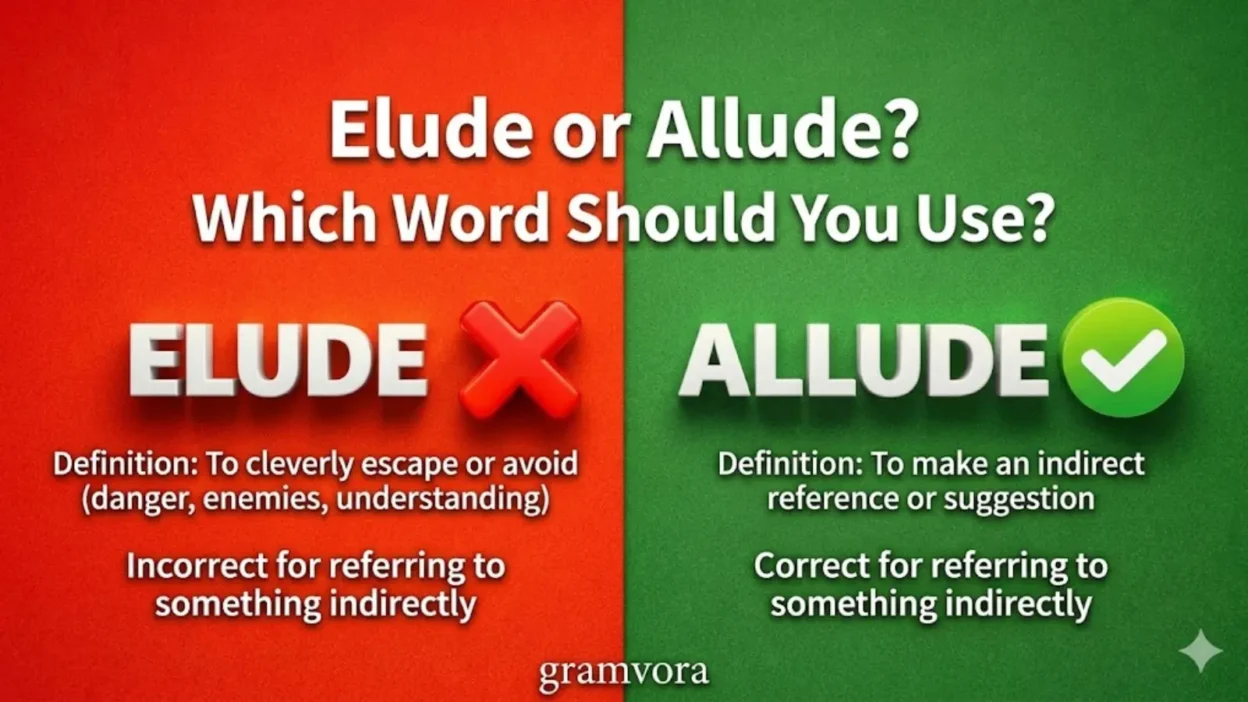
Use allude when you indirectly refer to something.
Use elude when something escapes, avoids, or remains beyond someone’s reach, understanding, or control.
Examples:
- The senator alluded to recent events without naming anyone.
- The suspect eluded police for several days.
A simple way to remember it:
- Allude = hint at something
- Elude = escape something
That single distinction will solve most usage questions.
Why People Confuse Them
There are several reasons these words create confusion.
First, they look very similar on the page.
Compare them:
- allude
- elude
Only one letter changes.
Second, their pronunciations are close enough that many people hear them incorrectly in conversation.
A practical pronunciation guide:
- Allude: uh-LOOD
- Elude: ee-LOOD
Third, both words often appear in formal writing, journalism, literature, and academic discussions. People may encounter them less often than everyday vocabulary, making them easier to mix up.
Another reason is that both words can involve something indirect.
When you allude, you mention something indirectly.
When something eludes you, it remains beyond your grasp or understanding.
Because both situations involve something not fully stated or obtained, confusion sometimes occurs.
However, the actions themselves are very different.
One is about communication.
The other is about avoidance or escape.
Key Differences At A Glance
| Feature | Allude | Elude |
|---|---|---|
| Main meaning | Refer indirectly | Escape, evade, avoid |
| Part of speech | Verb | Verb |
| Typical structure | Allude to something | Elude someone or something |
| Common context | Speaking and writing | Avoidance or unattainability |
| Related noun | Allusion | Elusion (rare) |
| Focus | Communication | Escape or avoidance |
| Example | She alluded to the issue. | The answer eluded him. |
The easiest way to think about the difference is this:
Allude involves words.
Elude involves escape, avoidance, or something remaining unattainable.
Meaning and Usage Difference
Understanding the meanings in depth makes it much easier to choose the right word.
Understanding Allude
The verb allude means to make an indirect reference to something.
Instead of openly stating a fact, idea, person, event, or situation, the speaker hints at it.
Examples:
- The article alluded to political tensions.
- The coach alluded to upcoming changes.
- She alluded to a disagreement without discussing details.
- The movie alludes to classic science-fiction stories.
Notice that the speaker never fully states the topic.
The reference is indirect.
In American English, allude is commonly followed by to.
Examples:
- He alluded to a recent controversy.
- The report alluded to possible risks.
- The author alluded to earlier research.
This pattern appears so frequently that many writers naturally associate the word with the phrase allude to.
Understanding Elude
The verb elude means to escape, evade, avoid, or remain beyond someone’s reach.
The word can be used literally or figuratively.
Literal examples:
- The suspect eluded police.
- The animal eluded capture.
- The hacker eluded security measures.
Figurative examples:
- Sleep eluded me.
- Success eluded the company.
- The answer eluded the students.
- The reason continues to elude researchers.
In these examples, nothing is physically running away.
Instead, something remains unattainable, difficult to understand, or impossible to achieve.
This figurative use is extremely common in modern American English.
The Core Difference
The distinction can be summarized simply:
- Allude = indirectly mention
- Elude = escape or avoid
If you’re talking about communication, choose allude.
If you’re talking about avoidance, escape, or something remaining out of reach, choose elude.
Tone, Context, and Formality
Both words are accepted in standard American English and can be used in formal or professional writing.
Neither word sounds casual or slang-like.
However, they tend to appear in different contexts.
Common Contexts for Allude
You often see allude in:
- speeches
- essays
- journalism
- literature
- academic writing
- business communication
Examples:
- The CEO alluded to future expansion plans.
- The professor alluded to a famous theory.
- The columnist alluded to past events.
Because allude involves indirect references, it often appears in discussions about language, communication, and storytelling.
Common Contexts for Elude
You often see elude in:
- news reports
- crime reporting
- sports coverage
- science writing
- everyday conversation
- professional communication
Examples:
- The suspect eluded arrest.
- Victory eluded the team.
- An explanation continues to elude scientists.
Because elude involves avoidance or unattainability, it appears in a wider range of situations.
Formality Comparison
| Context | Best Choice | Why |
|---|---|---|
| Hinting at a topic | Allude | Involves indirect reference |
| Mentioning something subtly | Allude | Communication-focused meaning |
| Escaping capture | Elude | Means evade or avoid |
| Failing to understand | Elude | Means beyond comprehension |
| Missing a goal | Elude | Means unattained or unreachable |
Neither word is more formal than the other.
The correct choice depends entirely on meaning.
Which One Should You Use?
When deciding between these words, ask yourself a simple question.
Are You Referring to Communication?
If someone is indirectly mentioning something, use allude.
Examples:
- The mayor alluded to future tax changes.
- The article alluded to a larger problem.
- She alluded to her childhood experiences.
Are You Referring to Escape or Avoidance?
If something escapes, avoids, or remains unattainable, use elude.
Examples:
- The suspect eluded capture.
- Sleep eluded him.
- The solution eluded the engineering team.
A quick mental shortcut:
People allude.
Problems, answers, suspects, success, and opportunities often elude.
This isn’t a strict grammar rule, but it helps reinforce the distinction.
When One Choice Sounds Wrong
Using the wrong word can dramatically change the meaning of a sentence.
Consider these examples.
Incorrect
- The senator eluded recent policy concerns.
Correct
- The senator alluded to recent policy concerns.
The senator is mentioning something indirectly, not escaping it.
Incorrect
- The suspect alluded the police.
Correct
- The suspect eluded the police.
The suspect escaped police.
No indirect reference is involved.
Incorrect
- The answer alluded me.
Correct
- The answer eluded me.
The answer remained beyond understanding.
Incorrect
- The article eluded environmental concerns.
Correct
- The article alluded to environmental concerns.
The article refers to those concerns indirectly.
These examples demonstrate why the two words cannot be used interchangeably.
Common Mistakes (and Quick Fixes)
Mistake #1: Forgetting “to” After Allude
Incorrect:
- She alluded the problem.
Correct:
- She alluded to the problem.
The phrase allude to is the standard construction.
Mistake #2: Using Allude When Escape Is Intended
Incorrect:
- The thief alluded authorities.
Correct:
- The thief eluded authorities.
Escaping authorities requires elude.
Mistake #3: Using Elude for Indirect References
Incorrect:
- The speaker eluded recent criticism.
Correct:
- The speaker alluded to recent criticism.
Mistake #4: Mixing Up Figurative Elude
Incorrect:
- The solution alluded engineers.
Correct:
- The solution eluded engineers.
The engineers could not find the solution.
Quick Fix
Remember:
- Allude = mention indirectly
- Elude = escape or evade
If you can replace the word with “hint at,” choose allude.
If you can replace it with “escape” or “avoid,” choose elude.
Everyday Examples
The best way to master these words is to see them in realistic situations.
Everyday Examples of Allude
- My manager alluded to upcoming promotions.
- The article alluded to problems within the company.
- The comedian alluded to a recent viral story.
- The teacher alluded to material that would appear on the exam.
- The author alluded to several classic novels.
- The speaker alluded to economic concerns.
- The report alluded to budget challenges.
- She alluded to personal difficulties without explaining them.
- The podcast host alluded to a future announcement.
- The director alluded to earlier films in the series.
Everyday Examples of Elude
- Sleep eluded me last night.
- The winning goal continued to elude the team.
- The answer eluded everyone in the room.
- Success eluded the startup for years.
- The suspect eluded arrest.
- The reason for the error still eludes us.
- A clear explanation has eluded researchers.
- The truth eluded investigators.
- The championship eluded the team again.
- The perfect solution continues to elude experts.
These examples reflect common modern American English usage.
Dictionary-Style Word Details
Verb
Allude
A verb meaning to refer indirectly to a person, event, idea, or topic.
Examples:
- allude to a problem
- allude to an event
- allude to a policy
Elude
A verb meaning to escape, evade, avoid, or remain beyond understanding.
Examples:
- elude capture
- elude detection
- elude understanding
Noun
Allude
Not commonly used as a noun in standard American English.
Related noun:
- allusion
Example:
- The speech contained several allusions.
Elude
Not commonly used as a noun in standard American English.
Related noun:
- elusion
This noun exists but is relatively uncommon in everyday usage.
Synonyms
Allude
Closest plain alternatives:
- hint
- suggest
- imply
- refer indirectly
- mention indirectly
Possible antonyms:
- state directly
- specify
- declare openly
Elude
Closest plain alternatives:
- evade
- escape
- avoid
- slip past
- dodge
Possible antonyms:
- confront
- encounter
- capture
The best synonym always depends on context.
Example Sentences
Allude
- The journalist alluded to earlier reports.
- She alluded to concerns about funding.
- The novel alludes to several historical events.
- The speaker alluded to recent developments.
- He alluded to a disagreement but gave no details.
Elude
- The answer eluded me.
- The criminal eluded authorities.
- Victory eluded the team.
- The truth eluded investigators.
- A practical solution continues to elude experts.
Word History
Allude
The word comes from Latin roots and developed into a term meaning an indirect reference or hint. Over time, English speakers used it primarily when discussing subtle references in speech and writing.
Elude
The word also traces back to Latin roots but developed a different meaning related to escaping, evading, or avoiding. Modern English uses it both literally and figuratively.
Although the words share some distant historical connections, their meanings separated long ago.
Today they represent two distinct concepts and should not be treated as interchangeable.
Phrases Containing
Allude
Common phrases include:
- allude to
- alluded to
- alluding to
- indirectly allude to
- frequently allude to
Examples:
- She alluded to the issue.
- The article alluded to earlier events.
Elude
Common phrases include:
- elude capture
- elude detection
- elude understanding
- elude explanation
- elude memory
- elude authorities
- elude arrest
Examples:
- The suspect eluded capture.
- The reason eluded explanation.
Conclusion
The difference between elude and allude is one of meaning, not style.
Use allude when someone indirectly refers to something.
Use elude when someone or something escapes, avoids, or remains beyond reach.