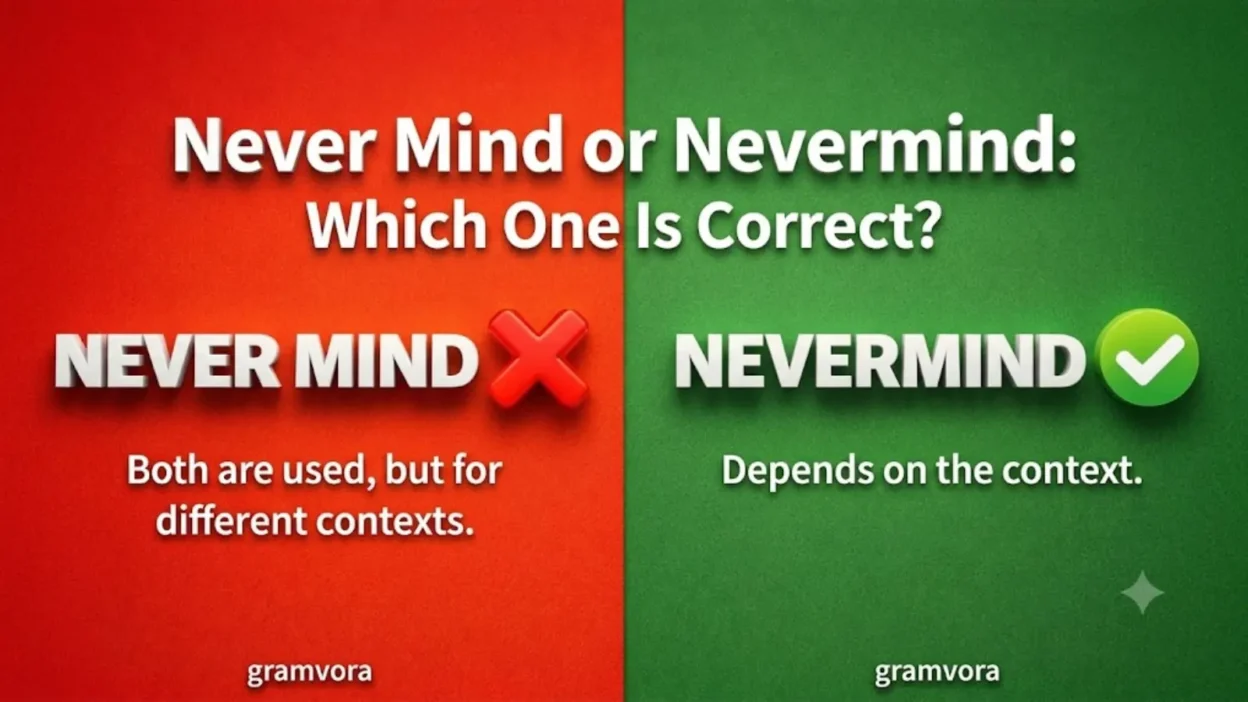
If you are choosing between never mind and nevermind, the safest choice is usually never mind as two words.
Use never mind when you mean “don’t worry,” “forget it,” “ignore that,” or “let alone.” This is the standard form in normal US English.
Nevermind as one word is much less common. It is mainly a noun in informal or dialect-style expressions like pay him no nevermind or it makes no nevermind to me.
So the main difference is simple: never mind is the everyday phrase most writers need. Nevermind is a limited noun form that sounds casual, old-fashioned, regional, or stylized.
Quick Answer
Use never mind in almost every regular sentence.
Correct: Never mind, I found my phone.
Also correct: Never mind the cost; we need to fix the leak.
Another correct use: I can barely walk today, never mind run a mile.
Use nevermind only when it works as a noun meaning “attention,” “concern,” “business,” or “difference,” usually after no.
Correct but informal: Don’t pay him no nevermind.
Correct but very casual: It makes no nevermind to me.
For school, work, business writing, emails, articles, and clear everyday writing, choose never mind.
Why People Confuse Them
People confuse never mind and nevermind because they sound the same when spoken. You cannot hear the space between the words.
Another reason is casual typing. In texts, captions, comments, and song titles, people often close common phrases into one word. That does not always make the closed form standard.
The phrase never mind is also common in speech, so many people type it the way it feels: fast and casual. That is how nevermind often appears when someone means “forget it.”
Still, standard written English keeps the common phrase open: never mind.
The one-word form is not useless, but it has a narrower job. It is mostly a noun in expressions about paying no attention or saying something is none of someone’s business.
Key Differences At A Glance
| Context | Best Choice | Why |
|---|---|---|
| Telling someone not to worry | never mind | Standard phrase |
| Saying “forget it” | never mind | Common everyday use |
| Meaning “let alone” | never mind | Standard linking phrase |
| Formal writing | never mind | Clear and widely accepted |
| “Pay no attention” in dialect-style speech | nevermind | Works as a casual noun |
| “It makes no difference” in casual speech | nevermind | Noun use after “no” |
| Professional email | never mind | Safer and clearer |
| Character dialogue with regional flavor | nevermind | May fit voice or style |
Meaning and Usage Difference
Never mind is a phrase. It can tell someone not to worry, ask someone to ignore something, or show that a second thing is even less likely than the first.
Examples:
Never mind, we can try again tomorrow.
Never mind what I said earlier.
I can’t afford a weekend trip, never mind a two-week vacation.
In these sentences, never mind is not acting like one regular noun. It works as a set phrase.
Nevermind is different. In standard use, it is mainly a noun. It means something like “attention,” “concern,” “business,” or “difference.” It often appears with no.
Examples:
Don’t pay that comment no nevermind.
What I spend is no nevermind of yours.
It makes no nevermind to me.
These examples sound casual and regional. They are not the best fit for clean formal prose.
Tone, Context, and Formality
Never mind fits almost every tone. It can be casual, polite, neutral, or serious.
Casual: Never mind, I got it.
Polite: Never mind the delay; I appreciate your help.
Serious: Never mind the cost for now; safety comes first.
Nevermind has a much narrower tone. It sounds informal and often gives a sentence a folksy, regional, or old-fashioned feel. In some dialogue, that may be the exact effect a writer wants.
Example:
Don’t pay him no nevermind; he complains about everything.
That sentence sounds like spoken character voice. It would feel out of place in a formal report.
Pronunciation does not need much attention here because both forms sound the same in normal speech: NEV-er mind. The real issue is spelling and sentence role, not sound.
Which One Should You Use?
Use never mind unless you have a clear reason to use nevermind as a noun.
Choose never mind when you mean:
• don’t worry
• forget it
• ignore that
• leave it alone
• not to mention
• let alone
Choose nevermind only when it means a kind of concern, attention, business, or difference.
Small comparison:
• never mind: a standard phrase used in most contexts
• nevermind: a casual noun used in limited expressions
• never mind: best for school, work, and clear writing
• nevermind: best only when the informal noun meaning is intended
If you are unsure, write never mind. That choice will be right far more often.
When One Choice Sounds Wrong
Nevermind sounds wrong when it replaces the standard phrase never mind.
Wrong: Nevermind, I found the receipt.
Better: Never mind, I found the receipt.
Wrong: I can barely finish one page, nevermind the whole chapter.
Better: I can barely finish one page, never mind the whole chapter.
Wrong: Nevermind what she said.
Better: Never mind what she said.
On the other hand, never mind may look less natural if the writer is clearly using the noun expression.
Less natural: Don’t pay him no never mind.
More natural for that informal expression: Don’t pay him no nevermind.
Even then, the sentence is very casual. In polished writing, you could say:
Don’t pay attention to him.
Ignore him.
His comment does not matter.
Common Mistakes (and Quick Fixes)
The most common mistake is using nevermind when the writer means “forget it.”
Mistake: Nevermind, I changed my mind.
Fix: Never mind, I changed my mind.
Another mistake is using nevermind for “let alone.”
Mistake: She can’t drive downtown, nevermind across the state.
Fix: She can’t drive downtown, never mind across the state.
Some writers also treat nevermind as a modern, cleaner spelling. That is risky. It may look casual or careless to many readers.
A quick test helps:
If you can replace the phrase with don’t worry, forget it, or let alone, use never mind.
If the sentence means attention, concern, business, or difference, and it appears after no, then nevermind may fit.
Everyday Examples
Here are natural examples for never mind:
Never mind, I’ll call them myself.
You forgot the file? Never mind; we can print another copy.
Never mind the small details for now.
I can’t cook dinner tonight, never mind host ten people.
Never mind what the comments say.
She can’t remember my name, never mind my birthday.
I was going to ask for help, but never mind.
Never mind the typo; the message is clear.
Here are natural examples for nevermind:
Don’t pay that rumor no nevermind.
It makes no nevermind to me which table we use.
His bad mood is no nevermind of mine.
She said it was no nevermind to her.
Notice the difference. The never mind examples sound normal in everyday writing. The nevermind examples sound more like casual speech or character dialogue.
Dictionary-Style Word Details
Verb
never mind: Can work like a verb phrase in commands such as never mind the mess or never mind what I said. The meaning is close to “do not worry about,” “do not pay attention to,” or “do not concern yourself with.”
nevermind: Not commonly used as a verb in standard US English. When someone writes nevermind to mean “forget it,” the standard written form is usually never mind.
Noun
never mind: Not normally used as a noun in the standard phrase. It is mainly an idiomatic phrase.
nevermind: Used as a noun in informal expressions. It can mean “attention,” “concern,” “business,” or “difference,” especially in phrases like no nevermind, pay no nevermind, and no nevermind of yours.
Synonyms
never mind: Closest plain alternatives include don’t worry, forget it, ignore it, leave it alone, don’t bother, not to mention, and let alone. The best synonym depends on the sentence.
nevermind: Closest plain alternatives include attention, concern, business, matter, or difference. These are not always exact replacements because nevermind has a very casual tone.
Clear antonyms do not work neatly for the whole comparison. For never mind, an opposite idea could be pay attention or be concerned, but those are phrase-level opposites, not exact word-for-word antonyms.
Example Sentences
never mind:
Never mind, I found the address.
Never mind the broken chair; we have extras.
I can’t finish the first draft today, never mind revise it.
Never mind what I said earlier; the plan changed.
nevermind:
Don’t pay him no nevermind.
It’s no nevermind of mine where they park.
That little delay makes no nevermind to us.
Her opinion is no nevermind to him.
Word History
never mind: The phrase is old and well established. It comes from the ordinary words never and mind, with mind carrying the idea of care, attention, or concern.
nevermind: The one-word noun developed from the phrase never mind. Dictionaries record it as a noun used in informal or older-style expressions. The exact story of how every regional use spread is not something readers need to overstate. The safe point is that the noun exists, but it is limited.
Phrases Containing
never mind:
never mind that
never mind about that
never mind what I said
never mind the cost
never mind doing that
never mind the details
nevermind:
pay no nevermind
don’t pay him no nevermind
no nevermind of yours
make no nevermind
it’s no nevermind to me
Conclusion
For most writing, never mind is the correct and safest choice. Use it when you mean “don’t worry,” “forget it,” “ignore that,” or “let alone.”
Nevermind is not the normal spelling for those meanings in standard written English. It is mainly a casual noun in expressions like pay no nevermind or it makes no nevermind.
The easiest rule is this: when in doubt, write never mind as two words. Use nevermind only when you truly mean the informal noun.