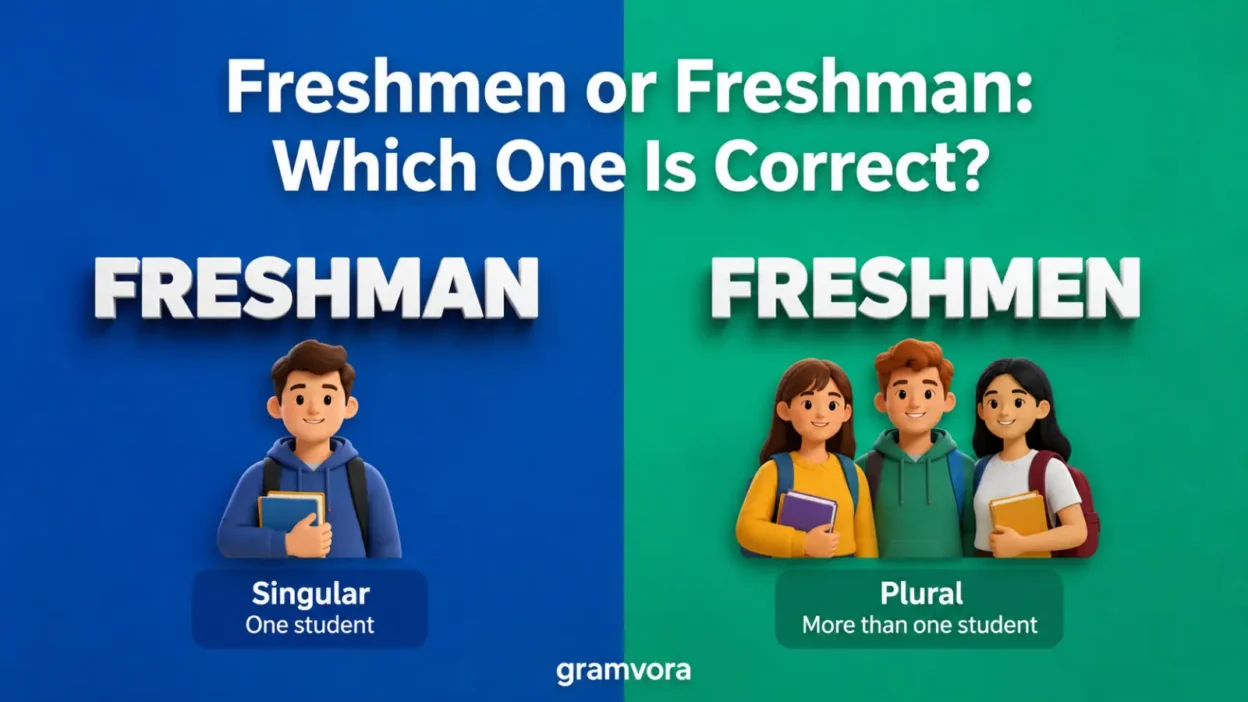
Freshmen and freshman are both correct, but they are not used the same way.
Use freshman when you mean one first-year student or when the word describes another noun, such as freshman year or freshman class.
Use freshmen when you mean two or more first-year students.
That is the main difference. The tricky part is that freshman can describe a group when it comes before another noun. That is why freshman class is correct, even though the class has many students.
Quick Answer
Use freshman for one person.
Example:
She is a freshman at a public high school in Ohio.
Use freshmen for more than one person.
Example:
The freshmen met their advisors after lunch.
Use freshman before another noun.
Example:
My freshman year went by fast.
So the correct phrase is freshman year, not freshmen year.
Why People Confuse Them
People confuse freshman and freshmen because they look almost the same. They also sound very close in normal speech.
The spelling difference is small:
- freshman ends in man
- freshmen ends in men
That pattern is similar to man and men. One person is a man. More than one person are men. In the same way, one first-year student is a freshman. More than one first-year student are freshmen.
The second reason is phrase use. A group can be called freshmen, but the group’s year, class, seminar, or orientation is usually described with freshman.
That is why this sentence is correct:
The freshmen attended freshman orientation.
Here, freshmen means the students. Freshman describes the orientation.
Key Differences At A Glance
| Context | Best Choice | Why |
|---|---|---|
| One first-year student | freshman | It is singular. |
| Two or more first-year students | freshmen | It is plural. |
| First year of school | freshman year | Freshman describes year. |
| Group of first-year students as a class | freshman class | Freshman describes class. |
| Students themselves | freshmen | It names more than one student. |
| Before another noun | freshman | It works as a modifier. |
Meaning and Usage Difference
Freshman means a student in the first year of high school, college, or a similar program. It can also mean someone new to a job, activity, or public role.
Examples:
Avery is a freshman in college.
The freshman senator gave her first speech.
My freshman year was harder than I expected.
Freshmen is the plural form of freshman. It means more than one first-year student or more than one newcomer.
Examples:
The freshmen moved into the dorms on Friday.
Three freshmen joined the debate team.
Several freshmen asked about parking passes.
The pronunciation is not very helpful because both words are often said almost the same way in everyday speech: FRESH-muhn. Because the sound is so close, spelling and sentence role matter more than pronunciation.
Tone, Context, and Formality
Both words are common in US English. You will see them in schools, colleges, sports writing, campus emails, and news stories.
Freshman is common in phrases like:
- freshman year
- freshman class
- freshman dorm
- freshman seminar
- freshman orientation
- freshman quarterback
Freshmen is common when the sentence is about the people themselves:
- incoming freshmen
- college freshmen
- high school freshmen
- several freshmen
- the freshmen on the team
Some schools prefer first-year student instead of freshman. That choice is often about inclusive or official school language, not about the grammar difference between freshman and freshmen.
If your school uses first-year student, follow that style in official writing. In general US writing, freshman and freshmen are still widely understood.
Which One Should You Use?
Choose freshman when you can replace it with “one first-year student” or when it comes before another noun.
Correct:
I am a freshman.
She joined the freshman class.
He missed freshman orientation.
They talked about their freshman year.
Choose freshmen when you can replace it with “first-year students.”
Correct:
The freshmen arrived early.
Most freshmen live on campus.
Two freshmen started for the basketball team.
The advisor met with incoming freshmen.
A simple test helps:
If you mean people, ask how many.
One person: freshman.
More than one person: freshmen.
If the word comes before another noun, use freshman.
When One Choice Sounds Wrong
Freshmen year sounds wrong in standard US English because freshmen is plural, but the word is being used to describe year.
Write:
Correct: freshman year
Wrong: freshmen year
Freshmen class also sounds wrong in standard edited writing. The word before class should be freshman.
Write:
Correct: freshman class
Wrong: freshmen class
However, freshmen is correct when it names the students.
Correct:
The freshmen were excited about the first game.
The school welcomed freshmen from across the state.
This is the pattern that matters most:
| Feature | freshman | freshmen |
| Number | Singular | Plural |
| Main noun use | One first-year student | Two or more first-year students |
| Modifier use | Yes: freshman year | Not standard: freshmen year |
| Common phrase | freshman class | incoming freshmen |
Common Mistakes (and Quick Fixes)
Mistake: She is a freshmen.
Fix: She is a freshman.
Why: One student needs the singular form.
Mistake: I loved my freshmen year.
Fix: I loved my freshman year.
Why: Freshman describes year.
Mistake: The freshmen class is large.
Fix: The freshman class is large.
Why: Freshman describes class.
Mistake: There are three freshman in my study group.
Fix: There are three freshmen in my study group.
Why: Three students need the plural form.
Mistake: All freshman must attend orientation.
Fix: All freshmen must attend orientation.
Why: All points to a group of students.
Everyday Examples
I am a freshman at a community college.
My brother is a freshman in high school.
The freshmen waited outside the gym before orientation.
Most freshmen were nervous on the first day.
My freshman year taught me how to manage my time.
The freshman class elected a president.
Two freshmen made the varsity team.
The professor teaches a freshman writing course.
Incoming freshmen should check their email before move-in day.
A freshman asked where the library was.
The freshmen on our floor planned a movie night.
Her freshman schedule includes biology, English, and algebra.
Dictionary-Style Word Details
Verb
Freshmen: Not commonly used as a verb in standard US English.
Freshman: Not commonly used as a verb in standard US English.
Use these words as nouns, or use freshman as a describing word before another noun.
Noun
Freshmen: A plural noun meaning more than one first-year student or more than one newcomer.
Example:
The freshmen toured the campus.
Freshman: A singular noun meaning one first-year student or one newcomer.
Example:
The freshman found her first class without help.
Synonyms
Freshmen: Closest plain alternatives are first-year students, new students, newcomers, and beginners, depending on context.
Freshman: Closest plain alternatives are first-year student, new student, newcomer, beginner, or rookie, depending on context.
Clear antonyms are not always exact, but in school contexts, senior can be an opposite because it refers to a student in the final year of a typical high school or college sequence.
Example Sentences
Freshmen:
The freshmen met their resident assistant after dinner.
Several freshmen joined the robotics club.
Incoming freshmen should bring a photo ID to orientation.
Freshman:
Mia is a freshman at a state university.
His freshman year started with a full class schedule.
The freshman class raised money for the school library.
Word History
Freshman: The word combines the idea of being new or inexperienced with man, which has also been used historically in a broader “person” sense in some compound words.
Freshmen: This is the plural form of freshman. It follows the same basic spelling pattern as man changing to men in the plural.
Do not read the ending too literally in modern school use. A freshman can be any first-year student, not only a male student.
Phrases Containing
Freshmen:
incoming freshmen
college freshmen
high school freshmen
all freshmen
several freshmen
freshmen on campus
Freshman:
freshman year
freshman class
freshman orientation
freshman seminar
freshman dorm
freshman course
freshman senator
freshman quarterback
FAQs
Is it freshman or freshmen?
Both are correct, but they are used differently. Use freshman for one first-year student. Use freshmen for two or more first-year students.
Example:
She is a freshman.
The freshmen arrived early.
Is freshman singular or plural?
Freshman is singular. It means one first-year student in high school, college, or another program.
Example:
My cousin is a freshman at college.
Is freshmen plural?
Yes. Freshmen is the plural form of freshman. It means more than one first-year student.
Example:
The freshmen attended orientation together.
Is it freshman year or freshmen year?
The correct phrase is freshman year. In this phrase, freshman describes the word year, so the singular form is used.
Correct:
My freshman year was busy.
Wrong:
My freshmen year was busy.
Is it freshman class or freshmen class?
The correct phrase is freshman class. Here, freshman works like a describing word before class.
Correct:
The freshman class is large this year.
Wrong:
The freshmen class is large this year.
Can I say “I am a freshmen”?
No. Say I am a freshman because you are talking about one person.
Correct:
I am a freshman in high school.
Wrong:
I am a freshmen in high school.
When should I use freshmen?
Use freshmen when you are talking about more than one first-year student.
Examples:
Several freshmen joined the club.
The freshmen moved into the dorms on Friday.
Incoming freshmen should check their email.
When should I use freshman?
Use freshman for one first-year student or before another noun.
Examples:
She is a freshman.
He is in his freshman year.
The freshman class met in the gym.
Is “freshmans” a word?
No. Freshmans is not the standard plural form. The correct plural is freshmen.
Correct:
Three freshmen joined the team.
Wrong:
Three freshmans joined the team.
Are freshman and freshmen pronounced differently?
They can sound very similar in everyday speech. Because of that, it is better to focus on meaning and grammar. Use freshman for one student or before a noun, and freshmen for more than one student.
Can freshman describe a group?
Yes, but only when it describes another noun.
Example:
The freshman class planned a fundraiser.
In this sentence, freshman describes class. If you are talking about the students themselves, use freshmen.
Example:
The freshmen planned a fundraiser.
Is first-year student better than freshman?
Both can be correct. Many schools still use freshman, but some prefer first-year student in official writing. If your school has a style guide, follow that. Otherwise, freshman and freshmen are widely understood in US English.
Conclusion
The choice between freshmen and freshman depends on number and sentence role.
Use freshman for one first-year student. Also use freshman before another noun, as in freshman year, freshman class, and freshman orientation.
Use freshmen for more than one first-year student.
Remember this simple guide: one student is a freshman, many students are freshmen, and the year or class is usually freshman.