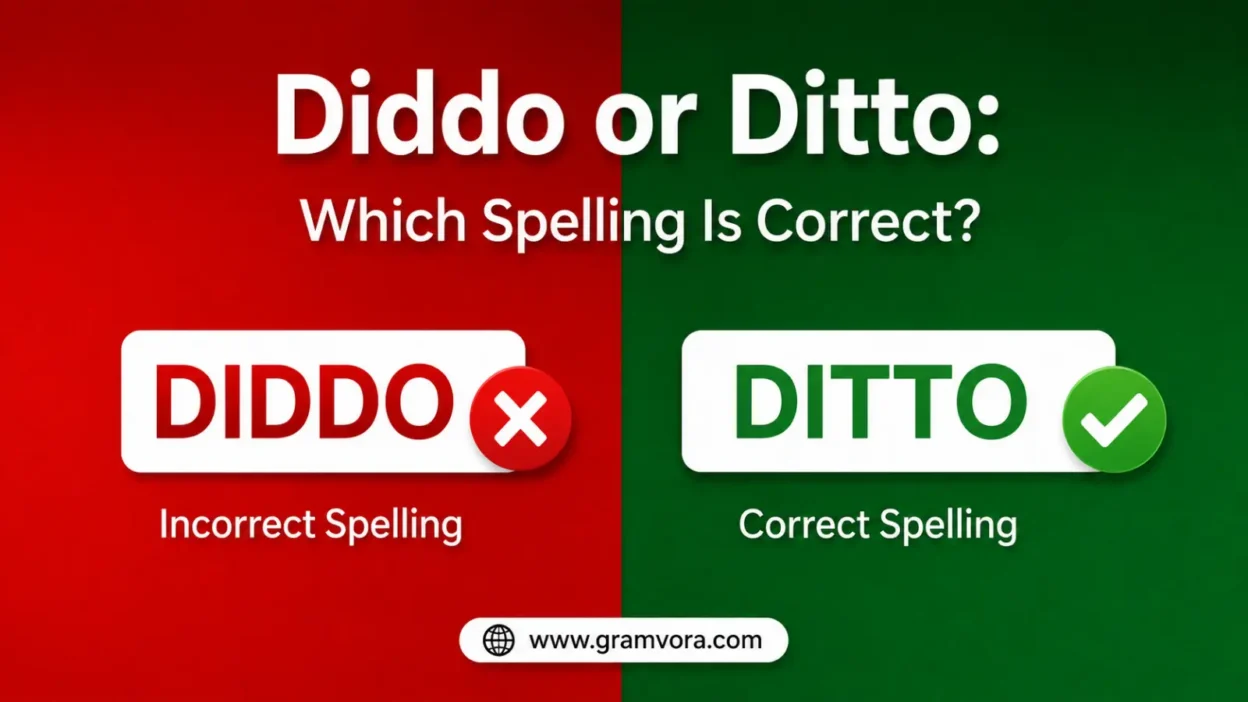
If you are choosing between diddo or ditto, use ditto. It is the correct standard spelling when you mean “same here,” “me too,” “the same as above,” or “that also applies.”
Diddo is usually a misspelling of ditto. You may see it in casual messages, usernames, brand names, or as a personal name, but that does not make it the correct word for agreement or repetition.
The main point is simple: write ditto in normal US English. Use diddo only when you are copying a name, title, handle, or brand that is officially spelled that way.
Quick Answer
Ditto is correct. Diddo is not the standard spelling for the word that means “same here,” “me too,” or “the same thing again.”
Correct: “I loved that movie.” “Ditto.”
Incorrect: “I loved that movie.” “Diddo.”
In polished writing, schoolwork, emails, captions, and comments, choose ditto.
Why People Confuse Them
People confuse diddo and ditto because the word is short, casual, and often heard before it is written. In fast American speech, ditto can sound like “DIT-oh,” and the middle sound may feel softer than a clear hard “t.”
That sound can make some writers guess the spelling as diddo. Texting also makes the mistake more common because people type quickly and do not always check short replies.
Another reason is visual. Diddo looks like it could be a playful English word, especially beside words with doubled letters. Still, when the meaning is agreement or repetition, ditto is the form readers expect.
Key Differences At A Glance
- Diddo: Usually a misspelling when someone means ditto.
- Ditto: Correct word for “same here,” “likewise,” or “same as above.”
- Diddo: May appear as a name, username, or brand, but that is a separate use.
- Ditto: Works in conversation, lists, notes, and some casual writing.
- Diddo: Avoid it in school, work, public posts, and edited writing.
- Ditto: Pronounced roughly DIT-oh in US English.
Meaning and Usage Difference
Diddo does not carry the standard English meaning by itself when the intended word is ditto. It is best treated as a spelling error unless it is part of a proper name.
Ditto means that the same idea, statement, action, or item applies again. In conversation, it can mean “me too” or “I agree.” In lists, it can mean “same as the item above.”
| Context | Best Choice | Why |
|---|---|---|
| Replying “same here” | ditto | It is the correct word for agreement. |
| Repeating an item in a list | ditto | It can mean “same as above.” |
| Writing a school answer | ditto, or repeat the full wording | Diddo looks like a spelling mistake. |
| Using a person’s exact name | Diddo, if that is the official spelling | Proper names keep their spelling. |
| Formal report | Usually repeat the words | Ditto may sound too casual. |
Tone, Context, and Formality
Ditto is correct, but it often feels casual. It works well in texts, comments, quick replies, friendly emails, and notes.
Example:
“I’m ready for lunch.”
“Ditto.”
In a formal report, legal document, academic paper, or serious business message, repeating the full wording is usually clearer than using ditto. The word is not wrong, but it can feel too clipped or conversational.
Diddo has a different problem. It does not simply sound informal. It looks incorrect when used for ditto. That makes it risky in any writing where accuracy matters.
What Does Diddo Mean?
“Diddo” is not the standard spelling of the common English word “ditto.” In most cases, people who write “diddo” are likely referring to “ditto,” which means the same thing or I agree with what was just said.
For example, if someone says, “I love this movie,” another person might reply, “Ditto.” This means, “I love this movie too.”
The spelling “diddo” can sometimes appear as an informal or mistaken version of “ditto,” especially in casual online conversations. If you want to use the standard English word, ditto is the correct spelling.
Example:
- Person 1: “I’m really tired today.”
- Person 2: “Ditto.”
Here, “ditto” means “I’m really tired too.”
So, if you searched for “what does diddo mean,” you probably mean “what does ditto mean?” The standard word is ditto, not “diddo.”
Which One Should You Use?
Use ditto when you want to show agreement or avoid repeating the same idea.
Use it like this:
“I need a break.”
“Ditto.”
Or in a list:
Black pens — 12
Ditto — 8
That second line means the same item is being repeated.
Use diddo only if it is the exact spelling of a name, brand, title, or handle. Do not use it as a casual spelling of ditto in normal writing.
Pronunciation and Usage Details
The standard word ditto is pronounced with two syllables. The stress falls on the first syllable.
How to Use “Ditto”
“Ditto” is commonly used to mean “the same for me,” “I agree,” or “the same thing.” It is especially common in casual conversations and informal writing.
Examples:
- “I’m ready to go.” — “Ditto.”
- “I really enjoyed the movie.” — “Ditto!”
- “She said she needed a break, and I felt ditto.”
- “I agree with everything you just said.” — “Ditto.”
“Ditto” can also be used when repeating information that is exactly the same as something already stated. In modern everyday English, however, it is often used as a short way of expressing agreement.
Is “Diddo” Pronounced Differently?
Usually, diddo is simply an incorrect spelling of ditto, so people who write “diddo” generally intend the same word. For standard English writing, use ditto.
When One Choice Sounds Wrong
Diddo sounds wrong when readers expect standard English.
Wrong: “I feel the same way. Diddo.”
Right: “I feel the same way. Ditto.”
Ditto can also sound wrong if the previous statement is unclear. Since ditto points back to something already said, the reader must know exactly what is being repeated.
Unclear: “The plan, the cost, and the timeline changed. Ditto.”
Clearer: “The plan changed, and the timeline did too.”
A good rule is this: use ditto only when the repeated idea is obvious.
Common Mistakes (and Quick Fixes)
Mistake: Writing diddo because it sounds close.
Fix: Remember that ditto has two t’s.
Mistake: Using ditto in very formal writing where clarity matters more than brevity.
Fix: Repeat the full word or phrase.
Mistake: Using ditto after a long or confusing sentence.
Fix: State exactly what you mean.
Mistake: Thinking diddo and ditto are two accepted spellings of the same word.
Fix: Treat ditto as the correct spelling and diddo as a typo unless it is a proper name.
Everyday Examples
Correct: “I loved the tacos.” “Ditto.”
Incorrect: “I loved the tacos.” “Diddo.”
Correct: “My phone needs charging, and ditto my laptop.”
Clearer in everyday speech: “My phone needs charging, and so does my laptop.”
Correct: “The first shirt is medium; the second is ditto.”
Better for clarity: “The first shirt is medium; the second is the same size.”
Correct: “She said the meeting was useful, and I dittoed that in my notes.”
More natural: “She said the meeting was useful, and I agreed.”
Dictionary-Style Word Details
Verb
Diddo: Not commonly used as a verb in standard US English when you mean “repeat,” “copy,” or “agree.” If you write “diddoed,” most readers will read it as an error.
Ditto: Can work as a verb, meaning to repeat, copy, imitate, or echo. This use is real but not as common in everyday speech.
Example: “Several employees dittoed the manager’s concern.”
Noun
Diddo: Not a standard noun for the meaning “same as above” or “me too.” It may appear as a proper name, but that is separate from this word-choice issue.
Ditto: Can be a noun. It may mean something repeated, a duplicate, or a ditto mark used in a list to show that the item above should be repeated.
Example: “Use a ditto under the repeated item.”
Synonyms
Diddo: No meaning-matched synonyms apply because diddo is not the standard word for this meaning. The quick fix is to change it to ditto.
Ditto: Closest plain alternatives include same here, me too, likewise, same as above, also, and the same.
Antonyms do not fit perfectly because ditto depends on context. In conversation, the opposite might be not me. In a list, the opposite might be different or not the same.
Example Sentences
Diddo: “Diddo” is not recommended when you mean “same here.”
Example of the mistake: “I agree with you. Diddo.”
Better: “I agree with you. Ditto.”
Ditto: “I’m excited for the weekend.” “Ditto.”
Ditto: “The first report is due Friday; ditto the second.”
Ditto: “She praised the new policy, and her supervisor dittoed the comment.”
Word History
Diddo: No clear standard word history applies when diddo is used as a misspelling of ditto. Treat it as an error unless it is part of an exact name or title.
Ditto: The word comes through Italian, with roots connected to the idea of something already said. English later used it for repeated words, repeated items, agreement, and similarity. The safe takeaway is simple: the accepted English spelling is ditto.
Phrases Containing
Diddo: No standard phrases use diddo for the meaning “same here” or “same as above.”
Ditto: Common and useful phrases include:
- ditto marks
- ditto mark
- ditto for me
- ditto that
- same here; ditto
Use these in casual or practical contexts. In formal writing, spell out the repeated idea when clarity matters.
FAQs
Ditto is correct. Diddo is usually a misspelling when someone means “same here,” “me too,” or “the same as above.”
Ditto means the same thing applies again. In conversation, it can mean “me too” or “I agree.” In lists, it can mean “same as the item above.”
Diddo is not the standard spelling for this meaning. You may see it as a name, username, or brand, but when you mean “same here,” the correct word is ditto.
People often write diddo because ditto can sound like “DIT-oh” in fast speech. The soft middle sound makes some writers guess the spelling incorrectly.
Yes. Ditto works well in casual texts and comments.
Example:
“I’m tired.”
“Ditto.”
Ditto is mostly informal or conversational. It is fine in casual writing, but in formal writing, it is usually clearer to repeat the full wording.
Use phrases like the same applies, likewise, also, or repeat the full idea.
Example:
Casual: “Ditto for the second option.”
Formal: “The same applies to the second option.”
Sometimes, yes, but only if the previous sentence was “I love you.” In that case, ditto can mean “I feel the same way.” Still, “I love you too” sounds warmer and clearer.
Yes. Ditto can be a noun when it means a repeated item or a ditto mark used to show that the same word or information should be repeated.
Remember this: ditto has two t’s, not two d’s. If you mean “same here,” write ditto.
Yes, ditto can mean “I agree” when it is used as a short response to someone’s statement. It can also simply mean “the same thing,” depending on the context.
The main difference is spelling. Ditto is the standard English word, while diddo is generally an incorrect spelling used when someone intends to write “ditto.”
Conclusion
The choice between diddo or ditto is easy once you know the standard form. Ditto is the correct spelling. It means “same here,” “likewise,” “the same as above,” or “that also applies.”
Diddo is usually a misspelling when used with that meaning. You may see it as a name, handle, or brand, but that does not make it the right spelling for the word ditto.
For clear US English, write ditto. When the context is formal or the repeated idea is not obvious, repeat the full wording instead.