“Discrete” and “discreet” sound the same, but they do not mean the same thing. That is why this pair causes so many writing mistakes.
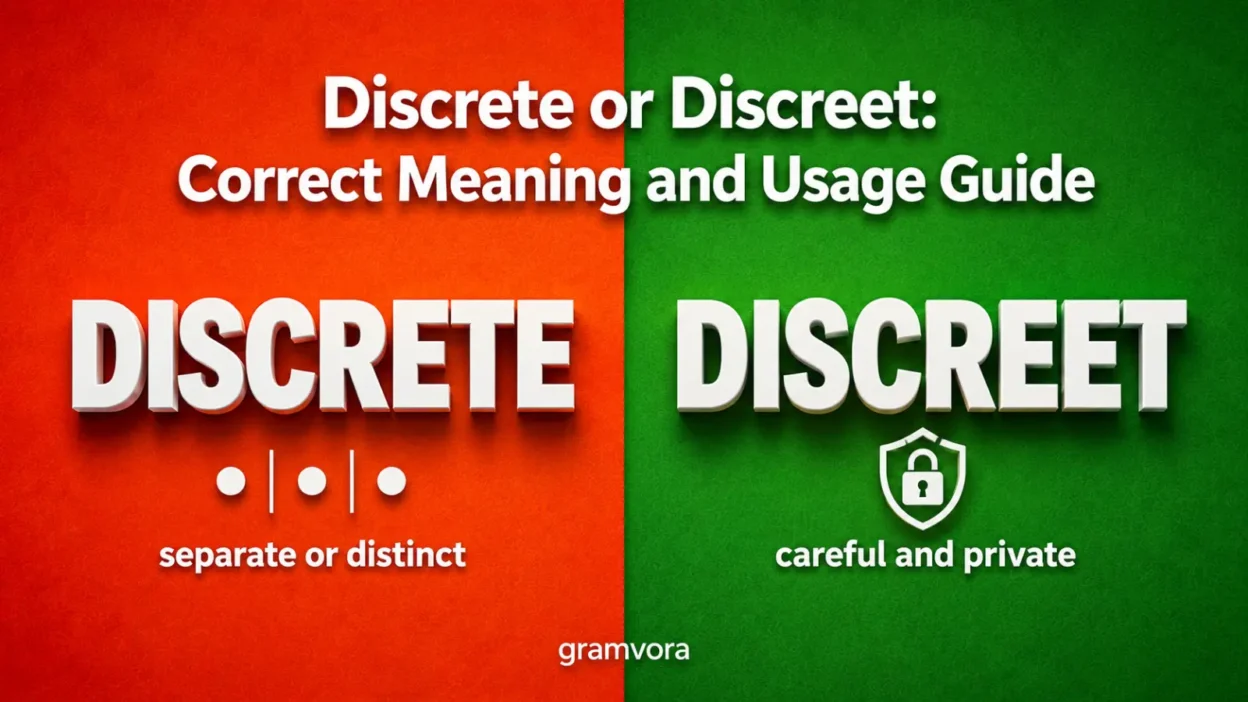
Use “discrete” when you mean separate, distinct, or individual. Use “discreet” when you mean careful, tactful, private, subtle, or not drawing attention.
The spelling difference matters because each word points to a different idea. A report may have discrete sections. A person may be discreet about private news. A design may have a discreet logo. A study may measure discrete groups.
Once you connect “discrete” with separation and “discreet” with careful privacy, the choice becomes much easier.
Quick Answer
Use “discrete” for things that are separate or distinct. Use “discreet” for behavior, speech, actions, or designs that are careful, private, tactful, or subtle.
Correct: The project has three discrete phases.
Correct: Please be discreet about the surprise party.
They are homophones, so they sound alike. In writing, though, they are not interchangeable.
Why People Confuse Them
People confuse these words because they look almost identical and sound the same in normal speech. The only spelling difference is the order of the letters near the end: “-ete” in “discrete” and “-eet” in “discreet.”
The meanings also feel close at first because both can involve separation in a loose way. For example, private information may be kept apart from public attention. That overlap can make writers choose the wrong spelling.
Still, modern usage keeps them separate. “Discrete” describes separate parts, units, categories, stages, or values. “Discreet” describes careful behavior, quiet handling, privacy, subtle appearance, or good judgment.
A helpful memory trick: in “discrete,” the two e’s are separated by the “t.” That word means separate.
Key Differences At A Glance
| Context | Best Choice | Why |
|---|---|---|
| Separate parts of a project | discrete | The parts are distinct units. |
| Private or sensitive behavior | discreet | The person is careful and tactful. |
| Math, data, or research values | discrete | The values are separate, countable, or distinct. |
| A quiet design choice | discreet | The design does not attract much attention. |
| A secret conversation | discreet | The speaker handles it carefully. |
| Stages in a process | discrete | The stages are separate steps. |
| A small logo on clothing | discreet | The logo is subtle and not flashy. |
| Groups in a study | discrete | The groups are separate categories. |
Meaning and Usage Difference
“Discrete” means separate or distinct. It describes things that can be viewed as individual units rather than one continuous whole.
Examples:
The training program has five discrete modules.
The survey divided responses into discrete age groups.
The issue was a discrete problem, not part of a larger failure.
“Discreet” means careful, tactful, private, unobtrusive, or unlikely to attract attention. It often describes people, actions, comments, designs, or places.
Examples:
Please be discreet when you discuss the client’s situation.
She gave him a discreet warning before the meeting.
The restaurant has a discreet entrance on the side street.
Both words are usually adjectives. Their pronunciation is the same in everyday US English, so the difference appears mainly in spelling and meaning.
Tone, Context, and Formality
“Discrete” often sounds more technical or precise. You may see it in writing about research, math, data, science, business planning, and structured processes. It can also work in everyday English when “separate” or “distinct” is the intended meaning.
Example: The app stores each task as a discrete item.
“Discreet” sounds more social, personal, professional, or design-related. It often appears when privacy, tact, or subtlety matters.
Example: The manager was discreet about the employee’s request.
“Discreet” can also describe objects or design choices that do not stand out.
Example: The jacket had a discreet logo near the cuff.
The difference is not about US versus UK English. In standard US English, both words are valid, but they serve different meanings.
Which One Should You Use?
Use “discrete” when the idea is separation.
Choose it for:
- discrete steps
- discrete categories
- discrete values
- discrete groups
- discrete phases
- discrete units
Use “discreet” when the idea is careful behavior or quiet visibility.
Choose it for:
- discreet conversation
- discreet inquiry
- discreet warning
- discreet service
- discreet entrance
- discreet design
A simple test works well: replace the word with “separate.” If the sentence still makes sense, “discrete” may be right.
The project has three separate phases.
The project has three discrete phases.
Now try replacing the word with “tactful” or “subtle.” If that fits, use “discreet.”
She was tactful about the issue.
She was discreet about the issue.
When One Choice Sounds Wrong
Some mistakes are easy to spot once you know the meanings.
Wrong: Please be discrete about the salary discussion.
Correct: Please be discreet about the salary discussion.
The sentence is about privacy and tact, not separate parts.
Wrong: The class was divided into three discreet groups.
Correct: The class was divided into three discrete groups.
The groups are separate, not careful or subtle.
Wrong: The hotel offered discrete service for celebrities.
Correct: The hotel offered discreet service for celebrities.
The service is private and low-attention, not separate.
Wrong: The report covers five discreet issues.
Correct: The report covers five discrete issues.
The issues are separate topics.
Common Mistakes (and Quick Fixes)
Mistake 1: Using “discrete” to mean private.
Wrong: He was discrete about the family matter.
Fix: He was discreet about the family matter.
Mistake 2: Using “discreet” for separate parts.
Wrong: The system has four discreet components.
Fix: The system has four discrete components.
Mistake 3: Assuming “discreet” always means secret.
“Discreet” can involve privacy, but it does not always mean hidden. It can also mean tactful, careful, modest, subtle, or not attention-grabbing.
Example: A discreet necklace may simply be small and understated.
Mistake 4: Forgetting the adverb forms.
Use “discretely” for separate treatment.
Use “discreetly” for careful or subtle action.
Example: The samples were analyzed discretely.
Example: She left the room discreetly.
Everyday Examples
Here are natural examples that show the difference clearly.
Discrete:
The budget is divided into discrete spending categories.
Each lesson focuses on a discrete skill.
The doctor described three discrete symptoms.
The company treats each location as a discrete business unit.
The event had discrete morning and afternoon sessions.
Discreet:
Please be discreet when you ask about the promotion.
He made a discreet phone call from the hallway.
The building has a discreet security camera near the entrance.
She gave a discreet nod to show she understood.
The brand uses discreet packaging for private orders.
Mini comparison:
- Discrete = separate, distinct, individual.
- Discreet = careful, tactful, private, subtle.
- Discrete fits parts, groups, values, and stages.
- Discreet fits people, behavior, comments, service, and design.
- Discrete answers “Are these separate?”
- Discreet answers “Is this handled quietly or tactfully?”
Dictionary-Style Word Details
Verb
Discrete: Not commonly used as a verb in standard US English. In normal writing, use it as an adjective.
Discreet: Not used as a verb in standard US English. Use it as an adjective.
Noun
Discrete: Not commonly used as a noun in everyday US English. The common everyday use is adjectival, as in “discrete parts.” The related noun form is “discreteness.”
Discreet: Not commonly used as a noun. The related noun forms are “discretion” and “discreetness,” but “discretion” is much more common in everyday writing.
Synonyms
Discrete: Closest plain alternatives include separate, distinct, individual, detached, and independent. Useful opposites include connected, joined, continuous, or blended, depending on context.
Discreet: Closest plain alternatives include tactful, careful, prudent, subtle, unobtrusive, and private. A clear opposite is “indiscreet.”
Do not swap these synonym sets. “Subtle” does not usually mean “separate,” and “separate” does not usually mean “tactful.”
Example Sentences
Discrete:
The presentation was divided into four discrete sections.
Each customer complaint was treated as a discrete case.
The study measured several discrete outcomes.
Discreet:
Please keep your comments discreet during the meeting.
The assistant handled the request in a discreet way.
The house has a discreet entrance behind the garden wall.
Word History
The two words share an older background, but modern English gives them different jobs. “Discrete” kept the idea of separation or distinction. “Discreet” developed the sense of careful judgment, privacy, tact, or subtle behavior.
The shared history explains why they look and sound alike. It does not make them interchangeable today.
Phrases Containing
Discrete:
discrete parts
discrete units
discrete steps
discrete categories
discrete variables
discrete data
discrete stages
discrete components
Discreet:
discreet inquiry
discreet conversation
discreet warning
discreet service
discreet packaging
discreet location
discreet design
discreet gesture
FAQs
Is it discrete or discreet?
Both words are correct, but they mean different things. Use discrete when something is separate or distinct. Use discreet when someone or something is careful, private, subtle, or tactful.
What is the main difference between discrete and discreet?
Discrete means separate or individual. Discreet means careful, private, or not drawing attention. For example, “discrete parts” means separate parts, while “discreet service” means quiet or private service.
Can discrete and discreet be used interchangeably?
No. They sound the same, but they are not interchangeable in writing. “Discrete” is about separation. “Discreet” is about privacy, tact, or subtle behavior.
Which word means private or secret?
Discreet is the right word when you mean private, careful, or tactful. For example: “Please be discreet about the surprise party.”
Which word means separate?
Discrete means separate or distinct. For example: “The report is divided into three discrete sections.”
Is “discreet” the same as “secret”?
Not always. “Discreet” can mean private, but it can also mean subtle, careful, tactful, or not obvious. A discreet logo, for example, is small or understated, not necessarily secret.
Is “discrete” used in math or data?
Yes. “Discrete” is common in math, data, research, and technical writing. It often describes separate values, groups, categories, or units.
How do I remember discrete vs discreet?
Use this memory trick: in discrete, the two e’s are separated by the letter “t.” That matches the meaning of discrete, which means separate.
What is an example of discrete in a sentence?
“The project was divided into five discrete stages.”
Here, “discrete” means the stages are separate and distinct.
What is an example of discreet in a sentence?
“She made a discreet phone call from the hallway.”
Here, “discreet” means she made the call quietly or privately.
Conclusion
The choice between “discrete” and “discreet” is simple once you focus on meaning.
Use “discrete” when something is separate, distinct, or divided into individual units. Use “discreet” when someone or something is careful, tactful, private, subtle, or not drawing attention.
Remember the spelling clue: in “discrete,” the “t” separates the two e’s. That matches the meaning: separate. For quiet handling, privacy, or tact, choose “discreet.”