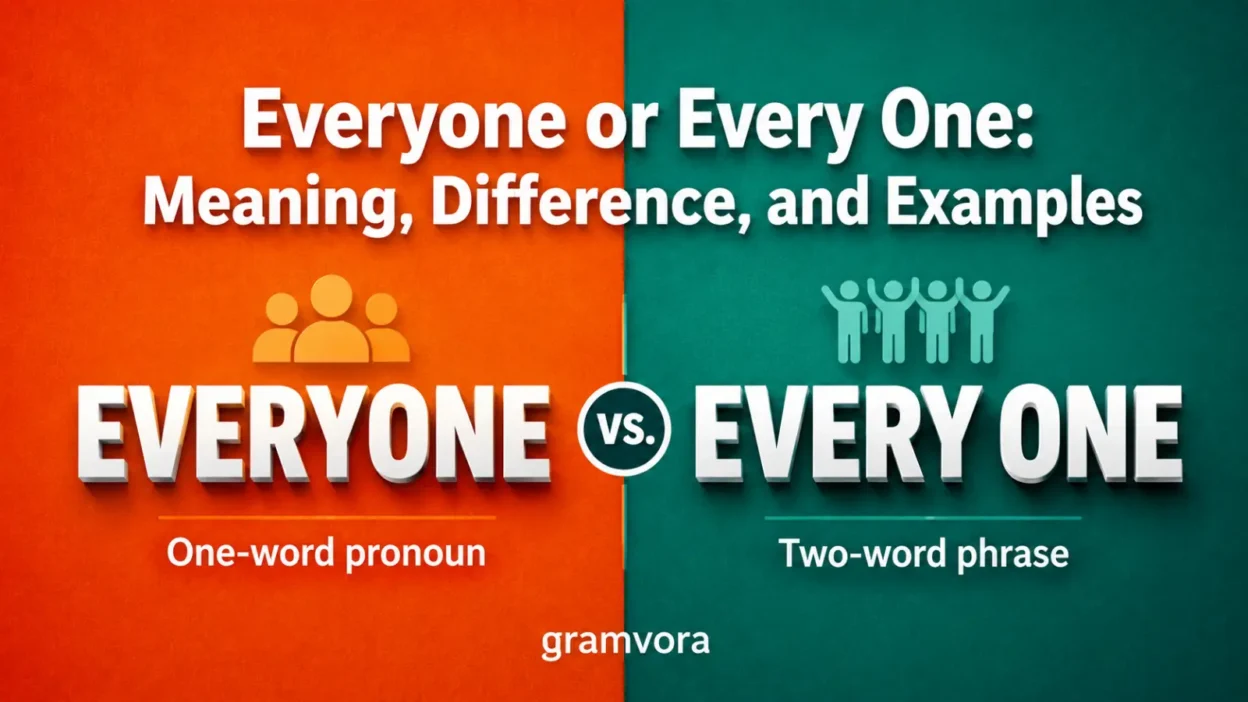
Everyone or every one can look almost identical, but they do not work the same way. The one-word form, everyone, means “every person.” The two-word form, every one, means “each individual one” in a group.
This difference matters because the wrong choice can make a sentence sound awkward or unclear. Write everyone when you mean all people as a group. Write every one when you want to point to each person or thing separately.
Quick Answer
Use everyone when you mean “every person” or “everybody.” Use every one when you mean “each one,” especially before of. For example, “Everyone arrived early” means all the people arrived. “Every one of the chairs was taken” means each chair was taken individually.
Why People Confuse Them
People confuse these terms because they contain the same words: every and one. In speech, they can also sound very close. The spelling difference is small, but the grammar difference is real.
The main confusion happens before of. Many writers type “everyone of them,” but that is not standard. The correct phrase is every one of them because you are pointing to each member of a group.
A useful test is to replace every with each. If each one makes sense, every one is probably right. If each one sounds odd, everyone may be the better choice.
Key Differences At A Glance
| Feature | everyone | every one |
|---|---|---|
| Form | One word | Two words |
| Main meaning | Every person | Each individual one |
| Refers to | People only | People or things |
| Common pattern | everyone is, everyone has | every one of them is |
| Best replacement | everybody | each one |
Both forms are treated as singular when they are the subject of a sentence. That is why we write “Everyone is ready” and “Every one of the tickets is gone.”
Meaning and Usage Difference
Everyone is an indefinite pronoun. It refers to all the people in a group without naming them one by one.
Correct: Everyone in the room heard the announcement.
Correct: Everyone has a different opinion.
Every one is a two-word phrase. It means each individual person or thing in a group. It often appears before of.
Correct: Every one of the students turned in the form.
Correct: I checked the files, and every one was complete.
In speech, everyone usually flows as one word. Every one may place more stress on one because the sentence is pointing to individual items. Still, the spelling is the key difference in writing.
Tone, Context, and Formality
Everyone is neutral and common in everyday US English. It works in casual writing, school assignments, workplace messages, and formal writing.
Every one is also standard, but it sounds more specific. It draws attention to each separate member of a group. Because of that, it often feels more careful or emphatic.
Use everyone when the group matters as a whole.
Correct: Everyone needs to sign in at the front desk.
Use every one when each member matters separately.
Correct: Every one of the applications was reviewed.
Neither form is slang. The difference is not about casual vs formal English. It is about whether you mean all people together or each individual one.
Which One Should You Use?
| Context | Best Choice | Why |
| You mean all people in a group | everyone | It means every person or everybody. |
| You mean each person separately | every one | It points to individual members. |
| You mean each thing separately | every one | Everyone refers to people, not things. |
| The next word is of | every one | The standard pattern is every one of. |
| You can replace it with everybody | everyone | Everybody matches the meaning of everyone. |
| You can replace it with each one | every one | Each one matches the meaning of every one. |
A simple rule works most of the time: everyone means everybody; every one means each one.
When One Choice Sounds Wrong
Everyone sounds wrong when the sentence is about things instead of people.
Incorrect: Everyone of the cookies was gone.
Correct: Every one of the cookies was gone.
Everyone also sounds wrong directly before of.
Incorrect: Everyone of my cousins came to dinner.
Correct: Every one of my cousins came to dinner.
Every one sounds wrong when you simply mean a whole group of people.
Awkward: Every one enjoyed the movie.
Better: Everyone enjoyed the movie.
The two-word form can be correct without of, but only when the context clearly points to individual members.
Correct: I tested the markers, and every one worked.
Common Mistakes (and Quick Fixes)
Mistake 1: Writing “everyone of them.”
Incorrect: Everyone of them agreed.
Correct: Every one of them agreed.
Mistake 2: Using everyone for objects.
Incorrect: Everyone of the boxes was labeled.
Correct: Every one of the boxes was labeled.
Mistake 3: Using a plural verb after everyone.
Incorrect: Everyone are ready.
Correct: Everyone is ready.
Mistake 4: Using a plural verb after every one of.
Incorrect: Every one of the players are ready.
Correct: Every one of the players is ready.
The noun after of may be plural, but the subject every one is still singular.
Everyday Examples
Everyone should bring a photo ID to the appointment.
Every one of the IDs was checked at the door.
Everyone at the office got the update.
Every one of the emails was sent before noon.
Everyone loves a clear answer.
Every one of the answers needs a source in the report.
Everyone in our group ordered coffee.
Every one of the cups had a name written on it.
Everyone gets one vote.
Every one of the ballots must be counted.
Everyone was surprised by the final score.
Every one of the fans stayed until the end.
Everyone can join the meeting online.
Every one of the links works on my laptop.
Dictionary-Style Word Details
Verb
everyone: Not used as a verb in standard US English. It functions as a pronoun.
every one: Not used as a verb. It is a two-word phrase built from every plus one.
Noun
everyone: Not commonly used as a noun. It is an indefinite pronoun that stands for all people in a group.
every one: Not a single noun. The word one can stand for a person or thing, so the full phrase can work like a noun phrase.
Synonyms
everyone: Closest plain alternatives include everybody, all, all people, and one and all. Clear opposites include nobody and no one.
every one: Closest plain alternatives include each one, each individual one, all of them, and each person or thing. Useful opposites include none of them and not one.
These alternatives depend on context. Everybody can replace everyone in many sentences, but it cannot replace every one before of.
Example Sentences
everyone: Everyone has a chance to ask a question.
everyone: The teacher reminded everyone about the deadline.
everyone: Not everyone likes working from home.
every one: Every one of the forms was signed.
every one: She saved every one of the old family photos.
every one: Every one of us knew the answer.
Word History
everyone: The one-word form has been used for a very long time in English as a pronoun meaning every person.
every one: This is not mainly a separate single-word entry. It is a phrase formed from every and one. Because it is a phrase, its history is best understood through the separate words rather than as one fixed headword.
The safe takeaway is simple: the modern difference is grammatical and practical, not based on a special hidden origin.
Phrases Containing
everyone:
- everyone else
- everyone knows
- everyone’s opinion
- everyone who’s anyone
every one:
- every one of us
- every one of them
- every one of the files
- each and every one
Use everyone’s when you need the possessive form of everyone.
Correct: Everyone’s schedule changed.
Use every one of when you mean each individual member.
Correct: Every one of the schedules changed.
FAQs
Is “everyone” one word or two?
“Everyone” is one word. It is a pronoun that means “every person” or “everybody” in a group.
What does “every one” mean?
“Every one” means each individual person or thing in a group. It is often used before “of,” as in “every one of them.”
Is “everyone of them” correct?
No. The correct form is “every one of them.” “Everyone” should not be used before “of.”
Does “everyone” take a singular or plural verb?
“Everyone” takes a singular verb. For example: “Everyone is ready,” not “Everyone are ready.”
Can “every one” refer to things, not just people?
Yes. “Every one” can refer to both people and things, depending on the context.
What is the easiest way to remember the difference?
If you can replace it with “everybody,” use “everyone.” If you mean “each one,” use “every one.”
Is “everyone” more common than “every one”?
Yes. “Everyone” is much more common because it refers to people in general conversation and writing.
Can “every one” stand alone without “of”?
Yes, but it is less common. Example: “I checked the files, and every one was correct.”
Are “everyone” and “every one” interchangeable?
No. They are not interchangeable because they serve different grammatical roles and meanings.
Which one should I use in formal writing?
Both are acceptable in formal writing, but you must choose based on meaning: “everyone” for people in general, and “every one” for each individual item or person.
Conclusion
Everyone and every one are both correct, but they fit different sentences. Everyone means every person or everybody. Every one means each individual one and can refer to people or things.
For the easiest choice, use this test: if you mean everybody, write everyone. If you mean each one, especially before of, write every one.