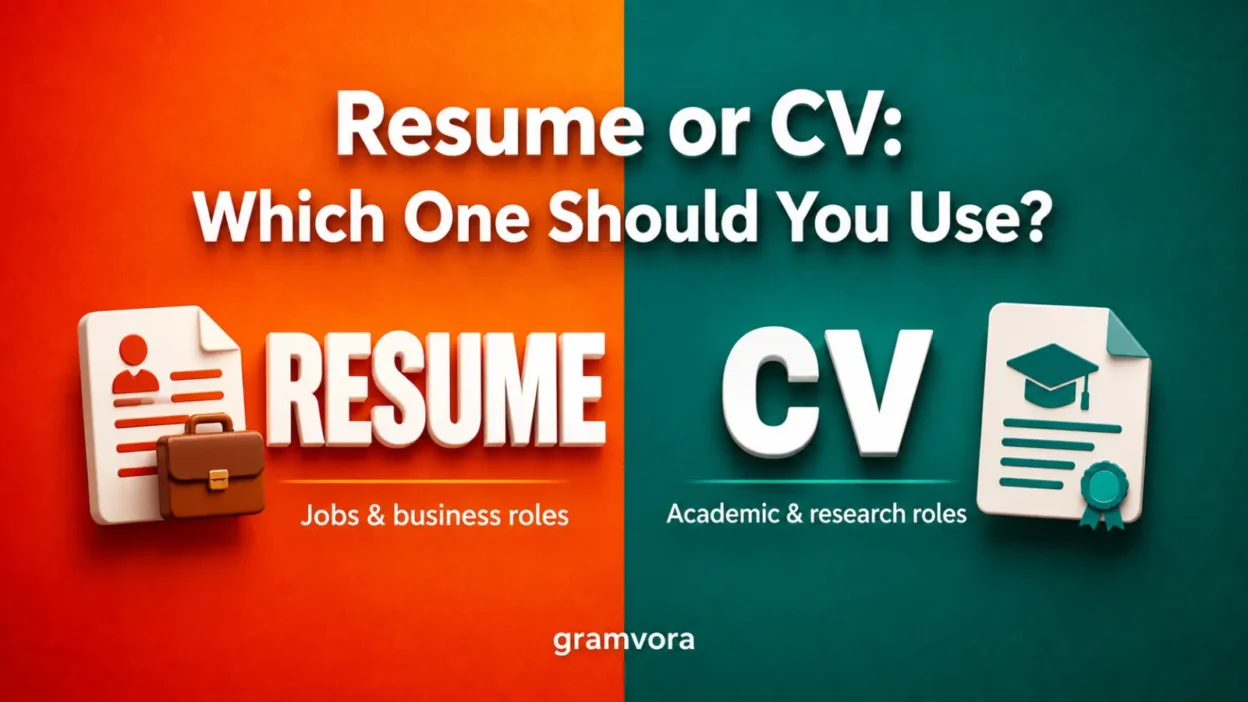
Choosing between resume or CV can feel confusing because both terms refer to application documents. However, in US English, they do not usually mean the same thing.
For most jobs in the United States, use resume. A resume is a short, targeted document that highlights your most relevant work experience, skills, and education.
Use CV when you apply for academic, research, medical-academic, grant, fellowship, or some international roles. A CV is usually longer and gives a fuller record of your academic and professional background.
The safest rule is simple: follow the job posting first. If it asks for a resume, send a resume. If it asks for a CV, send a CV. When the posting is unclear, the type of role usually tells you which word fits better.
Quick Answer
In US English, resume is correct for most job applications. Use it for business, retail, marketing, tech, customer service, trades, internships, and most office roles.
CV is correct when the application expects a full academic or research record. You may need a CV for professor jobs, research posts, medical fellowships, academic grants, graduate programs, and scholarly opportunities.
So, the choice is not about which word sounds smarter. It is about what kind of document the reader expects.
If you are applying to a regular US company, “resume” will usually sound natural. If you are applying to a university department, research lab, or academic committee, “CV” will usually sound more appropriate.
Why People Confuse Them
People confuse resume and CV because both documents summarize a person’s background. They can include education, work history, skills, awards, and contact details. Also, some employers use the words loosely.
Another reason is regional usage. In the United States, resume usually means a short job document, while CV often means a longer academic document. In some other English-speaking places, CV may refer to the regular job document Americans call a resume.
The spelling of resume can add another layer of confusion. You may see resume, résumé, or resumé. For a US job document, resume without accent marks is common and easy to type.
Key Differences At A Glance
| Context | Best Choice | Why |
|---|---|---|
| Applying to a US company | Resume | It is the standard short job document. |
| Applying for a professor role | CV | Academic hiring expects a full record. |
| Applying for a research fellowship | CV | Research work often needs publications and projects. |
| Applying for a retail or service job | Resume | The employer wants relevant experience quickly. |
| Applying outside the US | Depends on country | Some countries use CV for the standard job document. |
| Upload field says “resume” | Resume | Follow the application wording. |
| Upload field says “CV” for a US academic role | CV | The role likely expects academic detail. |
Meaning and Usage Difference
A resume is a short, focused document. It shows why you fit one specific job. Most resumes highlight recent work, key skills, education, certifications, and measurable achievements.
A CV means curriculum vitae. In US usage, it usually gives a fuller record of your academic and professional life. A CV may include education, teaching experience, research, publications, presentations, grants, awards, fellowships, licenses, and professional service.
Pronunciation can also help. The job-document noun resume is commonly said like REZ-oo-may or rez-oo-MAY. The verb resume, meaning “continue again,” sounds like ri-ZOOM. CV is pronounced by saying the letters: see-vee.
Compact comparison:
- Resume: short, targeted, job-focused.
- CV: longer, detailed, academic or research-focused in US English.
- Resume: common for most US employers.
- CV: common for scholarly, medical-academic, and research settings.
Tone, Context, and Formality
Both words are professional, but they signal different expectations.
Resume sounds normal in everyday US hiring. A recruiter, store manager, HR assistant, or startup founder will usually expect a resume for a standard job opening. It sounds practical, direct, and job-focused.
CV sounds more formal and academic in the United States. It tells the reader that the document may include scholarly work, publications, presentations, teaching history, and research activity.
However, do not assume CV always means “more impressive.” Sending a long CV for a basic job can make your application harder to scan. Likewise, sending a one-page resume for a faculty job may leave out important academic details.
The best word is the one that matches the reader’s expectation.
Which One Should You Use?
Use resume when you apply for most US jobs. This includes roles in sales, tech, design, hospitality, healthcare administration, finance, construction, customer support, and general office work.
Use CV when the role depends on academic credentials, research output, teaching history, publications, or grants. This includes many professor, lecturer, postdoctoral, research scientist, medical faculty, and fellowship applications.
For students, the choice depends on the opportunity. A student applying for a part-time job should usually use a resume. A graduate student applying for a research conference, fellowship, or academic position may need a CV.
If a US employer says “upload your resume/CV,” check the role. For a normal company job, a resume is usually the better choice. For an academic role, use a CV.
When One Choice Sounds Wrong
Resume can sound wrong when the application asks for a full academic record. For example, a university hiring committee may need your publications, teaching experience, grants, and presentations. A short resume may feel incomplete.
CV can sound wrong when a standard US employer expects a quick summary. A hiring manager for a sales job may not want ten pages of coursework, conference talks, and old projects.
Also, avoid using CV just because it sounds more formal. In US business hiring, clarity matters more than formality.
These examples show the difference:
“Please attach your resume for the customer support role.”
This sounds natural.
“Please attach your CV for the customer support role.”
This may sound unusual in US English unless the company uses international wording.
Common Mistakes (and Quick Fixes)
One common mistake is sending the same document everywhere. Instead, match the document to the role.
Wrong: “I sent my full CV for every US job.”
Better: “I sent a targeted resume for each US job.”
Another mistake is making a resume too long. A resume should focus on the strongest details for that job. It should not try to list your entire life.
A third mistake is calling a CV a resume in academic contexts. If your document includes publications, grants, teaching, research, and conference work, CV may be the clearer label.
Also, do not confuse the noun resume with the verb resume.
Wrong: “I will CV work tomorrow.”
Better: “I will resume work tomorrow.”
Everyday Examples
Here are natural US-English examples:
I updated my resume before applying for the marketing job.
Please upload your resume as a PDF.
Her resume highlights five years of customer service experience.
The recruiter reviewed my resume before the phone interview.
He created a one-page resume for the internship.
She submitted a CV for the assistant professor position.
His CV includes publications, conference talks, and research grants.
The fellowship application asks for a full CV.
My graduate adviser reviewed my CV before I applied for the research role.
The university requested a CV, teaching statement, and cover letter.
Dictionary-Style Word Details
Verb
resume: As a verb, resume means to start again after stopping. It is pronounced ri-ZOOM.
Example: We will resume the meeting after lunch.
This verb meaning is separate from the job-document noun.
cv: Not commonly used as a verb in standard US English. Do not write “I will CV my experience.” Use summarize, list, document, or prepare a CV instead.
Noun
resume: As a noun, resume means a short document that presents your qualifications for a job. In US English, this is the standard word for most job applications.
Example: I sent my resume to three companies.
cv: As a noun, CV is the abbreviation for curriculum vitae. In US English, it usually means a longer academic or research document.
Example: She attached her CV to the fellowship application.
Synonyms
resume: Closest plain alternatives include résumé, job summary, career summary, and application document. These are not always exact replacements.
cv: Closest plain alternatives include curriculum vitae, academic CV, academic record, and professional record. These depend on context.
Clear antonyms do not really fit either term. A cover letter, portfolio, or transcript may be part of an application, but those are different documents, not opposites.
Example Sentences
resume: Please email your resume by Friday.
resume: Her resume lists her strongest software skills first.
resume: I need to resume my job search next week.
cv: His CV includes three peer-reviewed articles.
cv: The grant committee asked for a two-page CV.
cv: Update your CV before applying for the research fellowship.
Word History
resume: The job-document noun comes through French and carries the idea of a summary. That fits its modern use because a resume summarizes your qualifications.
cv: CV stands for curriculum vitae, a Latin phrase often understood as “course of life.” That history fits the longer document because a CV can show a fuller record of academic and professional work.
Do not rely on word history alone to choose. Modern US context matters more.
Phrases Containing
resume:
- send a resume
- upload your resume
- update your resume
- resume summary
- resume file
- resume format
cv:
- academic CV
- full CV
- curriculum vitae
- CV for research
- CV for fellowship
- CV publications section
FAQs
Is a resume the same as a CV?
In US English, a resume and a CV are usually not the same. A resume is a short, focused document for most job applications. A CV is usually longer and gives a fuller record of academic, research, teaching, publication, and professional experience. However, in some countries, people use CV for the same type of document Americans call a resume.
Should I send a resume or CV for a job application?
For most US job applications, send a resume. This works best for company jobs, internships, retail roles, office jobs, tech jobs, customer service roles, and most private-sector positions. Send a CV when the application asks for one or when the role is academic, research-based, medical-academic, or fellowship-related.
What does CV stand for?
CV stands for curriculum vitae. In US English, it usually means a detailed document that lists academic background, research, publications, teaching experience, grants, awards, and professional service. It is common in universities, research institutions, and some medical fields.
Can I use a CV instead of a resume?
You can use a CV instead of a resume only when the employer or program expects one. For a normal US job, a long CV may feel too detailed. A targeted resume is usually better because it helps the hiring manager see your most relevant skills and experience quickly.
How long should a resume or CV be?
A resume is usually short and focused. Many US resumes are one or two pages, depending on experience. A CV can be longer because it may include publications, presentations, grants, research projects, and teaching history. The right length depends on the role and the application instructions.
Is “resume” or “résumé” correct?
Both resume and résumé can refer to the job document. In modern US writing, resume without accent marks is very common, especially in online applications and file names. Résumé is also correct, but it is less convenient to type.
What should I name my file: resume or CV?
Use the word that matches the document. For a regular US job, use a file name like FirstName-LastName-Resume.pdf. For an academic or research application, use FirstName-LastName-CV.pdf. A clear file name looks professional and helps the reader identify your document quickly.
Conclusion
For most US job applications, choose resume. It is short, focused, and expected by most employers.
Choose CV when the application needs a fuller academic or research record. A CV fits faculty roles, research positions, grants, fellowships, and some medical-academic opportunities.
The best final rule is this: follow the job posting. A regular US job usually needs a resume, while an academic or research role usually needs a CV.