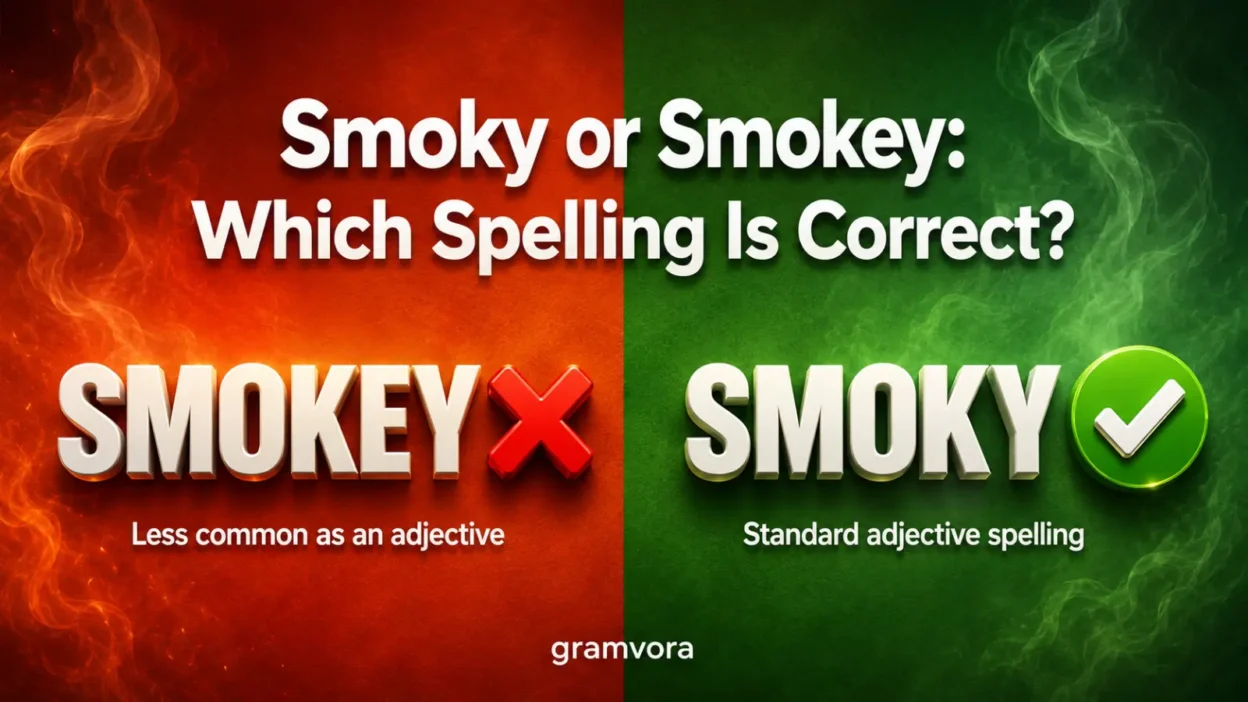
Smoky or smokey is a spelling question, not a meaning question. Both forms refer to the same basic idea when used for something related to smoke, but they are not equally preferred in modern US English.
For most writing, smoky is the better choice. Use it for a smoky room, smoky flavor, smoky skies, smoky eye makeup, or a smoky voice. Smokey is best known in names, titles, brands, and the official name Smokey Bear.
Quick Answer
Use smoky in standard US English when you mean filled with smoke, smelling like smoke, tasting like smoke, resembling smoke, or having a low, husky quality. Smokey exists as a less common variant, but it often looks informal, old-fashioned, or name-like. For polished writing, choose smoky unless you are writing a proper name, brand, title, or quoted spelling.
Why People Confuse Them
The confusion is easy to understand. English often keeps the final e before adding y, as in stone → stony losing the e but home → homey keeping it in common use. So smokey feels possible.
Another reason is cultural familiarity. Many Americans know Smokey Bear, Smokey Robinson, or titles that use Smokey. Those proper names make the spelling with e look normal.
Still, the ordinary adjective in modern US writing is smoky.
Key Differences At A Glance
| Context | Best Choice | Why |
|---|---|---|
| A room filled with smoke | smoky | Standard adjective spelling |
| Food with a smoke-like taste | smoky | Preferred in US writing |
| Hazy wildfire air | smoky | Standard public-use spelling |
| Eye makeup style | smoky | Common fashion spelling |
| A low, husky voice | smoky | Standard figurative use |
| Smokey Bear | Smokey | Official proper name |
| A brand or product name | Smokey, if official | Keep the chosen brand spelling |
| Formal school or work writing | smoky | Safest edited choice |
Are They the Same Word?
As adjectives, smoky and smokey point to the same meaning. They can describe smoke, haze, flavor, smell, color, or a husky voice.
The difference is spelling preference. Smoky is the main spelling. Smokey is a less common variant, and many readers will notice it because the more familiar standard form has no e.
Pronunciation does not create a useful difference here. Both are normally said like SMOH-kee.
A compact comparison helps:
| Feature | smoky | smokey |
|---|---|---|
| Main role | Standard adjective | Less common adjective variant |
| Best use | Regular descriptive writing | Names, brands, titles, quoted style |
| US preference | Strongly preferred | Accepted by some sources, but less safe |
| Meaning | Related to smoke | Same meaning when used as adjective |
| Reader reaction | Natural and standard | May look informal or name-like |
US vs UK Preference
For a US audience, smoky is the clear default. It looks clean, current, and standard in edited American English.
UK sources also commonly use smoky as the main spelling. Some dictionary treatment recognizes smokey as a variant, especially in broader or older usage, but that does not make it the better everyday choice.
So this is not like color vs colour, where the split is clearly American versus British. With smoky or smokey, the safer rule is simpler: use smoky for the adjective in both ordinary US writing and most edited writing.
Which Spelling Should You Use?
Use smoky for nearly every normal sentence.
Write:
The restaurant had a smoky smell from the grill.
The sky turned smoky after the wildfire.
The sauce had a deep smoky flavor.
She wore a soft smoky eye.
His voice sounded smoky and tired.
Use Smokey when it is part of an official name, public figure’s name, title, brand, product, or quoted wording.
Write:
Smokey Bear is a famous wildfire-prevention mascot.
The sign used the brand spelling “Smokey BBQ.”
The playlist included a Smokey Robinson song.
Do not change proper names to match the general spelling rule.
When One Spelling Looks Wrong
Smoky can look wrong only if the official spelling is Smokey. For example, Smoky Bear would be wrong because the mascot’s name is Smokey Bear.
Smokey can look wrong in normal descriptions. A phrase like smokey air may be understood, but many editors would change it to smoky air. The same applies to smokey flavor, smokey room, and smokey haze.
The safest test is simple: if it is describing smoke, use smoky. If it is a name or chosen label, preserve Smokey.
Common Mistakes (and Quick Fixes)
Mistake: The cabin smelled smokey after the fire.
Fix: The cabin smelled smoky after the fire.
Mistake: We ordered smokey ribs.
Fix: We ordered smoky ribs.
Mistake: A smokey haze covered the road.
Fix: A smoky haze covered the road.
Mistake: Smoky Bear reminds people to prevent wildfires.
Fix: Smokey Bear reminds people to prevent wildfires.
Mistake: The article changed a brand name from Smokey to smoky.
Fix: Keep the official spelling when it is part of a name.
Everyday Examples
The kitchen got smoky when the pan overheated.
The chili had a smoky kick from the roasted peppers.
A smoky sunset settled over the city.
She blended gray shadow into a smoky eye look.
The singer’s smoky voice fit the blues track.
We opened the windows because the room was too smoky.
The smoky smell stayed in his jacket.
Smokey Bear appeared on the wildfire safety poster.
The restaurant’s sign said “Smokey Joe’s,” so we kept the spelling.
For the headline, the editor changed smokey flavor to smoky flavor.
Dictionary-Style Word Details
Verb
• smoky: Not commonly used as a verb in standard US English. It is mainly an adjective.
• smokey: Not commonly used as a verb in standard US English. As a lowercase adjective, it is a less common spelling variant.
Noun
• smoky: Not usually a common noun in everyday US English. It may appear in names, titles, or special uses, but the regular word is an adjective.
• smokey: More likely to appear as a name, nickname, title word, or slang noun in certain contexts. Do not use it as the normal noun form for smoke.
Synonyms
• smoky: Closest plain alternatives include hazy, smoke-filled, sooty, dusky, smoke-flavored, husky, and throaty, depending on the sentence.
• smokey: Same word idea when used as the adjective variant. The alternatives do not change because of the spelling.
Useful opposites can include clear, clean, fresh, or bright, depending on context. For flavor, the opposite may be mild or clean-tasting, but those are not exact opposites in every sentence.
Example Sentences
• smoky: The smoky air made the drive harder.
• smoky: The dip had a smoky taste from the grilled corn.
• smoky: Her smoky voice made the song feel warmer.
• smokey: The menu used the brand spelling “Smokey Grill.”
• smokey: Some dictionaries recognize smokey as a less common variant, but smoky is safer for regular writing.
• smokey: Keep Smokey when you mean Smokey Bear or another official name.
Word History
• smoky: Formed from smoke plus the adjective ending -y. That ending often means “having the quality of” something.
• smokey: A variant spelling with the same adjective meaning in some dictionary treatment. Today, it is less common as a general adjective and more familiar in proper names, brands, and titles.
The important point is practical, not historical: modern edited writing usually prefers smoky.
Phrases Containing
• smoky: smoky flavor, smoky haze, smoky air, smoky room, smoky skies, smoky eye, smoky voice, smoky smell, smoky quartz, smoky topaz.
• smokey: Smokey Bear, Smokey Robinson, Smokey and the Bandit, Smokey Joe, and brand or product names that choose this spelling.
FAQs
Is smoky or smokey correct?
Smoky is the standard spelling in modern US English. Use it when describing something filled with smoke, smelling like smoke, tasting like smoke, or looking hazy. Smokey exists as a less common variant, but it is usually safer to use smoky unless you are writing a name, title, or brand.
Is smokey a misspelling?
Smokey is not always a misspelling, but it is not the best default spelling for regular writing. Some dictionaries recognize it as a variant of smoky. However, many editors and readers expect smoky in phrases like smoky flavor, smoky air, and smoky room.
Why is Smokey Bear spelled with an E?
Smokey Bear is a proper name, so the official spelling uses Smokey with an e. Proper names do not always follow the most common spelling pattern. That is why you should write Smokey Bear, but still write smoky air or smoky flavor in normal descriptions.
Do smoky and smokey mean the same thing?
Yes. When used as adjectives, smoky and smokey mean the same thing. Both can describe something related to smoke. The difference is preference and context, not meaning. Smoky is the standard spelling, while smokey is less common and often appears in names or style-based spellings.
Should I write smoky flavor or smokey flavor?
Write smoky flavor. This is the standard and most natural spelling for food, drinks, sauces, spices, and barbecue descriptions. Smokey flavor may be understood, but it looks less polished unless it is part of a brand or product name.
Is smoky used in British English too?
Yes. Smoky is also the common standard spelling in British English. This pair is not mainly a US-versus-UK spelling split. For most everyday and edited writing, smoky is the safer spelling in both American and British English.
Is smokey ever better than smoky?
Smokey is better when it is the official spelling of a name, brand, title, or quoted wording. For example, write Smokey Bear and Smokey Robinson because those are proper names. For ordinary descriptions, use smoky.
How do you remember smoky vs smokey?
Use this simple rule: if you are describing smoke, use smoky. If you are writing a name or brand that officially uses Smokey, keep the e. So it is smoky skies, smoky barbecue, and Smokey Bear.
Conclusion
For standard US writing, choose smoky. It is the safest spelling for smoke-filled air, smoke-like flavor, hazy skies, eye makeup, color, smell, and voice.
Use Smokey when it is part of an official name, title, brand, or quoted spelling. Lowercase smokey may be recognized as a variant, but it is not the best default for polished writing.