
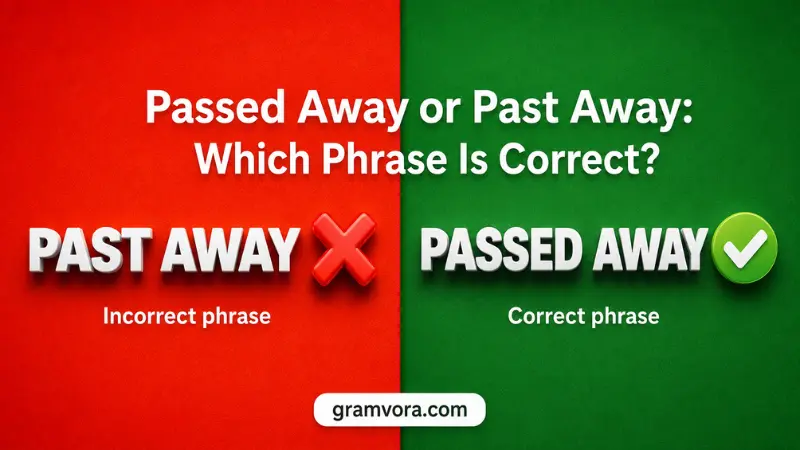
Passed away is the correct expression when you mean that someone died. Past away is not standard English in this context.
The expression uses passed, the past-tense form of the verb pass. The word past cannot replace it because past does not function as the verb in this sentence.
Quick Answer
Use passed away when respectfully referring to someone’s death.
Correct: “Her grandfather passed away last year.”
Incorrect: “Her grandfather past away last year.”
The mistake is common because passed and past sound the same in American English. However, their grammatical roles are different. The expression needs the verb passed, not the word past.
Why People Confuse Them
The confusion mainly comes from pronunciation. In ordinary American speech, passed and past are both pronounced like “past.”
Because the difference cannot be heard, writers must choose the spelling by looking at the word’s job in the sentence.
In passed away, the word passed describes what happened. It is therefore a verb. By contrast, past usually refers to an earlier time, a previous condition, or a position beyond something.
Key Differences At A Glance
| Context | Best Choice | Why |
| Referring gently to someone’s death | passed away | It is the established verb phrase. |
| Writing a condolence message | passed away | It sounds indirect and compassionate. |
| Referring to an earlier time | past | It can describe time, but not form past away. |
| Writing a direct factual statement | died | It is clearer and less indirect. |
| Using the perfect tense | has or had passed away | Passed acts as the past participle. |
| Writing past away to mean died | Neither | The expression is not standard English. |
Meaning and Usage Difference
The difference is grammatical as well as practical:
- Passed away: A standard past-tense verb phrase meaning that someone died.
- Past away: A nonstandard spelling that does not correctly express this meaning.
The base expression is pass away. When the action happened in the past, pass becomes passed.
“Several years ago, their neighbor passed away.”
The word past has other valid uses. It may refer to an earlier period, as in “That happened in the past,” or a position beyond something, as in “We drove past the hospital.” However, those uses do not make past away correct.
Tone, Context, and Formality
Passed away is a euphemism, which means it expresses an uncomfortable fact in a gentler, less direct way. It is common in condolence messages, family announcements, memorial notices, conversations about grief, and some obituaries.
“She passed away peacefully with her family beside her” sounds softer than “She died with her family beside her.”
Still, died is not automatically rude. It is direct, clear, and grammatically correct. Medical records, legal documents, historical accounts, and factual reports may favor direct wording when precision is more important than emotional softness.
The best choice depends on the situation. Use passed away when a compassionate tone feels appropriate. Use direct wording when clarity is the main concern.
Which One Should You Use?
Use passed away whenever the choice is limited to these two expressions.
For a past event, write:
“His uncle passed away in May.”
With has, write:
“His uncle has passed away.”
With had, write:
“His uncle had passed away before the family moved.”
For an event that has not happened, use the base form:
“The family is preparing for the possibility that he may pass away.”
Do not use past away in any of these structures.
When One Choice Sounds Wrong
Past away sounds possible because it is pronounced exactly like passed away. On the page, however, its grammatical weakness becomes clear.
Consider this sentence:
“Her aunt past away on Monday.”
The sentence needs a verb describing what the aunt did. Past cannot perform that job. Replacing it with passed supplies the correct past-tense verb:
“Her aunt passed away on Monday.”
The same principle applies even when other words appear around the expression. Write recently passed away, has passed away, or passed away peacefully. Never change passed to past.
Common Mistakes (and Quick Fixes)
A frequent mistake is writing “My grandfather past away.” Change past to passed because the sentence needs the past tense of pass.
Another error is “She has pass away.” After has, use the past participle: “She has passed away.”
Some writers use “She was passed away.” That structure is normally incorrect because pass away is intransitive; it does not take a passive construction. Write “She passed away” instead.
Writers may also assume that passed away must always replace died. It does not. Both can be correct, but their tones differ. Choose the wording that suits the audience and purpose.
Everyday Examples
“My former teacher passed away over the weekend.”
“We were sorry to hear that your grandmother passed away.”
“The family announced that he had passed away peacefully at home.”
“Her dog passed away after many happy years with the family.”
“Several months have passed since their neighbor passed away.”
“The notice said that the longtime community volunteer passed away on Friday.”
In every example, replacing passed with past would create an error.
Dictionary-Style Word Details
Verb
Passed away: The simple past or past participle form of the intransitive phrasal verb pass away. It commonly means to die.
Simple past: “She passed away last winter.”
Past participle: “She has passed away.”
Past away: Not commonly used as a verb in standard US English. The word past cannot replace the verb passed in this expression.
Noun
Passed away: Not a noun. The complete expression functions as a verb phrase.
Past away: Not a recognized noun phrase with the intended meaning. Although past can work as a noun by itself, as in “the distant past,” that role does not create the expression past away.
Synonyms
Passed away: The direct equivalent is died. Closest gentler alternatives include passed on and, in suitable sentence structures, is deceased.
There is no exact phrase-level antonym that fits every sentence. Contextual opposites include remained alive or survived.
Past away: No synonyms apply because it is not the standard expression for this meaning.
Example Sentences
Passed away: “Our neighbor passed away peacefully in her sleep.”
Passed away: “I was saddened to learn that your father had passed away.”
Past away: “Our neighbor past away peacefully” is incorrect. Change it to “Our neighbor passed away peacefully.”
Word History
Passed away: The expression developed as an indirect way to describe death. It uses the idea of passing from life or leaving the present state, which helps explain its gentler tone.
Past away: It has no separate history as a standard death-related expression. The form usually appears because writers confuse two identically pronounced words.
Phrases Containing
Passed away: Common combinations include passed away peacefully, recently passed away, has passed away, had passed away, and passed away at home.
Past away: No standard death-related phrases contain this form.
FAQs
Is it “passed away” or “past away”?
Passed away is correct when you mean that someone died. Past away is incorrect in standard English because the phrase requires the past-tense verb passed.
Why is “past away” incorrect?
Past usually refers to an earlier time or a position beyond something. It is not the past-tense form of pass. Since pass away is a verb phrase, its past-tense form is passed away.
What does “passed away” mean?
Passed away is a gentle and indirect way to say that a person or animal died. It is commonly used in condolence messages, family announcements, memorial notices, and sensitive conversations.
Is “passed away” more polite than “died”?
Passed away often sounds softer and more compassionate than died. However, died is not grammatically wrong or necessarily rude. It may be more suitable in medical, legal, historical, or factual writing.
Is “has passed away” grammatically correct?
Yes. Has passed away is correct because passed functions as the past participle after has.
Correct: “Her grandfather has passed away.”
Incorrect: “Her grandfather has pass away.”
Can “passed away” be used for animals?
Yes. People often use passed away when speaking sensitively about the death of a pet or other beloved animal.
Example: “Our family dog passed away peacefully last weekend.”
What is the present-tense form of “passed away”?
The base form is pass away.
Present or future context: “The doctor said he may pass away soon.”
Past context: “He passed away peacefully.”
How can I remember the correct phrase?
Remember that the expression describes an action, so it needs a verb. Pass is the verb, and its past-tense form is passed. Therefore, the correct phrase is always passed away, not past away.
Conclusion
Use passed away, not past away, when referring to someone’s death.
The expression requires passed because it comes from the verb pass away. The word past can describe earlier time or a position beyond something, but it cannot act as the required verb.
Remember the basic pattern: pass away in the present becomes passed away in the past. That rule will keep the expression accurate in condolences, announcements, conversations, and everyday writing.


