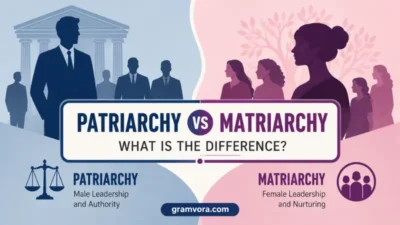

Matriarchy and patriarchy are both standard English words, but they describe different systems of authority. In the simplest comparison, a matriarchy places primary authority with women or a female head, while a patriarchy places primary authority with men or a male head.
The difference can apply to a family, community, institution, or wider society. However, these terms require more care than simply asking whether women or men are present in leadership positions.
A society where inheritance follows the mother’s family line, for example, is not automatically a matriarchy. Likewise, one woman holding an important office does not by itself make a society matriarchal.
Quick Answer
Both matriarchy and patriarchy are correct. The right choice depends on who holds the primary authority in the system you are describing.
Use matriarchy when women, mothers, or female leaders hold the central or dominant authority.
Use patriarchy when men, fathers, or male leaders hold the central or dominant authority.
The words are commonly treated as contrasting concepts, but they should not always be understood as perfect mirror images.
Why People Confuse Them
The words look similar because they share the ending -archy, which is associated with rule or government.
Their first parts provide the main clue. Matri- relates to mothers or women, while patri- relates to fathers or men.
Confusion also occurs because discussions of these systems may involve inheritance, family descent, household leadership, politics, property, and social power at the same time. Those features can overlap, but they do not always match.
A culture can give women an important role in inheritance without giving women primary political authority. That distinction matters when choosing matriarchy.
Key Differences At A Glance
- Matriarchy: primary authority is associated with women or female leadership.
- Patriarchy: primary authority is associated with men or male leadership.
- Both: standard nouns describing forms or patterns of social organization.
- Neither word: should be chosen only because a particular family has a strong mother or father.
- Important distinction: lineage or inheritance alone does not always prove who holds broader social power.
Meaning and Usage Difference
Matriarchy describes a system, society, family, or group in which women or a female head hold primary authority. Some dictionary senses also connect the word with descent and inheritance through women.
Patriarchy describes social organization in which fathers or men hold primary authority. In broader modern usage, it can refer to a system in which men hold a disproportionately large share of social, political, economic, or institutional power.
Both words are nouns. Their adjective forms are matriarchal and patriarchal, but those forms are not interchangeable with the nouns.
For example:
“Historians debated whether the society was a matriarchy.”
“The author examines patriarchy in several institutions.”
Tone, Context, and Formality
Both terms are standard and suitable for academic, educational, historical, cultural, and serious everyday discussion.
Matriarchy is often used descriptively or when discussing a proposed, historical, fictional, or debated form of social organization.
Patriarchy also works descriptively, but it frequently appears in discussions of gender inequality, institutional power, family roles, and social criticism. Because of that context, it may carry a more critical tone in some conversations.
The grammatical form itself is not informal or insulting. Tone depends heavily on what the writer is claiming about a particular family, culture, institution, or society.
Which One Should You Use?
Use the word that accurately identifies the authority structure being discussed.
| Context | Best Choice | Why |
|---|---|---|
| Women hold the primary governing authority | matriarchy | The system centers authority in women |
| Men hold the primary governing authority | patriarchy | The system centers authority in men |
| A fictional country is governed mainly by women | matriarchy | Female leadership defines the imagined system |
| A social structure gives men dominant institutional power | patriarchy | Male authority is the relevant feature |
| You know only that descent follows women | Neither automatically | Descent alone may not establish who holds overall authority |
Do not choose matriarchy simply because women are respected, own some property, or have influential family roles. Similarly, do not label every male-led organization a complete patriarchy without considering what level of social organization you mean.
When One Choice Sounds Wrong
Matriarchy sounds wrong when the sentence clearly describes a system centered on male authority.
Incorrect: “The society was a matriarchy in which fathers held nearly all formal authority.”
Better: “The society was a patriarchy in which fathers held nearly all formal authority.”
The reverse problem also occurs.
Incorrect: “The fictional kingdom created a patriarchy by placing governing authority mainly in the hands of women.”
Better: “The fictional kingdom created a matriarchy by placing governing authority mainly in the hands of women.”
Another mistake is using matriarchy when the only known fact concerns maternal descent. A family line passing through women does not necessarily tell you who controls political, economic, or household decisions.
Common Mistakes (and Quick Fixes)
Mistake: Treating the terms as names for biological differences.
Fix: They describe social organization and authority, not biological characteristics.
Mistake: Assuming a female leader creates a matriarchy.
Fix: Look at the wider distribution of authority rather than one leadership position.
Mistake: Assuming a male head of one household proves an entire society is a patriarchy.
Fix: State the level clearly—family, institution, community, or society.
Mistake: Equating female-line inheritance with matriarchy in every case.
Fix: Separate inheritance patterns from broader control and decision-making.
Mistake: Using the adjective where a noun is required.
Fix: Use “a patriarchal system,” but “a patriarchy.” Use “a matriarchal society,” but “a matriarchy.”
Everyday Examples
“The novel imagines a matriarchy where women hold most government positions.”
“The class discussed how patriarchy can shape expectations about family roles.”
“The documentary asks whether the community should accurately be called a matriarchy.”
“Researchers disagreed over how broadly the word patriarchy should be applied.”
“Female inheritance alone did not prove that the community was a matriarchy.”
“The professor used patriarchy to describe a system of predominantly male authority.”
“The story reverses traditional power roles by imagining a matriarchy.”
“The discussion compared matriarchy and patriarchy without assuming that every society fits perfectly into either category.”
Dictionary-Style Word Details
Verb
- matriarchy: Not commonly used as a verb in standard US English. It is a noun.
- patriarchy: Not commonly used as a verb in standard US English. It is a noun.
Use the adjective forms matriarchal and patriarchal when you need to modify another noun.
Noun
- matriarchy: A system, society, family, or group in which primary authority is held by women or a female head. The plural is matriarchies.
- patriarchy: A system, society, family, or group in which primary authority is held by men or a male head. In broader usage, it can describe disproportionate male control of social power. The plural is patriarchies.
Both nouns can refer either to an organizing system or, depending on context, to a society organized under that system.
Synonyms
Neither word has a perfect one-word synonym that works in every context.
- matriarchy — closest plain alternatives: female-led system, female-centered authority structure, rule by women.
- patriarchy — closest plain alternatives: male-led system, male-dominated authority structure, rule by men.
The two words can function as broad contrasts, but treating them as exact opposites in every academic context can hide important differences in how the concepts are defined.
Example Sentences
- matriarchy: “Her fantasy novel takes place in a matriarchy governed by senior women.”
- matriarchy: “The researchers questioned whether the community truly qualified as a matriarchy.”
- patriarchy: “The course examines how patriarchy influenced family and institutional authority.”
- patriarchy: “The historian used patriarchy to describe the concentration of formal power among men.”
Word History
- matriarchy: The English word was formed from matriarch with the noun-forming ending -y, following the existing pattern of patriarchy. Its components ultimately connect the idea of motherhood or women with rule.
- patriarchy: The word comes through older Greek and Latin forms associated with a ruling father or male family head. Its meaning later broadened beyond a single household to describe wider systems of male authority.
The modern meanings depend on context, so word origins should not be treated as complete definitions of present-day usage.
Phrases Containing
Common constructions with matriarchy include:
- “a matriarchy”
- “under a matriarchy”
- “living in a matriarchy”
- “a form of matriarchy”
Common constructions with patriarchy include:
- “the patriarchy”
- “under patriarchy”
- “a form of patriarchy”
- “patriarchy in society”
- “patriarchy in the workplace”
FAQs
What is the main difference between matriarchy and patriarchy?
A matriarchy is a system in which women or female leaders hold primary authority. A patriarchy is a system in which men or male leaders hold primary authority. The main difference is who has the greater share of social, family, or institutional power.
Is matriarchy the opposite of patriarchy?
Matriarchy and patriarchy are commonly treated as contrasting systems because one centers female authority and the other centers male authority. However, they are not always perfect mirror images because real societies may divide power, inheritance, and family roles in more complex ways.
Is a matrilineal society the same as a matriarchy?
No. A matrilineal society traces descent or inheritance through the female line. A matriarchy refers to a system in which women hold primary authority. A society can follow female-line descent without being governed mainly by women.
Can a woman-led family be called a matriarchy?
Sometimes, but context matters. A family may informally be described as a matriarchy if a woman clearly holds the central authority. However, one influential woman does not automatically make a wider community or society matriarchal.
Are matriarchy and patriarchy nouns?
Yes. Both matriarchy and patriarchy are nouns. Their adjective forms are matriarchal and patriarchal. For example, you can say “a patriarchy” or “a patriarchal society.”
What is an example of patriarchy?
A system in which men hold most formal authority in government, property ownership, family decisions, or major institutions may be described as a patriarchy. The word should be used when male authority is a meaningful feature of the wider system.
What is an example of matriarchy?
A society or fictional community in which women hold most major leadership and decision-making roles may be described as a matriarchy. The term refers to the broader authority structure rather than simply the presence of powerful women.
Which word should I use: matriarchy or patriarchy?
Use matriarchy when primary authority is centered on women. Use patriarchy when primary authority is centered on men. If the evidence only concerns inheritance, family descent, or one individual leader, a more specific description may be more accurate.
Conclusion
The difference between matriarchy vs patriarchy comes down mainly to where primary authority is concentrated.
Matriarchy refers to a system centered on female authority. Patriarchy refers to a system centered on male authority and, in broader modern usage, can describe structures in which men hold a disproportionate share of power.
Both words are correct nouns. Choose between them according to the actual authority structure being described—not simply the gender of one leader or the family line through which inheritance passes.
When those details are unclear, a more specific description is often better than forcing a society, family, or institution into either label.