
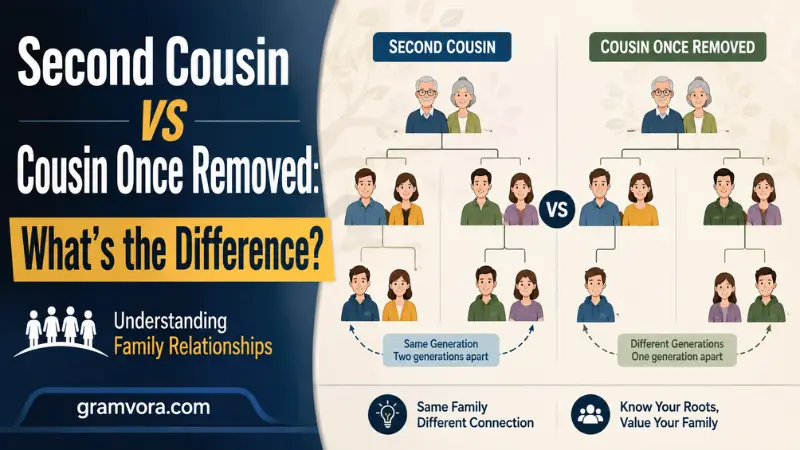
The difference between a second cousin and a cousin once removed comes down to two separate parts of a family relationship: cousin degree and generation.
A second cousin has a specific position in your family tree. You and your second cousin are in the same generation and share great-grandparents.
A cousin once removed is different. The words once removed tell you that the two relatives are one generation apart. However, the phrase cousin once removed does not tell you the cousin degree by itself.
That is why these expressions should not automatically be treated as two names for the same relationship.
Quick Answer
Use second cousin when two people are in the same generation and their closest shared ancestors are their great-grandparents.
Use cousin once removed when there is a one-generation gap in a cousin relationship. For full precision, you normally also need the degree, such as first cousin once removed or second cousin once removed.
So, second cousin tells you the cousin degree, while once removed tells you about a generation difference.
Why People Confuse Them
The confusion usually begins with a first cousin’s child.
It may seem logical to call that person your second cousin because they come after your first cousin. That is not how standard cousin relationships are calculated.
Your first cousin’s child is one generation below you. The underlying cousin degree remains first cousin, but the generation gap makes the relationship once removed.
Meanwhile, your child and your first cousin’s child are in the same generation. Those two people are second cousins.
The number and the removal therefore measure different things.
Key Differences At A Glance
| Context | Best Choice | Why |
|---|---|---|
| You share great-grandparents and are in the same generation | second cousin | The relationship has second-cousin degree and no generation gap |
| You and a cousin are one generation apart | cousin once removed | “Once removed” identifies a one-generation difference |
| You need an exact family-tree label for a removed cousin | Specify the degree plus once removed | “Cousin once removed” alone does not identify the cousin degree |
| Your first cousin has a child | cousin once removed | The child is one generation below you, not your second cousin |
| Your parent’s first cousin is being described | cousin once removed | That relative is one generation above you |
Meaning and Usage Difference
A second cousin is a person whose relationship to you runs through shared great-grandparents. Typically, your grandparent and your second cousin’s grandparent are siblings. Your parents are first cousins, and you and the other person are second cousins.
A cousin once removed describes a cousin relationship with a one-generation difference. The phrase is less specific because it does not state whether the cousin degree is first, second, third, or another degree.
The most useful distinction is:
- second cousin: cousin degree is specified; no removal is stated, so the relatives are in the same generation.
- cousin once removed: generation difference is specified; cousin degree still needs context for complete precision.
Both expressions function as noun phrases referring to family relationships.
Tone, Context, and Formality
Both terms are standard and neutral. They are especially useful when discussing genealogy, family trees, ancestry records, or large extended families.
In casual conversation, many Americans simply say cousin when the exact relationship does not matter.
Second cousin is easy to use as a complete relationship label. Cousin once removed can also appear in conversation, but it is less exact unless the listener already knows which cousin degree is meant.
For formal family-history work, giving both the cousin degree and removal is clearer.
Which One Should You Use?
Start by asking whether you and the other person are in the same generation.
If you are in the same generation and share great-grandparents, use second cousin.
If one person is one generation above or below the other, a once removed relationship may apply. You then need to determine the cousin degree.
For example, your parent’s first cousin is not your second cousin. That person is one generation above you in the first-cousin line.
Likewise, your first cousin’s child is not your second cousin. The child is one generation below you in that same first-cousin line.
When One Choice Sounds Wrong
Calling your first cousin’s child your second cousin is inaccurate in precise family-tree terminology. The child is not in your generation.
Calling two same-generation relatives who share great-grandparents cousins once removed is also inaccurate. There is no generation gap between them, so they are second cousins.
Another problem appears when cousin once removed is treated as one fixed relationship. It is not. The phrase tells you how many generations separate the relatives but does not identify the full cousin degree.
Common Mistakes (and Quick Fixes)
A common mistake is thinking that second cousin means “the child of my cousin.” Fix this by checking generation first. Your first cousin’s child is one generation removed from you.
Another mistake is thinking removed means distant, estranged, divorced, or no longer part of the family. In cousin terminology, removal refers to a difference in generations.
People also sometimes assume that every cousin one generation away is the same kind of cousin. Instead, cousin degree and removal must be considered separately.
Finally, do not assume age determines removal. Two people can be many years apart in age while still belonging to the same genealogical generation.
Everyday Examples
Suppose Maya and Jordan have great-grandparents named Robert and Helen. Maya descends from Robert and Helen through one child, while Jordan descends through another. Maya and Jordan occupy the same generation. They are second cousins.
Now imagine Maya’s first cousin, Alex, has a daughter named Grace. Maya and Grace are one generation apart. Grace is in the first-cousin line relative to Maya, but the relationship is once removed.
At a family reunion, saying, “Jordan is my second cousin” gives a complete standard relationship.
Saying, “Grace is my cousin once removed” communicates the generation gap, but “first cousin once removed” would be more precise.
In a family-tree record, that extra precision is useful because a person can have first, second, third, and more distant cousins who are once removed.
Dictionary-Style Word Details
Verb
second cousin: Not used as a verb in standard US English. It is a noun phrase naming a family relationship.
cousin once removed: Not used as a verb in this genealogical sense. It is also a noun phrase.
Noun
second cousin: A countable family-relationship noun phrase. It refers to a cousin in the same generation whose shared ancestral relationship corresponds to second-cousin degree.
Example: “Natalie is my second cousin.”
cousin once removed: A noun phrase describing a cousin relationship involving a one-generation difference. Used alone, it does not state the cousin degree.
Example: “He described the relative as a cousin once removed.”
Synonyms
second cousin: There is no equally precise everyday one-word synonym. A closest plain alternative is “a relative who shares great-grandparents with me in the same generation.”
cousin once removed: There is no exact shorter synonym. A closest plain alternative is “a cousin one generation above or below.”
Neither expression has a useful direct antonym in ordinary family terminology.
Example Sentences
second cousin: “My second cousin and I discovered that our great-grandmothers were sisters.”
second cousin: “We met several second cousins at the family reunion.”
cousin once removed: “I knew she was a cousin once removed, but I had to check the family tree to find the exact degree.”
cousin once removed: “The records showed that the two relatives were one generation apart.”
Word History
second cousin: The expression belongs to the established English system of numbering cousin relationships. The word second identifies the cousin degree.
cousin once removed: The expression uses removed in its genealogical sense of generational separation. Once means the relatives are separated by one generation.
The important historical point for modern usage is the structure of the naming system: cousin degree and generational removal convey different information.
Phrases Containing
Expressions containing second cousin include second cousin once removed, second cousin twice removed, and second cousins.
Expressions containing cousin once removed include first cousin once removed and second cousin once removed. These fuller forms show why the cousin degree matters: once removed alone identifies only the generation gap.
FAQs
Is a second cousin the same as a cousin once removed?
No. A second cousin is in the same generation as you and shares great-grandparents with you. A cousin once removed is one generation above or below you in a cousin relationship. The terms describe different parts of a family connection.
What is my parent’s first cousin to me?
Your parent’s first cousin is your first cousin once removed. Your parent and that person are first cousins, while you are one generation below your parent. That one-generation difference creates the “once removed” relationship.
What is my first cousin’s child to me?
Your first cousin’s child is your first cousin once removed, not your second cousin. You and your first cousin belong to the same generation, while the child is one generation below you.
Who counts as my second cousin?
Your second cousin is someone in your generation who shares great-grandparents with you. Typically, your parents are first cousins, and you and their children are second cousins.
What does “once removed” mean in a family relationship?
Once removed means there is a difference of one generation between two cousins. Twice removed means a two-generation difference. Removal describes generation distance, not how emotionally close or distant two relatives are.
Can a second cousin also be once removed?
Yes. Second cousin once removed is a valid relationship. It means the cousin degree is second cousin, but the two relatives are one generation apart. This shows why cousin degree and removal are calculated separately.
Conclusion
Second cousin and cousin once removed are not interchangeable labels.
A second cousin is in your generation and shares the family-tree relationship associated with common great-grandparents. A cousin once removed is one generation above or below you in a cousin line.
The simplest way to avoid mistakes is to separate the calculation into two questions: first determine the cousin degree, then check whether the relatives are in the same generation.
If there is no generation difference, no removal is needed. If there is a one-generation difference, use once removed and, when precision matters, include the cousin degree as well.


