
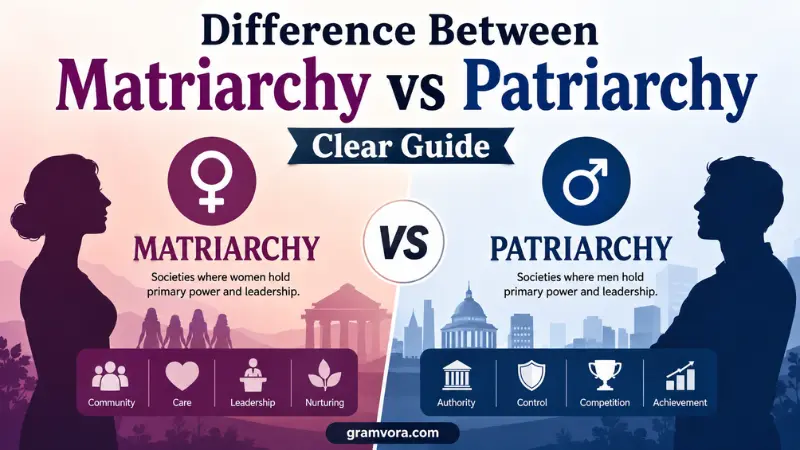
The difference between matriarchy and patriarchy is mainly about who holds authority or power within a family, group, institution, or society.
Matriarchy refers to a system in which women have the central authority or power. Patriarchy refers to a system in which men, traditionally fathers or other male leaders, hold the central authority or a disproportionately large share of power.
Both words are nouns, and both can describe social organization. The important point is that they describe systems of authority, not simply whether a family contains more women or men.
Quick Answer
Use matriarchy when you are describing a system in which women hold primary authority or power.
Use patriarchy when you are describing a system in which men hold primary authority or a disproportionately large share of power.
| Context | Best Choice | Why |
|---|---|---|
| Women hold primary authority | Matriarchy | The word describes female-centered authority. |
| Men hold primary authority | Patriarchy | The word describes male-centered authority. |
| A grandmother leads her family | Matriarch / matriarchal | This describes a woman as the family leader or a female-led structure. |
| A father or male elders control the family | Patriarch / patriarchal | This describes male leadership or control. |
| Descent follows the mother’s line | Matriarchy may fit, depending on context | Female-line descent is one established meaning, but it should not automatically be treated as the same thing as female political authority. |
| Descent follows the father’s line | Patriarchy may fit in some contexts | Male-line descent can accompany patriarchal organization, but the terms are not identical. |
Why People Confuse Them
The words look like direct opposites because they share the ending -archy, which relates to rule or authority.
The first parts point toward different family or gender associations: matri- relates to the mother, while patri- relates to the father.
That makes the basic contrast easy to remember. However, the definitions are more precise than simply “women rule” versus “men rule.”
For example, a family may have a strong female leader without the entire society being a matriarchy. Likewise, a family can have a male head without every institution around it necessarily being patriarchal.
Another source of confusion is descent. A society can trace family relationships or inheritance through the female line without necessarily giving women control over every political or social decision. The concepts of female-line descent and female authority should therefore not automatically be treated as identical.
Key Differences At A Glance
| Feature | Matriarchy | Patriarchy |
| Core idea | Female-centered authority or power | Male-centered authority or power |
| Typical leader | Woman or group of women | Man or group of men |
| Basic noun | matriarchy | patriarchy |
| Related adjective | matriarchal | patriarchal |
| Family use | Can describe a woman-led family structure | Can describe a man-led family structure |
| Broader social use | Can describe female-centered social organization | Can describe male-centered social organization |
| Common confusion | Equating it automatically with matrilineal descent | Equating it only with one father leading one household |
Meaning and Usage Difference
Matriarchy is a noun for a social organization or other unit in which women have significant or primary authority. Merriam-Webster also includes a meaning involving descent and inheritance through the female line. Cambridge likewise connects the term with female authority and female control of property.
Patriarchy is a noun for social organization in which fathers or other men control a family, clan, tribe, or larger social unit. Modern dictionary definitions also use it more broadly for systems in which men hold a disproportionately large share of power.
So, in a straightforward comparison:
- Matriarchy: authority is centered on women.
- Patriarchy: authority is centered on men.
The words can apply to a family, institution, community, or larger society, depending on the context.
A useful distinction
Do not automatically replace matrilineal with matriarchal.
Matrilineal concerns descent through the mother’s family line. Matriarchal concerns a relationship to a matriarch or matriarchy. A female-line family system does not necessarily mean that women exercise overall political or social control.
The same caution applies when discussing male-line descent and patriarchy.
Tone, Context, and Formality
Both matriarchy and patriarchy are standard nouns in American English. They are common in discussions of family structure, sociology, history, politics, culture, and gender relations.
The words can be neutral when used descriptively, but patriarchy is also frequently used critically when discussing unequal power between men and women. Current dictionary examples show the word being applied to broad social and institutional structures.
Matriarchy can also be descriptive, although its meaning can vary somewhat according to context. It may refer to female authority, a female-led family or group, or female-line inheritance and descent.
For precise writing, explain what you mean when the context could be ambiguous.
For example:
The novel depicts a matriarchy in which women hold political authority.
This is clearer than simply saying:
The novel depicts a matriarchy.
Which One Should You Use?
Choose matriarchy when the focus is on female authority, female leadership, or a social structure organized around women.
Choose patriarchy when the focus is on male authority, male leadership, or a social structure organized around men.
Use the related adjective when you are describing something rather than naming the system itself:
- matriarchal society
- matriarchal family
- patriarchal society
- patriarchal family
Compare:
The family is matriarchal because the grandmother has the final say.
The organization has been described as patriarchal because men hold most senior positions of authority.
The noun names the system; the adjective describes something connected with that system.
When One Choice Sounds Wrong
Matriarchy sounds wrong when the sentence clearly describes male-centered authority.
Incorrect:
The family was a matriarchy because the father controlled every major decision.
Better:
The family was a patriarchy because the father controlled every major decision.
Patriarchy sounds wrong when the sentence clearly describes female-centered authority.
Incorrect:
The community was a patriarchy because women held the main leadership positions.
Better:
The community was a matriarchy because women held the main leadership positions.
There is also a common precision problem:
The society was matriarchal because inheritance followed the mother’s line.
That conclusion may be too broad. Female-line inheritance alone does not necessarily establish that women hold overall authority.
Common Mistakes (and Quick Fixes)
Mistake 1: Treating the words as simple labels for women and men
These words describe systems of authority or organization, not individual gender identities.
Fix: Ask who holds the relevant authority.
Mistake 2: Assuming every female-led family is a matriarchy
A woman can be the leader of a family without the entire family system or wider society being a matriarchy.
Fix: Use matriarch or matriarchal when you are describing a specific female family leader or female-led structure.
Mistake 3: Assuming matrilineal means matriarchal
These terms can overlap in some discussions, but they describe different concepts.
Fix: Use matrilineal when the point is descent or inheritance through the mother’s line.
Mistake 4: Using patriarchy only for fathers
Modern usage often applies patriarchy more broadly to systems in which men hold disproportionate power.
Fix: Consider the broader social structure being described.
Mistake 5: Assuming matriarchy and patriarchy are always perfect mirror images
The dictionary meanings provide a basic contrast, but matriarchy has multiple established uses, including female-line descent.
Everyday Examples
Here are natural examples in modern American English:
The documentary examines how a patriarchal family structure affected the children.
The story takes place in a fictional matriarchy where women hold most government positions.
Her grandmother is the matriarch of the family.
The company was criticized for maintaining a patriarchal culture.
The novel imagines a matriarchal community led by several generations of women.
The family follows a matrilineal tradition, but that does not by itself prove that the family is a matriarchy.
The professor explained the historical development of patriarchy in different social institutions.
These examples show why context matters. The words can describe families, organizations, fictional societies, or broader social arrangements.
Dictionary-Style Word Details
Verb
- Matriarchy: Not commonly used as a verb in standard US English.
- Patriarchy: Not commonly used as a verb in standard US English.
Both are primarily nouns. Related adjectives such as matriarchal and patriarchal are used to describe people, structures, cultures, or systems.
Noun
- Matriarchy: A noun meaning a social system or group characterized by female authority, with dictionary definitions also covering female-line descent and inheritance in certain contexts. Its plural is matriarchies.
- Patriarchy: A noun meaning a social system in which fathers or other men hold authority, with a broader modern sense involving disproportionate male power. Its plural is patriarchies.
Pronunciation is also different:
- Matriarchy: roughly “MAY-tree-ar-kee”
- Patriarchy: roughly “PAY-tree-ar-kee”
Synonyms
Exact synonyms are limited because both words describe particular kinds of social organization.
- Matriarchy: Closest plain alternatives include female-led system or female-centered social system, depending on the intended meaning.
- Patriarchy: Closest plain alternatives include male-dominated system or male-centered social system, depending on the context.
These alternatives can be useful for clarity, but they do not necessarily match every dictionary sense exactly.
Example Sentences
- Matriarchy: The film portrays a matriarchy in which women hold most positions of authority.
- Patriarchy: The novel explores how patriarchy shaped the family’s expectations.
- Matriarchy: Her grandmother was the matriarch who guided the family.
- Patriarchy: The community’s patriarchal structure gave older men greater authority.
Word History
Matriarchy is recorded in English from the late 19th century; Merriam-Webster gives 1885 as its first known use.
Patriarchy is considerably older in English. Merriam-Webster gives 1632 as its first known use, while Oxford traces the word through Medieval Latin to Greek roots associated with a ruling father or family head.
The historical forms help explain why the two words look like counterparts, but modern definitions should guide present-day usage.
Phrases Containing
Common phrases with matriarchy include:
- a matriarchal society
- a matriarchal family
- a system of matriarchy
- life under matriarchy
Common phrases with patriarchy include:
- a patriarchal society
- a patriarchal family
- a system of patriarchy
- the effects of patriarchy
- a patriarchal structure
The adjectives matriarchal and patriarchal are especially useful when the sentence describes a structure, culture, or institution rather than naming the system itself.
FAQs
1. What is the difference between matriarchy and patriarchy?
Matriarchy generally describes a system in which women hold primary authority or power. Patriarchy describes a system in which men hold primary authority or a disproportionately large share of power.
2. Is matriarchy the opposite of patriarchy?
They are often presented as contrasting systems, but they are not always perfect opposites in every context. Matriarchy has meanings related to female authority and, in some contexts, female-line descent, while patriarchy can refer broadly to male-centered systems of power.
3. What does matriarchy mean?
Matriarchy is a noun describing a social or family system in which women have central authority or power. In some contexts, it can also refer to descent or inheritance through the female line.
4. What does patriarchy mean?
Patriarchy is a noun describing a social or family system in which fathers or other men hold authority. In modern usage, it can also describe broader systems where men hold disproportionate power.
5. Is a woman-led family automatically a matriarchy?
No. A woman may be the leader of a particular family without that family or its wider society being described as a matriarchy. Matriarchal can be more appropriate when describing a female-led family structure.
6. Is a man-led family automatically patriarchal?
Not necessarily. A father or grandfather may lead a family without the term patriarchy being appropriate for the entire social system. The word usually refers to a broader pattern of male authority or control.
7. Are matriarchy and matrilineal the same thing?
No. Matrilineal refers to descent or inheritance through the mother’s family line. Matriarchy concerns female authority or power and can have other meanings depending on context.
8. Are patriarchy and patrilineal the same thing?
No. Patrilineal refers to descent through the father’s family line. Patriarchy refers to male-centered authority or power. The two can occur together, but they do not mean the same thing.
9. What is the adjective form of matriarchy?
The adjective is matriarchal. For example: “The community has a matriarchal structure.”
10. What is the adjective form of patriarchy?
The adjective is patriarchal. For example: “The organization has a patriarchal structure.”
11. Can matriarchy and patriarchy describe a society?
Yes. Both terms can describe broader social organization. Matriarchy can describe a society centered on female authority, while patriarchy can describe a society or social structure in which men hold dominant authority.
Conclusion
The basic difference between matriarchy and patriarchy is the location of authority.
Matriarchy generally describes female-centered authority or a social organization associated with women’s power. Patriarchy describes male-centered authority or a system in which men hold a disproportionately large share of power.
The safest choice depends on what you are actually describing. If the focus is female authority, matriarchy is the appropriate noun. If the focus is male authority, patriarchy is the appropriate noun.
Just remember that matrilineal and matriarchal are not automatically interchangeable. Being precise about whether you mean descent, leadership, or broader social power makes the comparison much clearer.


