
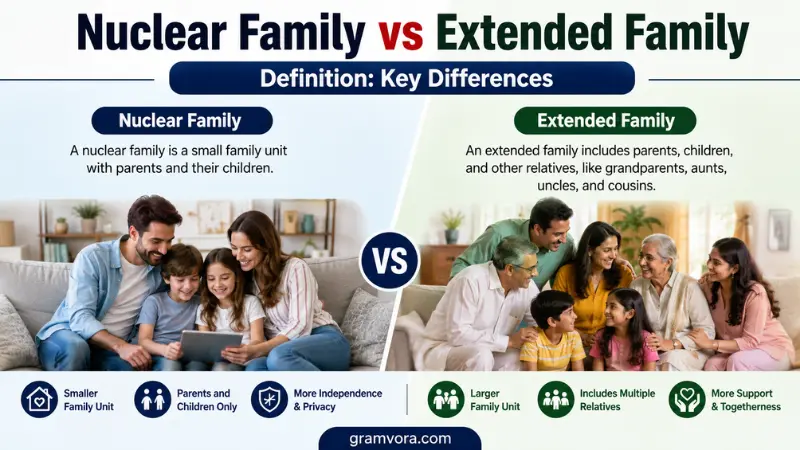
Nuclear family and extended family are both correct terms. The difference is mainly about which family members are included.
A nuclear family refers to the core family unit of parents and their children. An extended family goes beyond that core to include relatives such as grandparents, aunts, uncles, and cousins.
The two ideas can overlap. A nuclear family can be part of a much larger extended family.
Quick Answer
Use nuclear family when you mean parents and their children as a family unit.
Use extended family when you mean the wider family group that includes relatives beyond that core unit.
For example:
- Nuclear family: A married couple and their children.
- Extended family: That couple and their children plus grandparents, aunts, uncles, cousins, or other relatives.
So, the answer to nuclear family vs extended family definition is simple: both terms are correct, but they describe different scopes of family membership.
Why People Confuse Them
The terms are easy to confuse because they describe related family structures.
A nuclear family can sit at the center of an extended family. For example, two parents and their children may form one nuclear family, while their parents, siblings, nieces, nephews, and cousins belong to the wider extended family.
Living arrangements can also cause confusion. An extended family may live together, but the phrase can also describe relatives who live in separate homes, cities, or states.
The key question is not simply, “How many people are there?” Instead, ask, “Which relatives am I talking about?”
Key Differences At A Glance
| Feature | Nuclear family | Extended family |
|---|---|---|
| Core meaning | Core family unit | Wider family group |
| Typical members | Parents and children | Parents, children, and additional relatives |
| Scope | Narrower | Broader |
| Grandparents included | Usually outside the nuclear unit | Yes, when included in the wider group |
| Aunts and uncles included | Usually outside the nuclear unit | Yes |
| Living arrangement | May describe a household unit | May involve one household or relatives living elsewhere |
| Grammar | Noun phrase | Noun phrase |
The clearest difference is scope. Nuclear family focuses on the central parent-and-child unit, while extended family reaches beyond it.
Meaning and Usage Difference
A nuclear family is a family consisting of parents and their children considered as a unit.
For example:
The parents and their two children form a nuclear family.
The phrase does not depend simply on having a small number of people. Its meaning comes from the relationships being described.
An extended family includes relatives beyond the core parent-and-child group.
For example:
Her extended family gathered for Thanksgiving.
That group might include grandparents, aunts, uncles, cousins, and other relatives.
An extended family does not necessarily have to live in one house. Someone can naturally say that their extended family lives in several different states.
Tone, Context, and Formality
Both expressions are standard and neutral in American English.
Nuclear family can sound somewhat more analytical because it is common when discussing family structure, sociology, education, demographics, and household relationships.
Extended family is also common in everyday conversation:
We’re visiting my extended family this weekend.
Neither expression is automatically more formal or more polite. The important issue is accuracy.
Also, nuclear in this expression does not mean anything related to nuclear energy or weapons. It refers to the idea of a central or core unit.
Which One Should You Use?
Choose the term that matches the family members you mean.
| Context | Best Choice | Why |
|---|---|---|
| Parents and their children as one unit | Nuclear family | Describes the core family group |
| Grandparents are included | Extended family | Goes beyond the core unit |
| Aunts or uncles are included | Extended family | Refers to additional relatives |
| Cousins are part of the group | Extended family | Describes the wider family |
| A discussion focuses on parents and children | Nuclear family | Keeps the focus on the core unit |
| A discussion contrasts the core group with wider relatives | Both | Each term describes a different scope |
A useful test is: Am I talking about the core parent-and-child group, or the wider circle of relatives?
If it is the core group, nuclear family is usually the better choice. If the meaning extends beyond that group, extended family is usually clearer.
When One Choice Sounds Wrong
The terms are related, but they are not interchangeable.
For example:
My nuclear family includes my grandparents, three aunts, and several cousins.
If the writer means all of those relatives together, extended family is more precise:
My extended family includes my grandparents, three aunts, and several cousins.
The reverse can also happen:
Their extended family consists only of the parents and their two children.
If the intended meaning is specifically the parent-and-child unit, nuclear family is clearer.
There is an important nuance, though. A family can be both a nuclear family and part of an extended family. The terms can describe different levels of the same family network.
Common Mistakes (and Quick Fixes)
Mistake: Assuming nuclear family means a family with a specific number of children.
Fix: Focus on the family relationships, not a fixed number of children.
Mistake: Assuming extended family always means everyone lives together.
Fix: In everyday American English, extended family can also refer to relatives who live in different homes or locations.
Mistake: Treating the two expressions as strict opposites.
Fix: Think of them as related terms describing different scopes. A nuclear family can exist within an extended family.
Mistake: Thinking “nuclear” refers to nuclear energy.
Fix: Here, nuclear means the central or core family unit.
Everyday Examples
Here are natural examples of each expression:
- Nuclear family: “Our nuclear family moved to Arizona last year.”
- Nuclear family: “The study focuses on communication within the nuclear family.”
- Nuclear family: “Her nuclear family includes her spouse and two children.”
- Extended family: “My extended family is coming over for Thanksgiving.”
- Extended family: “His extended family lives across several states.”
- Extended family: “She grew up surrounded by grandparents, aunts, uncles, and cousins in her extended family.”
Notice that the choice depends on the group being described.
If the sentence centers on parents and children, nuclear family works. If it widens the circle to other relatives, extended family works.
Dictionary-Style Word Details
Verb
- Nuclear family: Not commonly used as a verb in standard US English. It functions as a noun phrase.
- Extended family: Not commonly used as a verb in standard US English. It functions as a noun phrase.
Neither expression should normally be used as a verb.
Noun
- Nuclear family: A noun phrase referring to parents and their children considered as a central family unit.
- Extended family: A noun phrase referring to the wider family group that includes relatives beyond that core unit.
Examples:
Their nuclear family moved into a new apartment.
Her extended family lives in several different states.
Both expressions can be singular or plural:
- one nuclear family / several nuclear families
- one extended family / several extended families
Synonyms
Exact one-word synonyms do not fully replace either expression in every context.
- Nuclear family: Closest plain alternative — core family unit. In some contexts, immediate family may overlap, but the terms are not always identical in scope.
- Extended family: Closest plain alternatives — wider family or broader family group. Relatives can sometimes express a similar idea but is broader and less specific.
The terms are commonly contrasted, but they are better treated as related categories than as strict antonyms.
Example Sentences
Nuclear family:
The parents wanted more privacy for their nuclear family.
Her nuclear family consists of her spouse and their children.
The article examines how the nuclear family functions as a social unit.
Extended family:
We invited our extended family to the graduation party.
His extended family includes several grandparents, aunts, uncles, and cousins.
She stays in regular contact with her extended family.
Word History
Nuclear family: Merriam-Webster records the first known use of the expression in 1924. The word nuclear here relates to the idea of a central core.
Extended family: Merriam-Webster records the first known use at about 1935. The expression describes a family group that extends beyond the central family unit.
The history supports the basic modern distinction: nuclear identifies the core, while extended indicates a wider family group.
Phrases Containing
Common phrases include:
- nuclear family unit
- nuclear family structure
- nuclear family household
- nuclear family members
- nuclear family home
- extended family members
- extended family network
- extended family gathering
- extended family household
- extended family support
These phrases help specify whether the discussion concerns the core family unit or a wider group of relatives.
FAQs
What is a nuclear family?
A nuclear family is a family unit made up of parents and their children. For example, two parents and their children living together can be described as a nuclear family.
What is an extended family?
An extended family includes relatives beyond the core parent-and-child unit. It may include grandparents, aunts, uncles, cousins, and other relatives.
What is the difference between a nuclear family and an extended family?
The main difference is scope. A nuclear family focuses on parents and children, while an extended family includes a wider circle of relatives.
Is a nuclear family part of an extended family?
Yes. A nuclear family can be part of a larger extended family. For example, parents and their children may form a nuclear family while grandparents, aunts, uncles, and cousins belong to the extended family.
Does an extended family have to live together?
No. Extended family members do not have to live in the same house. Relatives can live in different homes, cities, or states and still be part of the same extended family.
Are grandparents part of a nuclear family?
Usually, grandparents are considered part of the extended family rather than the nuclear family. A nuclear family generally refers to parents and their children.
Conclusion
The difference between nuclear family vs extended family is mainly about scope.
A nuclear family refers to the core family unit of parents and their children. An extended family includes relatives beyond that core, such as grandparents, aunts, uncles, and cousins.
The distinction is not simply about family size or whether everyone lives under one roof. An extended family can include relatives who live elsewhere, while a nuclear family can exist as part of a larger extended family.
If you mean the central parent-and-child unit, use nuclear family. If you mean the broader circle of relatives, use extended family.


[…] guide explains the immediate family vs. extended family definition, how the two terms differ, who typically belongs in each group, and how to use them correctly in […]