
Family is one of the most important social institutions studied in sociology. It shapes how people grow up, learn social rules, build relationships, and participate in their communities.
Two common family structures are the nuclear family and the extended family. These terms describe different ways relatives may be organized and connected within a household or family group.
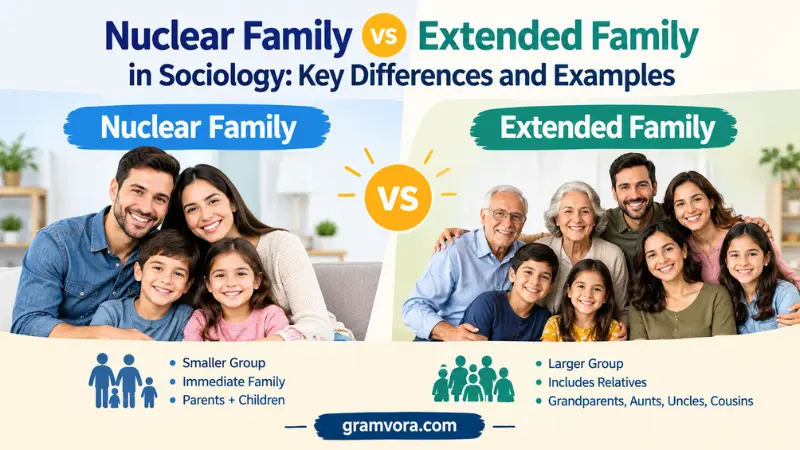
A nuclear family usually centers on parents and their children. An extended family includes additional relatives, such as grandparents, aunts, uncles, and cousins.
The difference is not simply about how many people live in one house. Sociologists also examine family roles, responsibilities, relationships, support systems, and living arrangements.
Understanding nuclear family vs extended family sociology can make it easier to see how families function in different cultures and communities. This guide explains both structures, their main differences, examples, advantages, challenges, and importance in society.
Quick Answer
In sociology, a nuclear family generally consists of parents and their children. An extended family includes the nuclear family plus other relatives, such as grandparents, aunts, uncles, or cousins.
The main difference is the range of relatives included in the family structure and the ways family members share relationships, responsibilities, and support.
Nuclear Family: Definition in Sociology
A nuclear family is a family unit commonly made up of two parents and their children. The children may be biological, adopted, or otherwise legally connected to the parents.
For example, a married couple living with their two children can form a nuclear family. The grandparents may live elsewhere and still remain important members of the wider family.
In sociology, the nuclear family is often discussed as a distinct household and kinship unit. However, it does not represent every family in modern society.
A nuclear family can take different forms. For example, a single parent and children may also be described as a nuclear household in some sociological discussions, depending on the definition being used.
The important idea is that the family centers on parents or parent figures and their dependent children rather than a larger network of relatives living together.
Extended Family: Definition in Sociology
An extended family includes relatives beyond parents and their children. These relatives may include grandparents, grandchildren, aunts, uncles, cousins, and other kin.
An extended family does not always mean that everyone lives under the same roof. Relatives can live in separate homes while maintaining close relationships and sharing responsibilities.
For example, grandparents may live with their adult child and grandchildren. This arrangement creates a household containing multiple generations.
Extended families can also provide practical and emotional support. Relatives may help with childcare, household duties, transportation, finances, or care for older family members.
The structure is especially important when family responsibilities are distributed across several generations.
Nuclear Family vs Extended Family: Main Difference
The clearest difference is the size and range of the family unit.
| Context | Nuclear Family | Extended Family |
|---|---|---|
| Basic structure | Parents and children | Parents, children, and other relatives |
| Generations | Usually one or two | Often multiple generations |
| Relatives | Smaller immediate unit | Wider kinship network |
| Household | Often one family unit | May contain several generations |
| Childcare | Mainly parents or guardians | Parents plus relatives |
| Elder care | Often handled within a smaller household | May be shared among relatives |
A nuclear family is therefore more limited in its household structure. An extended family connects the household to a wider network of relatives.
However, these categories are not always completely separate. A person can belong to a nuclear family while also being part of a large extended family.
Family Structure and Household Structure
One common mistake is treating family and household as exactly the same thing.
A household refers mainly to people who live together. A family refers to relationships created through birth, marriage, adoption, or other recognized forms of kinship.
For example, a grandmother might live in another state but remain an important member of an extended family.
Similarly, several unrelated adults can share a home without forming one family.
This distinction matters in sociology because researchers study both family relationships and living arrangements. The people who live together are not always everyone who belongs to the family network.
How Nuclear Families Function
Nuclear families often organize daily life around parents and children.
Parents or guardians may provide food, housing, emotional support, education, discipline, and financial assistance. Children generally depend on adults while they are young.
The smaller structure can make household decisions more direct. Parents may have greater control over daily routines, schedules, and household rules.
For example, parents might decide where children attend school, how household expenses are managed, and how responsibilities are divided.
At the same time, a smaller family network can place greater pressure on parents. There may be fewer relatives available to help with childcare or emergencies.
This is one reason sociologists examine both the benefits and limitations of different family structures.
How Extended Families Function
Extended families distribute relationships and responsibilities across a broader network.
Grandparents may help care for children. Adult siblings may support one another. Aunts and uncles may provide advice, transportation, or temporary childcare.
In some families, several generations share a home. In others, relatives live nearby or maintain regular contact while living separately.
The extended structure can create a strong support network. A family may have more people available when someone needs help.
However, more relatives can also mean more expectations. Family members may disagree about parenting, finances, household responsibilities, privacy, or major decisions.
Therefore, an extended family can provide strong support while also creating additional social pressures.
Family Roles in Sociology
Sociologists study the roles people perform within families.
Parents commonly have responsibilities connected with childcare, socialization, protection, and economic support. Children may learn social expectations through daily interaction with parents and other relatives.
Extended families can add more roles to this system.
For example:
• Grandparents may provide childcare and cultural knowledge.
• Adult children may help older parents.
• Aunts and uncles may act as trusted adults for younger relatives.
• Cousins may develop social and emotional relationships.
These roles vary greatly between families and cultures. There is no single way that every nuclear or extended family operates.
Socialization and Family Life
One major sociological function of family is socialization.
Socialization is the process through which people learn language, values, behavior, traditions, and social expectations.
A nuclear family can provide an important setting for early socialization. Parents often teach children basic communication, behavior, responsibility, and family expectations.
Extended families can provide additional sources of learning.
A child who regularly interacts with grandparents may learn family stories, traditions, cultural practices, and different perspectives. Cousins and other relatives can also influence behavior and social development.
This does not mean that one family structure automatically provides better socialization. The quality of relationships matters greatly.
Advantages of a Nuclear Family
A nuclear family may offer several practical benefits.
Greater privacy: A smaller household can give parents and children more personal space.
Simpler decision-making: Fewer adults may be involved in everyday household decisions.
Focused parenting: Parents may have greater control over childcare and household routines.
Mobility: A smaller household may find it easier to move for employment, education, or other opportunities.
Independence: Parents and adult children may develop greater independence from other relatives.
These benefits depend on the family’s circumstances. A nuclear household can also experience stress when parents have limited outside support.
Challenges of a Nuclear Family
A nuclear family can place significant responsibilities on a small number of people.
Parents may need to manage childcare, employment, household tasks, and financial responsibilities at the same time.
If a parent becomes ill or loses employment, fewer relatives may be immediately available to provide assistance.
Childcare can also become difficult when grandparents and other relatives live far away.
For some families, geographical mobility can increase this separation. Relatives may live in different cities or states because of jobs, education, housing costs, or personal choices.
Thus, independence can be helpful, but it can also reduce everyday family support.
Advantages of an Extended Family
Extended families can provide a broader support network.
Shared childcare: Grandparents and other relatives may help parents care for children.
Elder support: Adult children and other relatives may share responsibilities for older family members.
Emotional support: Family members may have more people to contact during difficult periods.
Cultural continuity: Older relatives can pass traditions, stories, language, and customs to younger generations.
Shared responsibilities: Household and family duties may be divided among several adults.
These benefits can be particularly important when family members live close together and maintain strong relationships.
Challenges of an Extended Family
Extended families can also face difficulties.
Privacy may be more limited when several relatives share a home. Different generations may have different expectations about parenting, household rules, money, or personal space.
Conflict can also develop when many people participate in important decisions.
For example, parents may want to use one parenting style while grandparents prefer another. Adult relatives may also disagree about financial responsibilities or elder care.
Living with relatives does not automatically create harmony. Strong communication and clear boundaries are often important.
Nuclear and Extended Families in Modern Society
Modern family life does not fit neatly into two categories.
People may move between different family arrangements during their lives. A young adult may grow up in a nuclear household, live independently, marry, have children, and later live with aging parents.
Divorce, remarriage, adoption, migration, employment, housing costs, and personal choices can also change household arrangements.
A family may therefore have characteristics of both structures.
For example, parents and children may live together as a nuclear household while grandparents live nearby and provide regular childcare. The household is nuclear, but the family network is strongly extended.
This example shows why sociologists consider family relationships more broadly than simply counting people in a home.
Cultural Differences in Family Structure
Family structures vary across cultures and communities.
Some societies place strong emphasis on multigenerational family relationships. In such settings, grandparents, adult children, and grandchildren may maintain close daily connections.
Other societies place greater emphasis on independent households. Adult children may move away from their parents for education, work, marriage, or personal independence.
Neither pattern can describe every family within a country.
Even within the United States, families differ by region, economic circumstances, cultural background, age, and personal preference.
For this reason, sociologists avoid assuming that one family structure represents everyone.
Common Confusion About Nuclear and Extended Families
A frequent mistake is saying that an extended family must live together.
That is not necessarily true.
An extended family can include relatives who live in different homes or even different cities. What matters is the broader network of family relationships.
Another mistake is assuming that nuclear families have no relationship with extended relatives.
A nuclear household can have strong relationships with grandparents, cousins, aunts, and uncles.
The terms describe family structures, not the emotional strength of every relationship.
Related Family Terms
Several related terms help explain family structures.
Immediate family usually refers to close relatives, such as parents, siblings, spouses, and children. The exact meaning can vary by context.
Extended family covers a wider group of relatives beyond the immediate household.
Multigenerational family refers to a family arrangement involving multiple generations, such as grandparents, parents, and children.
Household refers to people who live together, whether or not they are related.
These terms can overlap, but they are not identical.
Examples of Nuclear and Extended Families
Consider a family in which two parents live with their teenage daughter and son. The grandparents live in another state and visit several times each year.
The household is a nuclear family. However, the children still belong to a larger extended family that includes their grandparents, aunts, uncles, and cousins.
Now consider another family in which grandparents, parents, and children live together.
This household represents an extended or multigenerational family arrangement.
A third example involves parents and children living alone while grandparents live nearby and provide childcare several days a week. This situation shows how a nuclear household can maintain strong extended-family connections.
Mini Quiz
1. What is a nuclear family?
A. A group of unrelated roommates
B. A family unit centered on parents and children
C. A group containing only grandparents
D. A group of coworkers
Answer: B
2. What makes an extended family different?
A. It includes a wider network of relatives.
B. It cannot contain children.
C. Everyone must live in one country.
D. It contains no parents.
Answer: A
3. Does an extended family always live together?
Answer: No. Relatives can live separately and still belong to an extended family.
4. Why is family important in sociology?
Answer: Families help organize relationships, socialization, care, support, and responsibilities.
FAQs
What is the difference between a nuclear family and an extended family?
A nuclear family generally centers on parents and their children. An extended family includes additional relatives, such as grandparents, aunts, uncles, and cousins.
What is a nuclear family in sociology?
In sociology, a nuclear family is a relatively small family unit centered on parents or parent figures and their children. It is one type of family structure.
What is an extended family in sociology?
An extended family includes relatives beyond the immediate parent-and-child unit. It can connect multiple generations and wider kinship relationships.
Is a nuclear family better than an extended family?
Neither structure is automatically better. Each can provide different forms of support, independence, privacy, and responsibility.
Does an extended family have to live together?
No. Extended relatives can live in separate homes while remaining closely connected and sharing family responsibilities.
Why is the family important in sociology?
Family is important because it influences socialization, relationships, care, identity, responsibilities, and the transmission of social values.
Can a family be both nuclear and extended?
Yes. A household can consist of parents and children while those people remain part of a larger extended family network.
Conclusion
The main difference in nuclear family vs extended family sociology is the range of relatives included in the family structure. A nuclear family focuses on parents and children, while an extended family connects them with a wider network of relatives.
Neither structure works the same way for everyone. Family life depends on relationships, culture, living arrangements, responsibilities, and individual circumstances.
Understanding these differences helps explain how families organize support, socialization, care, and everyday life in society.


