
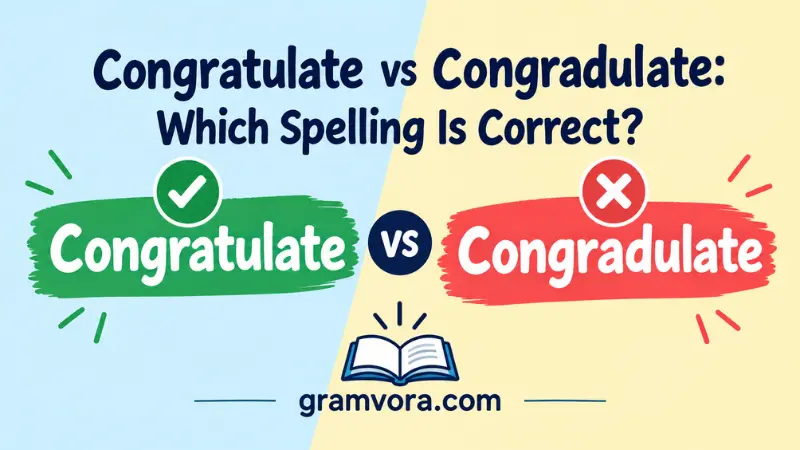
English spelling can be confusing, especially when two words look almost identical. A small change in a word can make the difference between correct writing and a spelling mistake. One common example is congratulate vs congradulate.
People sometimes write congradulate because it looks and sounds similar to congratulate. The difference is only one letter, but only one of these forms is accepted in standard English.
The correct spelling is congratulate. You should use it when expressing happiness about someone’s success, achievement, good news, or special occasion. The spelling congradulate is a misspelling and should be corrected in school assignments, emails, business messages, social media posts, and other forms of standard writing.
Learning the correct form will help you write more confidently and avoid an error that readers may notice.
Quick Answer: Congratulate or Congradulate?
Congratulate is the correct spelling. Congradulate is incorrect in standard English.
Use congratulate when you want to tell someone that you are happy about something they have achieved.
Examples:
- I want to congratulate you on your promotion.
- We congratulate the students who won the competition.
- Please congratulate your sister on her graduation.
- Everyone came to congratulate the newly married couple.
Do not write congradulate in these sentences. Although people may understand what you mean, the spelling is not standard.
A simple way to remember the correct form is to focus on the t in congratulate. The correct word contains the sequence -grat-, not -grad-.
Why Do People Confuse Congratulate and Congradulate?
The confusion usually comes from the way people hear and remember the word.
1. The Words Look Similar
Both forms contain many of the same letters. When someone writes quickly, it can be easy to replace the t in congratulate with a d.
However, visual similarity does not make two spellings equally correct. Standard English uses congratulate.
2. Pronunciation Can Cause Confusion
In ordinary speech, the middle consonants may not sound as clear as they look in writing. Depending on a speaker’s accent and speaking speed, listeners may not pay close attention to the exact consonant.
This can lead learners to remember an incorrect spelling.
The best approach is to learn the word’s standard written form rather than relying only on how it sounds.
3. Typing Quickly Can Create Errors
People often type messages without checking every word. A familiar word may come out incorrectly when someone is writing a quick text, comment, or email.
Spell-checking can help, but it is still useful to remember the correct form yourself.
4. Familiarity With Other Words Can Be Misleading
English contains many words with similar beginnings and endings. Writers sometimes apply a familiar spelling pattern to a word where it does not belong.
In this case, changing the t to a d does not create an accepted alternative. The spelling remains congratulate.
Key Difference at a Glance
| Feature | Congratulate | Congradulate |
|---|---|---|
| Spelling status | Correct | Incorrect |
| Standard English | Accepted | Not accepted as the standard spelling |
| Meaning | Express happiness about someone’s success | No separate standard meaning |
| Formal writing | Use it | Avoid it |
| Everyday messages | Correct choice | Spelling error |
| Example | I congratulate you on your award. | Incorrect spelling |
The main distinction is straightforward: congratulate is the standard word, while congradulate is a misspelling. They are not two regional versions of the same word.
Is Congradulate Ever Correct?
In standard American English, congradulate is not an accepted spelling variant of congratulate.
You should not use it as an alternative in a formal letter, school paper, professional email, résumé, article, or public announcement.
If you encounter congradulate in an online comment or personal message, it is most likely a spelling mistake. The intended word is generally clear from the context, but understanding the writer’s meaning does not make the spelling correct.
For example:
Incorrect: I would like to congradulate you on your new job.
Correct: I would like to congratulate you on your new job.
There is no need to invent a different meaning for congradulate. For ordinary English writing, simply replace it with congratulate.
How to Use Congratulate Correctly
The verb congratulate is used when you express pleasure or approval because of someone’s achievement, success, or good news.
It appears in many everyday situations, including graduations, promotions, awards, weddings, sporting events, and personal milestones.
Congratulate Someone on an Achievement
The common pattern is congratulate someone on something.
Examples:
- I congratulated Maria on her promotion.
- The principal congratulated the students on their excellent results.
- We congratulated our neighbor on winning the local election.
- Her manager congratulated her on completing the project.
Notice that the person receiving congratulations comes after the verb. The achievement is commonly introduced by on.
Congratulate Someone for an Action
You may also see congratulate someone for doing something, particularly when the focus is on a specific action or effort.
Examples:
- I congratulated him for speaking up during the meeting.
- The coach congratulated the team for working together.
- She congratulated her daughter for handling the challenge calmly.
In many everyday sentences, on is the more familiar choice when naming an achievement. The best preposition depends on the sentence and what you want to emphasize.
Use Congratulate in Professional Messages
The word is suitable for workplace communication. It expresses positive recognition without sounding overly casual.
Examples:
- I would like to congratulate you on your well-deserved promotion.
- Please join me in congratulating our newest team member.
- We congratulate the entire department on completing this important project.
In a professional message, check both spelling and sentence structure before sending it.
Use Congratulate in Personal Messages
The word also works naturally in friendly messages to family members and friends.
Examples:
- I called to congratulate my cousin on her engagement.
- We are excited to congratulate you on the arrival of your baby.
- Congratulations on your new home! I cannot wait to visit.
The last example uses congratulations, a related form of the same word family. It is commonly used as a noun or an expression of praise.
Everyday Examples: Correct and Incorrect
The examples below show how to identify and correct the spelling error.
Example 1: Graduation
Incorrect: I want to congradulate you on graduating from college.
Correct: I want to congratulate you on graduating from college.
Why? The verb must use the standard spelling congratulate.
Example 2: A New Job
Incorrect: Please congradulate Sarah on her new position.
Correct: Please congratulate Sarah on her new position.
Why? The intended action is expressing happiness about Sarah’s success.
Example 3: Winning a Competition
Incorrect: The teacher congradulated the winning team.
Correct: The teacher congratulated the winning team.
Why? The past-tense form is congratulated, with the same correct spelling stem.
Example 4: A Business Email
Incorrect: I am writing to congradulate you on this achievement.
Correct: I am writing to congratulate you on this achievement.
Why? Professional communication should use standard spelling.
Example 5: A Social Media Post
Incorrect: Let’s congradulate Jake for winning the championship!
Correct: Let’s congratulate Jake on winning the championship!
Why? A casual platform does not change the standard spelling.
Example 6: A Wedding
Incorrect: We would like to congradulate the happy couple.
Correct: We would like to congratulate the happy couple.
Why? The verb remains congratulate, regardless of the occasion.
Common Mistakes and Quick Fixes
A few simple habits can help you avoid this error.
Mistake 1: Replacing T With D
The most obvious mistake is writing congradulate instead of congratulate.
Quick fix: Remember the letter t in the middle of the correct spelling.
Mistake 2: Misspelling Related Forms
Once you learn congratulate, remember its common related forms:
- Congratulates: She congratulates every student who succeeds.
- Congratulated: They congratulated him after the match.
- Congratulating: We are congratulating the winners today.
- Congratulation: This is a formal expression of praise, although it is less common in everyday use than congratulations.
- Congratulations: Congratulations on your graduation!
The spelling of the main word remains consistent across these forms.
Mistake 3: Assuming Both Forms Are Acceptable
Some English words have accepted spelling variations. This does not mean every pair of similar-looking words has two correct forms.
Congratulate and congradulate are not an example of an accepted spelling variation.
Quick fix: When in doubt, consult a reliable dictionary and use congratulate.
Mistake 4: Ignoring the Error Because the Meaning Is Clear
Readers may understand congradulate, but a recognizable mistake is still a mistake.
Quick fix: Review important messages before sending them, particularly applications, announcements, business emails, and published writing.
Verb, Noun, and Related Word Forms
Verb
Congratulate is a verb. It describes the act of expressing pleasure or approval about someone’s success or good news.
Examples:
- I congratulate you on your achievement.
- She congratulated her brother yesterday.
- They are congratulating the winners now.
Congradulate is not the standard spelling of this verb.
Noun
The related noun is congratulation, while congratulations is the familiar form used to express praise or good wishes.
Examples:
- Congratulations on your new job!
- She received many congratulations after the announcement.
- Please accept my congratulations on your achievement.
Do not assume that congradulation is an acceptable spelling merely because it resembles the correct noun.
Synonyms
Depending on the context, the closest plain alternatives to congratulate include:
- Praise
- Commend
- Applaud
- Celebrate someone’s success
- Offer congratulations
These words are not exact replacements in every sentence. For instance, praise may focus on the quality of someone’s work, while congratulate often acknowledges a successful event or achievement.
There is no separate synonym list for congradulate because it is a misspelling rather than a distinct standard word.
Example Sentences
- I want to congratulate you on passing your exam.
- The company congratulated its employees on reaching the annual goal.
- We called to congratulate our friends on their wedding.
- Her parents congratulated her after the award ceremony.
- The mayor congratulated the volunteers for their hard work.
Each sentence uses the correct spelling and demonstrates a realistic context.
Word History
Congratulate comes through Latin-related word history, with the English verb connected to the idea of wishing someone joy or expressing pleasure about good fortune.
The historical background does not support treating congradulate as an alternative spelling. For modern writing, the important point is that congratulate is the established standard form.
Phrases Containing Congratulate
Common expressions include:
- Congratulate someone on a promotion
- Congratulate someone on graduating
- Congratulate the winners
- Congratulate a colleague on an achievement
- Congratulate someone on getting married
- Congratulate a team on its success
- Congratulate someone for their efforts
These phrases can be used in personal conversations, workplace messages, school announcements, and public statements. In each case, keep the spelling of congratulate unchanged.
FAQs
Is congratulate or congradulate correct?
Congratulate is correct. Congradulate is a misspelling in standard English.
Why do people spell congratulate as congradulate?
People may confuse the words because they look similar and the middle consonant can be unclear in fast speech. The correct spelling uses t.
Is congradulate accepted in American English?
No. Standard American English uses congratulate. Use that spelling in formal and informal writing.
Is congradulate a British spelling?
No. It is not the standard British spelling either. The correct spelling is congratulate.
What does congratulate mean?
It means to express pleasure or approval about someone’s success, achievement, or good news.
What is the past tense of congratulate?
The past tense is congratulated.
Example: We congratulated her on her promotion.
How do you spell congratulations?
The correct spelling is congratulations.
Example: Congratulations on your graduation!
Do you congratulate someone on or for something?
Both constructions occur. Congratulate someone on an achievement is a common pattern. Congratulate someone for doing something can also be used when emphasizing an action or effort.
Is congratulate a verb?
Yes. Congratulate is a verb that describes expressing happiness or approval about someone’s success.
How can I remember the correct spelling?
Remember that congratulate contains a t, not a d, in the middle. Read the word carefully and use a spelling checker when necessary.
Conclusion
The choice between congratulate and congradulate is simple: congratulate is the correct spelling, and congradulate is incorrect in standard English.
Use congratulate when recognizing someone’s achievement, celebrating good news, or expressing happiness about an important event. Remember its related forms, such as congratulated, congratulating, and congratulations, and check your writing before publishing or sending it.
With this spelling memorized, you can write clearer messages and avoid a common mistake in everyday American English.


