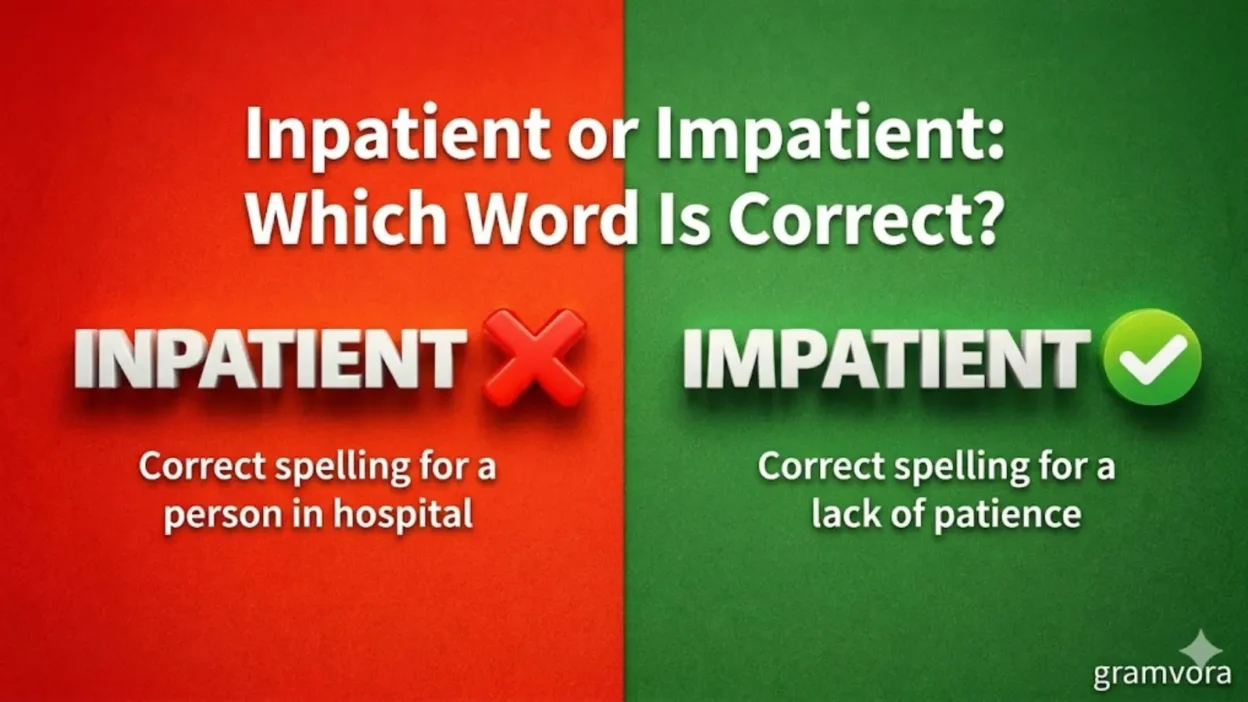
Both inpatient and impatient are correct words, but they are not interchangeable. The right choice depends on what you mean.
Use inpatient when you are talking about a person admitted to a hospital or medical facility for care. Use impatient when you mean someone is annoyed, restless, or unwilling to wait.
The difference is simple once you connect each word to its setting: inpatient belongs in medical contexts, while impatient belongs in emotional or behavior contexts.
Quick Answer
Inpatient means a patient who stays in a hospital or care facility while receiving treatment. It can also describe care, treatment, beds, units, or programs for those patients.
Example:
The doctor admitted him as an inpatient after the surgery.
Impatient means lacking patience, getting annoyed by delays, or being eager for something to happen soon.
Example:
She became impatient after waiting in line for an hour.
So, if someone is in a hospital for treatment, choose inpatient. If someone cannot wait calmly, choose impatient.
Why People Confuse Them
People confuse inpatient and impatient because they look and sound very similar. Only one letter changes: n in inpatient and m in impatient.
They also both contain patient, which can create another layer of confusion. A patient can be a person receiving medical care. A patient person can also wait calmly. That means the base word connects to both medicine and behavior.
The pronunciation can be close in everyday speech. A practical guide is:
• Inpatient: IN-pay-shunt
• Impatient: im-PAY-shunt
In fast conversation, the difference may be hard to hear. In writing, the context tells you which word is right.
Key Differences At A Glance
| Context | Best Choice | Why |
|---|---|---|
| Hospital admission | inpatient | It names a patient staying for medical care. |
| Medical treatment program | inpatient | It describes care given to admitted patients. |
| Waiting in line | impatient | It describes frustration or restlessness. |
| Wanting something soon | impatient | It can mean eager for something to happen. |
| Hospital unit or ward | inpatient | It modifies a medical noun. |
| Annoyed by delay | impatient | It describes a feeling or behavior. |
Compact comparison:
• inpatient = medical status, hospital care, noun or modifier
• impatient = lack of patience, annoyance, eagerness, adjective
• inpatient care is correct
• impatient care is wrong unless you mean care given in an annoyed way
• an impatient driver is correct
• an inpatient driver sounds wrong unless the driver is also a hospital patient
Meaning and Usage Difference
Inpatient refers to a person admitted to a hospital, rehab center, mental health facility, or similar setting for care. It is often used as a noun.
Example:
The hospital transferred the inpatient to a quieter room.
It is also often used before another noun, especially in healthcare writing.
Examples:
The clinic offers inpatient treatment.
The hospital added more inpatient beds.
Her insurance covered the inpatient stay.
Impatient describes a person, mood, tone, action, or response that shows a lack of patience. It is an adjective.
Examples:
The kids grew impatient during the delay.
He gave an impatient sigh.
Customers were impatient for an update.
Impatient can also mean eager, not only annoyed. In that use, it still shows a strong wish for something to happen soon.
Example:
She was impatient to start her new job.
Tone, Context, and Formality
Inpatient sounds medical, official, and practical. You will see it in hospital forms, insurance notes, health articles, discharge papers, and care plans.
Common medical uses include:
• inpatient care
• inpatient treatment
• inpatient rehab
• inpatient surgery
• inpatient ward
• inpatient admission
• inpatient stay
Impatient sounds everyday and emotional. It can be neutral, mildly negative, or clearly critical, depending on the sentence.
Neutral:
I am impatient to hear the results.
Mildly negative:
Please do not be impatient with the new employee.
Clearly critical:
The impatient driver honked at everyone.
In formal writing, impatient of can mean unwilling to tolerate something.
Example:
The manager was impatient of repeated excuses.
That phrasing is more formal than impatient with, which is common in everyday US English.
Which One Should You Use?
Use inpatient when the sentence is about medical care, hospital status, or treatment that requires admission.
Correct:
She entered an inpatient rehab program.
The hospital opened a new inpatient unit.
He was treated as an inpatient.
Use impatient when the sentence is about waiting, irritation, pressure, eagerness, or lack of calm.
Correct:
The crowd became impatient after the long delay.
I get impatient when meetings start late.
He was impatient to leave.
A quick test helps:
If you can replace the word with hospital patient, you probably need inpatient.
If you can replace it with annoyed, restless, or eager, you probably need impatient.
When One Choice Sounds Wrong
Inpatient sounds wrong when the sentence has nothing to do with medical care.
Wrong:
I was inpatient waiting for my coffee.
Correct:
I was impatient waiting for my coffee.
Impatient sounds wrong when the sentence is about hospital admission or medical treatment.
Wrong:
The doctor admitted her as an impatient.
Correct:
The doctor admitted her as an inpatient.
Be careful with phrases like patient care. The word patient alone can mean a person receiving care, but impatient does not mean “inside a patient” or “medical patient.” It means lacking patience.
Common Mistakes (and Quick Fixes)
Mistake: Using inpatient for frustration.
Wrong: The passengers were inpatient after the delay.
Fix: The passengers were impatient after the delay.
Mistake: Using impatient for medical admission.
Wrong: He stayed overnight as an impatient.
Fix: He stayed overnight as an inpatient.
Mistake: Treating the words as spelling variants.
Wrong idea: Inpatient and impatient are two spellings of the same word.
Fix: They are separate words with separate meanings.
Mistake: Writing impatient treatment when you mean hospital-based care.
Wrong: She needed impatient treatment after the injury.
Fix: She needed inpatient treatment after the injury.
Mistake: Writing inpatient with someone.
Wrong: Try not to be inpatient with the intern.
Fix: Try not to be impatient with the intern.
Everyday Examples
I get impatient when a delivery app says “five minutes away” for half an hour.
The doctor recommended inpatient care because the patient needed close monitoring.
The kids were impatient to open their gifts.
The hospital’s inpatient unit was full.
She tried not to sound impatient on the phone.
He checked into an inpatient program on Monday.
The audience became impatient when the concert started late.
Her inpatient stay lasted three nights.
Do not be impatient with yourself while learning a new skill.
The clinic does not offer inpatient services.
Dictionary-Style Word Details
Verb
• inpatient: Not commonly used as a verb in standard US English. You would not say “to inpatient someone” in normal writing. Use admit, hospitalize, or place in inpatient care instead.
Example:
The hospital admitted him for inpatient care.
• impatient: Not commonly used as a verb in standard US English. Use become impatient, grow impatient, or act impatient instead.
Example:
The crowd grew impatient after the delay.
Noun
• inpatient: Commonly used as a noun. It means a patient who stays in a hospital or care facility while receiving treatment.
Example:
The nurse checked on each inpatient before the shift ended.
• impatient: Not commonly used as a noun for a person in standard US English. The related noun is impatience, which means the state or feeling of being impatient.
Example:
Her impatience showed when she kept checking the time.
Synonyms
• inpatient: Closest plain alternatives include hospitalized patient, admitted patient, and resident patient in a care setting. The clearest opposite is outpatient, meaning a patient who receives care without being admitted for an overnight stay or inpatient status.
• impatient: Closest plain alternatives include restless, irritable, eager, antsy, annoyed, and unable to wait calmly. The best opposite is patient. Depending on context, calm can also work as an opposite.
Do not treat these synonym lists as interchangeable in every sentence. Eager can match one sense of impatient, but it may sound too positive when the sentence means annoyed.
Example Sentences
• inpatient:
The insurance form asked whether the procedure was inpatient or outpatient.
She was admitted as an inpatient after the accident.
The hospital expanded its inpatient mental health services.
His inpatient treatment required a care team available around the clock.
• impatient:
The driver became impatient at the red light.
I am impatient to see the final design.
Please do not be impatient with the customer service rep.
Her impatient tone made the room uncomfortable.
Word History
• inpatient: The word is built from in plus patient. The meaning connects to a patient being in a hospital or care setting for treatment. Some references differ slightly on early dating, so the safest point is the structure and modern medical use, not a single exact date.
• impatient: The word comes through older forms connected with “not bearing” or “not enduring.” In modern English, it means lacking patience, being easily annoyed by delay, or being eager for something to happen.
The two words are not close in meaning just because they look alike. Their histories and current uses point in different directions.
Phrases Containing
• inpatient:
inpatient care
inpatient treatment
inpatient rehab
inpatient program
inpatient unit
inpatient ward
inpatient bed
inpatient admission
inpatient stay
inpatient services
• impatient:
impatient with delays
impatient for change
impatient to leave
grow impatient
become impatient
sound impatient
an impatient reply
an impatient gesture
impatient of excuses
impatient at the wait
Conclusion
The choice between inpatient and impatient depends on meaning, not preference.
Use inpatient for hospital or facility-based medical care. It can name a patient or describe care, treatment, units, beds, programs, and stays.
Use impatient for a lack of patience. It describes someone who is annoyed by waiting, unwilling to tolerate delay, or eager for something to happen soon.