Meta Description: Gasses or gases? Learn the correct plural of gas, why both appear, and how to use the right spelling in modern American English writing.
Feature Image Prompt: Modern grammar comparison graphic showing “gas → gases” highlighted as correct plural and “gasses” marked as verb form, clean educational style
Alt Text: Comparison of gasses and gases showing correct plural usage of gas
Introduction
The words “gasses” and “gases” confuse a lot of English users because they look almost identical. One extra letter changes the meaning, and that small difference often leads to mistakes in writing.
At first glance, many people assume both are just spelling variations of the same plural word. But in modern English, only one is the correct and standard plural form for gas.
This guide explains everything in a simple, clear way so you never mix them up again.
We’ll break down what each spelling really means, why the confusion happens, and how to choose the correct form in everyday writing.
Quick Answer
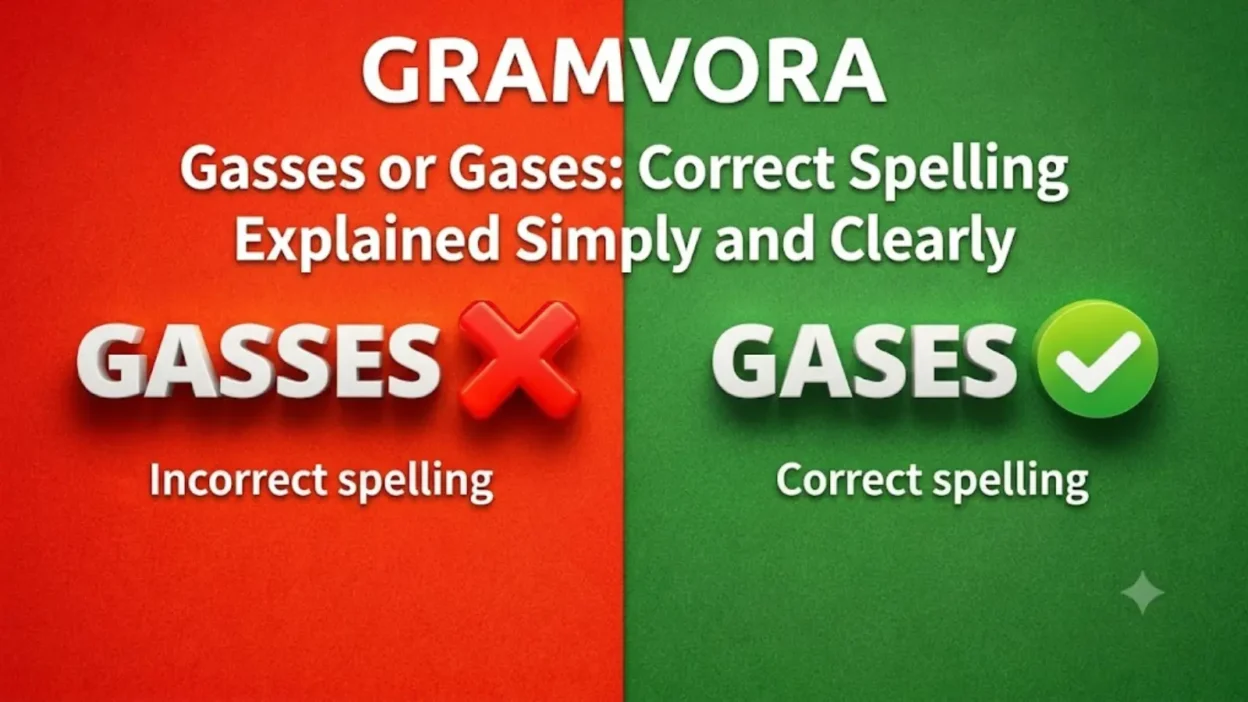
The correct plural of gas is gases.
Gasses is not used as the standard plural. It mainly appears as a verb form (from “to gas”) or in limited technical contexts, but it is not the accepted plural noun.
So in normal writing, especially in science, schoolwork, or professional English, the correct choice is always:
✔ gases
Why People Confuse Them
The confusion comes from how English often handles plural forms.
Many words ending in -s, -ss, -sh, or -ch form plurals by adding -es, such as:
- class → classes
- brush → brushes
- bus → buses
So naturally, people assume:
gas → gasses
But English doesn’t always follow a simple doubling pattern. Instead, “gas” becomes “gases”, following a spelling rule where -es is added without doubling the “s.”
Another reason for confusion is that “gasses” is a real word form, but it belongs to a different grammatical function (verb usage), not plural noun usage.
Key Differences At A Glance
| Feature | Gasses | Gases |
|---|---|---|
| Type | Verb form or rare usage | Plural noun |
| Meaning | To expose or treat with gas (verb use) | More than one gas type or quantity |
| Standard plural? | No | Yes |
| Common in modern writing | Rare | Very common |
| Used in science writing | No | Yes |
This table shows the most important point: only gases works as the normal plural noun.
Are They the Same Word?
They come from the same root word “gas,” but they are not used the same way.
Gases
This is the plural noun form. It refers to multiple types or amounts of gas.
Example idea: oxygen, nitrogen, carbon dioxide are all different gases.
Gasses
This form is mainly connected to the verb “to gas.” It can describe an action, not a quantity.
Example idea: a machine that “gasses” a container for sterilization.
So, they are related in origin, but they are not interchangeable in meaning or grammar.
US vs UK Preference
Both American English and British English strongly agree on this point:
✔ gases = correct plural form in both US and UK English
There is no major regional spelling split between “gases” and “gasses” when used as a noun.
The difference is not about geography but about grammar function:
- gases → plural noun (standard everywhere)
- gasses → verb form (limited use)
So whether you are writing in the US or UK, the correct plural remains the same.
Which Spelling Should You Use?
In almost all situations, you should use gases.
Use it when writing about:
- Air composition
- Science experiments
- Environmental topics
- Chemistry concepts
- Everyday descriptions
Avoid using gasses unless you are clearly using it as a verb.
A simple rule:
If you mean “more than one gas,” always write gases.
When One Spelling Looks Wrong
Using the wrong form usually stands out immediately to readers.
Incorrect usage
❌ The chamber contains toxic gasses.
Correct usage
✔ The chamber contains toxic gases.
The first sentence looks wrong because “gasses” is not accepted as a plural noun in modern standard English.
Another example:
❌ Greenhouse gasses affect climate change.
✔ Greenhouse gases affect climate change.
The second version is the natural, correct form used in science and education.
Common Mistakes (and Quick Fixes)
Mistake 1: Doubling the “s”
People assume English doubles consonants for plurals.
✔ Fix: Remember “gas → gases,” not “gasses.”
Mistake 2: Mixing verb and noun meanings
Some writers confuse the verb “gasses” with the noun plural.
✔ Fix: Ask yourself: Am I describing action or quantity?
- Action → gasses
- Quantity → gases
Mistake 3: Overthinking spelling rules
English spelling is not always consistent across all words.
✔ Fix: Treat “gases” as a fixed plural form you memorize.
Everyday Examples
Here are natural, modern examples showing correct usage:
- The experiment measured different gases released during the reaction.
- Cars produce exhaust gases that affect air quality.
- Scientists study greenhouse gases to understand climate change.
- The balloon slowly released its gases over time.
- Different gases behave differently under pressure.
Verb usage example (rare but valid)
- The technician gasses the equipment before storage.
Notice how the verb usage changes the meaning completely.
Dictionary-Style Word Details
Verb
- Gasses: Used as a verb meaning to expose something to gas or release gas into something.
- Gases: Not used as a verb form.
In modern usage, this verb appears mostly in technical or specialized contexts.
Noun
- Gasses: Not used as a standard plural noun in modern English.
- Gases: Plural noun of “gas,” meaning multiple types or amounts of gas.
This is the most important grammatical distinction between the two spellings.
Synonyms
- Gasses: No direct noun synonym; closest plain alternative depends on context (e.g., “gas treatment” in verb use).
- Gases: vapors, fumes, emissions, airborne substances (context-based alternatives)
These are not perfect replacements but can help describe similar scientific ideas.
Example Sentences
- Gasses: The facility gasses the storage units for sterilization purposes.
- Gases: The lab analyzed different gases under controlled conditions.
Both show how meaning shifts based on grammar role.
Word History
The word gas entered English scientific vocabulary and developed a standard plural form over time.
- Gases became the accepted plural noun used in scientific and general English writing.
- Gasses mainly developed through verb conjugation patterns in English, not as a plural noun tradition.
Today, modern usage strongly favors gases for plural meaning.
Phrases Containing
- Gasses: “gasses out” (rare technical or industrial verb use)
- Gases: greenhouse gases, toxic gases, noble gases, exhaust gases, industrial gases
These phrases show how dominant “gases” is in real-world usage.
FAQs
1. Which is correct: gasses or gases?
“Gases” is the correct plural of gas in modern English. “Gasses” is not used as a plural noun.
2. Why do people write “gasses” instead of “gases”?
Many people assume English doubles the “s” when forming plurals, but gas is an exception. The correct plural is formed by adding -es, not doubling the letter.
3. Is “gasses” ever correct in English?
Yes, but only as a verb form (from “to gas”), not as a plural noun. It is rare in everyday writing.
4. What is the plural of “gas” in American English?
In American English, the plural is gases. This is the standard form used in schools, science, and professional writing.
5. Does “gasses” have a different meaning than “gases”?
Yes. Gases refers to more than one gas. Gasses is usually a verb meaning to expose or treat something with gas.
6. Can I use “gasses” in scientific writing?
No, not as a plural noun. Scientific writing always uses gases when referring to multiple types or amounts of gas.
7. Is “gases” singular or plural?
Gases is plural. The singular form is gas.
8. What is an easy rule to remember?
If you mean “more than one gas,” always use gases. Never use “gasses” as a plural noun.
Conclusion
The difference between gasses and gases is simple once you understand the grammar behind it.
Gases is the correct and standard plural form of gas used in everyday English, science, and formal writing.
Gasses is mainly a verb form and should not be used as a plural noun.