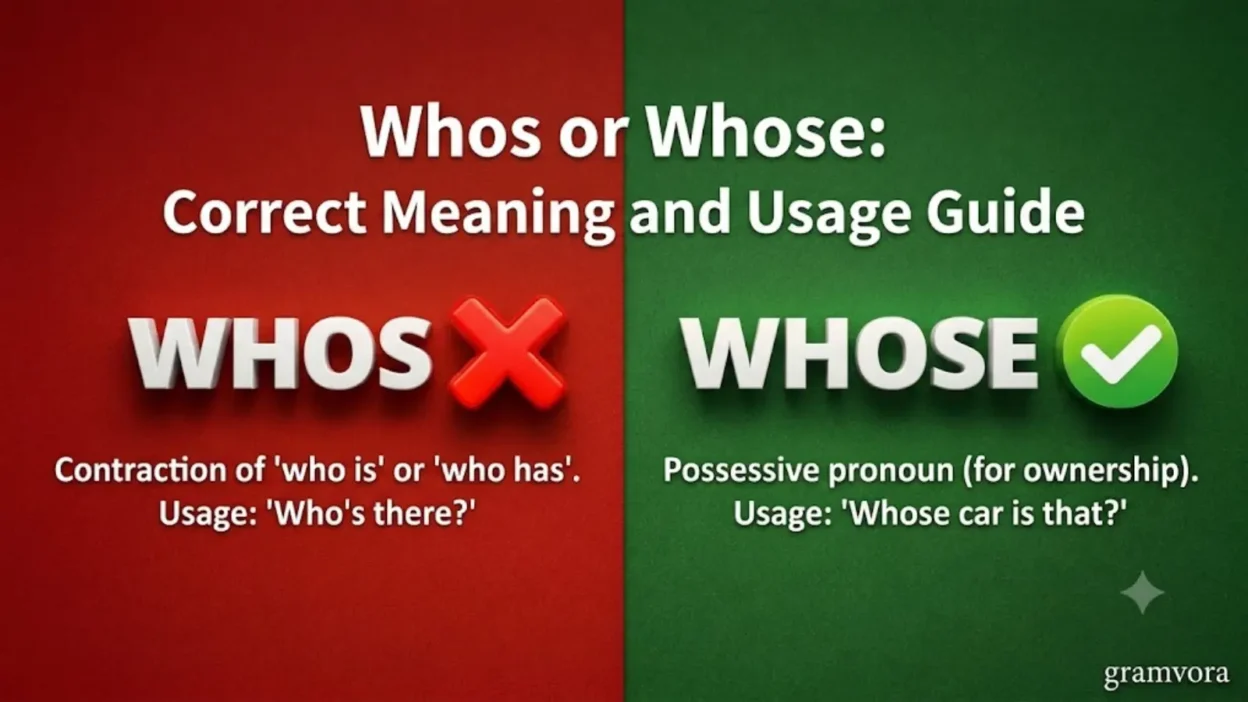
The correct choice is usually whose, not whos.
Use whose when you are talking about ownership, belonging, responsibility, authorship, or connection. For example, Whose phone is ringing? asks who the phone belongs to. The student whose project won tells us which student is connected to the winning project.
Whos without an apostrophe is not the standard spelling in regular US English. Most of the time, when people write whos, they really mean who’s, with an apostrophe. Who’s is a contraction. It means who is or who has.
That means the choice is not really between two equal words. Whose is a standard possessive form. Whos is usually a typing mistake or a missing-apostrophe version of who’s.
The easiest way to choose is to ask one simple question: can you replace the word with who is or who has? If yes, write who’s. If no, and the sentence is about possession or connection, write whose.
Quick Answer
Use whose when you mean “belonging to whom” or “connected to whom.”
Do not use whos in polished writing.
Incorrect: Whos jacket is on the chair?
Correct: Whose jacket is on the chair?
Incorrect: Whos coming to dinner?
Correct: Who’s coming to dinner?
The second example needs who’s, not whose, because the sentence means who is coming to dinner?
So the basic rule is:
Use whose for possession.
Use who’s for who is or who has.
Avoid whos in standard writing.
This matters because whose and who’s sound the same when spoken. You cannot rely on sound. You have to rely on meaning.
If the sentence is asking who owns something, use whose.
Why People Confuse Them
People confuse whos and whose because of sound, spelling, and apostrophes.
First, whose and who’s sound exactly alike in normal speech. When two words sound the same, writers often mix them up. The ear does not tell you which one to write.
Second, many people know that apostrophes can show possession. For example, Maria’s backpack means the backpack belongs to Maria. Because of that, some writers assume who’s must be possessive too. That is the mistake.
Who’s is not possessive. It is a contraction.
Who’s = who is
Who’s = who has
Examples:
Who’s at the door? = Who is at the door?
Who’s finished the assignment? = Who has finished the assignment?
Whose is the possessive form. It does not use an apostrophe.
Examples:
Whose door is open?
Whose assignment is missing?
Third, whos looks like a possible word because it resembles who, whose, and who’s. In fast texting or casual posts, people may drop apostrophes. But in clear writing, that missing apostrophe changes the quality of the sentence. It makes the word look unfinished or incorrect.
The confusion is understandable, but the fix is simple. Do not ask whether the word “looks possessive.” Ask what the sentence means.
Key Differences At A Glance
| Context | Best Choice | Why |
|---|---|---|
| Asking who owns something | whose | Shows possession or belonging |
| Asking who is doing something | who’s, not whos | Means “who is” |
| Asking who has done something | who’s, not whos | Means “who has” |
| Describing a person connected to a noun | whose | Links a person to something |
| Describing an object connected to another noun | whose | Can mean “of which” in some sentences |
| Writing for school or work | whose / who’s | These are standard forms |
| Fast informal typing | whos | Common missing-apostrophe error |
| Edited US English | avoid whos | It is usually not the accepted spelling |
Compact comparison:
- Whos: usually a misspelling or missing-apostrophe form of who’s
- Whose: the correct possessive form
- Who’s: means who is or who has
- Best test: replace the word with who is or who has
- Best habit: never use whos in careful writing
This comparison becomes easier once you stop treating whos and whose as equal choices. They are not equal in standard writing. Whose is a real possessive form. Whos is usually an error.
The extra form, who’s, matters because it explains where whos often comes from. When someone writes whos, the intended meaning is usually either who’s or whose. Your job as the writer is to choose the correct standard form.
Meaning and Usage Difference
Whose means “belonging to whom” or “connected with whom.” It can appear in questions and statements.
In questions, whose usually comes before a noun.
Use whose in questions about ownership, responsibility, or connection.
For example:
Whose phone is on the table?
Do you know whose keys are in the kitchen?
Can someone tell me whose turn it is to drive?
I still want to know whose idea started the group project.
Each sentence points to a person connected with something.
The phone belongs to someone.
The keys are connected to their owner.
A turn is assigned to a person.
An idea came from someone.
You can also use whose in statements when you want to connect a person, group, place, or thing to another detail.
I called the parent whose child left a backpack at school.
She is the writer whose article everyone shared.
That is the neighbor whose dog barks every morning.
We hired a designer whose portfolio matched our style.
In these sentences, whose works like a bridge. It connects one noun to another idea.
Whos does not have this role in standard writing. It does not correctly show possession, and it does not correctly form a contraction. If you write whos, readers may understand what you mean, but it will still look wrong in school, work, or published writing.
Incorrect: Whos report is on my desk?
Correct: Whose report is on my desk?
Incorrect: Whos leading the call?
Correct: Who’s leading the call?
The first sentence needs whose because it asks about the report. The second sentence needs who’s because it means who is leading the call.
Whose can also refer to things, companies, places, or groups when the sentence means “of which.” This use is common and natural.
We stayed in a hotel whose rooms faced the ocean.
The company whose app crashed sent an apology.
I read a book whose ending surprised me.
Some writers avoid this structure, but it is normal in standard English. It often sounds smoother than a longer phrase.
Tone, Context, and Formality
Whose is neutral.
Examples:
Whose lunch is in the fridge?
Please confirm whose signature is required.
The applicant whose resume we reviewed is available Friday.
The tone changes because of the sentence around the word, not because of whose itself. In a casual sentence, it sounds casual. In a professional sentence, it sounds professional.
Whos, on the other hand, looks careless in most formal or edited contexts. It may appear in a text message, a social post, or a quick note, but it is not the best spelling when clarity matters.
Casual but not polished: Whos going tonight?
Better: Who’s going tonight?
Casual but not polished: Whos bag is this?
Better: Whose bag is this?
There is also a pronunciation issue. Whose and who’s are pronounced the same: like hooz. Because they sound alike, readers cannot use pronunciation to decide the spelling. Meaning is the only reliable guide.
Use whose when the word points to a noun or a connection.
Whose apartment are we meeting at?
Whose notes should I copy?
Use who’s when the word can expand to who is or who has.
Who’s meeting us there?
Who’s copied the notes already?
Avoid whos unless you are quoting someone’s exact informal spelling. In your own writing, choose the standard form.
Which One Should You Use?
Use whose when the sentence is about ownership, relationship, responsibility, source, or connection.
Ask yourself: is something attached to a person, group, place, or thing?
If yes, whose is probably correct.
Whose wallet is this?
The wallet belongs to someone.
Whose shift starts at noon?
The shift is assigned to someone.
Whose name should go on the form?
The name belongs on the form.
Whose decision was it?
The decision came from someone.
Use whose in sentences that describe people too.
The student whose locker was open went to the office.
The coach whose team won shook everyone’s hand.
The woman whose car broke down called roadside help.
These sentences are not asking a question, but whose still shows connection.
Do not use whos as your final choice. When you see whos, pause and decide whether you need whose or who’s.
Try this test:
Replace the word with who is.
Whos calling?
Who is calling?
This works, so write who’s calling?
Now try another sentence:
Whos jacket is this?
Who is jacket is this?
That does not work, so write whose jacket is this?
Try who has too.
Whos seen my keys?
Who has seen my keys?
This works, so write who’s seen my keys?
Whos keys are these?
Who has keys are these?
That does not work, so write whose keys are these?
This test catches most mistakes quickly.
When One Choice Sounds Wrong
Whos sounds wrong when the sentence needs either whose or who’s in standard spelling.
Incorrect: Whos phone keeps buzzing?
Correct: Whose phone keeps buzzing?
The phone belongs to someone, so the sentence needs whose.
Incorrect: Whos at the front desk?
Correct: Who’s at the front desk?
The sentence means who is at the front desk, so it needs who’s.
Whose sounds wrong when the sentence means who is or who has.
Incorrect: Whose coming with us?
Correct: Who’s coming with us?
Incorrect: Whose been to Chicago before?
Correct: Who’s been to Chicago before?
Incorrect: Whose responsible for the update?
Correct: Who’s responsible for the update?
In each wrong sentence, whose does not show possession. It is being used where a contraction belongs.
A helpful way to spot the problem is to look at the word after it. If the next word is a noun, whose may be right.
Whose phone
Whose car
Whose idea
Whose team
Whose account
If the next word is a verb or adjective, who’s may be right.
Who’s calling
Who’s ready
Who’s available
Who’s finished
Who’s responsible
This is not a perfect rule for every sentence, but it helps in common everyday writing.
Common Mistakes (and Quick Fixes)
Mistake: Whos book is on the counter?
Fix: Whose book is on the counter?
Why: The sentence asks who owns the book.
Mistake: Whose going to pick up dinner?
Fix: Who’s going to pick up dinner?
Why: The sentence means who is going.
Mistake: I don’t know whos in charge.
Fix: I don’t know who’s in charge.
Why: The sentence means who is in charge.
Mistake: The employee who’s badge was missing checked in late.
Fix: The employee whose badge was missing checked in late.
Why: The badge belongs to the employee. The possessive form is whose.
Mistake: Whos already submitted the form?
Fix: Who’s already submitted the form?
Why: The sentence means who has already submitted the form.
Mistake: Whose available after 3 p.m.?
Fix: Who’s available after 3 p.m.?
Why: The sentence means who is available.
Mistake: Whos name should I write down?
Fix: Whose name should I write down?
Why: The name is connected to a person.
Mistake: Ask the person who’s package arrived.
Fix: Ask the person whose package arrived.
Why: The package belongs to, or is connected to, that person.
Mistake: Whos turn is it to pay?
Fix: Whose turn is it to pay?
Why: The turn belongs to someone.
Mistake: Whose had experience with this software?
Fix: Who’s had experience with this software?
Why: The sentence means who has had experience.
The quick fix is always the same: expand the word. If who is or who has fits, use who’s. If the sentence is about belonging or connection, use whose.
Everyday Examples
Here are more natural examples to show how whose works in real writing.
Each question asks about possession, connection, or responsibility.
Whose in everyday statements:
I found the student whose folder was missing.
That is the neighbor whose mailbox got damaged.
She thanked the nurse whose kindness helped her relax.
We hired the photographer whose style matched our wedding.
I called the customer whose order was delayed.
They interviewed the chef whose restaurant just opened downtown.
In these examples, whose connects a person to something.
Now compare those with who’s, because this is where whos often appears by mistake.
Incorrect: Whos bringing the snacks?
Correct: Who’s bringing the snacks?
Incorrect: Whos ready for the test?
Correct: Who’s ready for the test?
Incorrect: Whos been using my desk?
Correct: Who’s been using my desk?
Incorrect: Whos calling this late?
Correct: Who’s calling this late?
These sentences are not about ownership. They mean who is or who has.
Now compare pairs:
Whose phone is ringing?
This asks who owns the phone.
Who’s calling?
This asks who is making the call.
Whose meeting is this?
This asks who the meeting belongs to or who organized it.
Who’s meeting us there?
This asks who is meeting us there.
Whose dog is outside?
This asks who owns the dog.
Who’s outside?
This asks who is outside.
The spelling changes because the meaning changes.
Dictionary-Style Word Details
Verb
Whos: Not commonly used as a verb in standard US English. In this comparison, whos is usually a spelling mistake, not an action word.
Incorrect: He whos the answer.
This does not work as standard English.
If the intended meaning is who is, write who’s.
Correct: Who’s answering the phone?
If the intended meaning is possession, write whose.
Correct: Whose answer was accepted?
Whose: Not used as a verb. Whose does not show action. It shows possession or connection.
Correct: Whose car is blocking the driveway?
Correct: That is the artist whose painting sold yesterday.
In both sentences, whose connects a noun to a person or thing. It does not act like a verb.
Noun
Whos: Not commonly used as a noun in standard US English. You may see whos online as a missing-apostrophe form, but that does not make it the normal noun form in regular writing.
If someone writes Whos at the door?, the standard version is Who’s at the door?
If someone writes Whos jacket is this?, the standard version is Whose jacket is this?
Whose: Not a noun. It works as a possessive form. It can appear before a noun, or it can stand in for a noun phrase when the noun is already understood.
Before a noun:
Standing on its own:
Whose is this?
I found a phone, but I don’t know whose it is.
In whose is this, the noun is understood from the situation. The speaker may be pointing at a phone, jacket, notebook, or other item.
Synonyms
Whos: No true synonym applies because whos is not the standard form in this comparison. It usually needs to be corrected to either who’s or whose.
If the intended meaning is who is, the correct form is who’s.
Who’s next? = Who is next?
If the intended meaning is who has, the correct form is also who’s.
Who’s finished? = Who has finished?
If the intended meaning is possession, the correct form is whose.
Whose coat is this? = The coat belongs to whom?
Whose: Closest plain alternatives include belonging to whom, of whom, and of which. These are not always natural word-for-word replacements, but they explain the meaning.
Whose phone is this?
Closest plain alternative: This phone belongs to whom?
The writer whose book won the award gave a speech.
Closest plain alternative: The writer of whom the book won the award gave a speech.
That version sounds stiff, so whose is usually better.
A house whose roof was damaged needs repairs.
Closest plain alternative: A house of which the roof was damaged needs repairs.
Again, whose sounds smoother.
Clear antonyms do not fit this pair well. Since whose asks or shows possession, it does not have a simple opposite that works in normal sentences.
Example Sentences
Whos:
Incorrect: Whos at the door?
Correct: Who’s at the door?
Incorrect: Whos backpack is under the table?
Correct: Whose backpack is under the table?
Incorrect: Whos been using my account?
Correct: Who’s been using my account?
Incorrect: Whos responsibility is this?
Correct: Whose responsibility is this?
These examples show why whos is risky. Sometimes the correction is who’s. Sometimes the correction is whose. The meaning decides.
Whose:
Whose phone number did you save?
Did you ask whose coat you borrowed?
I’m not sure whose office we are meeting in.
Please confirm whose email should receive the invoice.
The player whose ankle was injured left the game.
After the flood, the family whose house was damaged stayed with relatives.
We chose the plan whose cost made the most sense.
I talked to the manager whose team handled the issue.
These sentences all use whose to show ownership, source, or connection.
Word History
Whos: No separate standard word history is needed for whos in this comparison because it is not usually treated as a separate standard word in ordinary US English. It is most often a missing-apostrophe spelling of who’s or a mistaken spelling used where whose belongs.
The useful modern point is simple: do not use whos in careful writing.
Whose: Whose is the possessive form connected to who. In modern English, it is used to ask or explain who something belongs to, who something is connected with, or which thing something belongs to.
Writers do not need a deep history lesson to use it correctly. The main point is that whose is the standard possessive form, even though it does not have an apostrophe.
That can feel odd because many possessive nouns use apostrophes, such as Jordan’s laptop or the company’s policy. Pronouns work differently. Forms like his, hers, its, theirs, and whose show possession without apostrophes.
Phrases Containing
Whos:
No standard everyday phrases use whos as the preferred spelling. When this spelling appears, it usually needs correction.
Write who’s when you mean:
who’s next
who’s there
who’s calling
who’s coming
who’s ready
who’s finished
who’s in charge
Write whose when you mean possession or connection.
Whose:
Common phrases and sentence patterns include:
whose turn
whose fault
whose idea
whose name
whose phone
whose car
whose house
whose job
whose responsibility
whose decision
whose account
whose team
whose side
whose work
whose story
These phrases are common because everyday life often involves ownership, credit, blame, responsibility, and connection.
Conclusion
Use whose when the sentence is about possession, ownership, responsibility, source, or connection.
Whos is usually not correct in standard US English. It is most often a missing-apostrophe form of who’s or a mistaken spelling where whose should appear.