Introduction
Saviour or savior is a spelling-choice question, not a meaning question. Both spellings refer to the same word: a person who saves, rescues, or brings help in a serious situation.
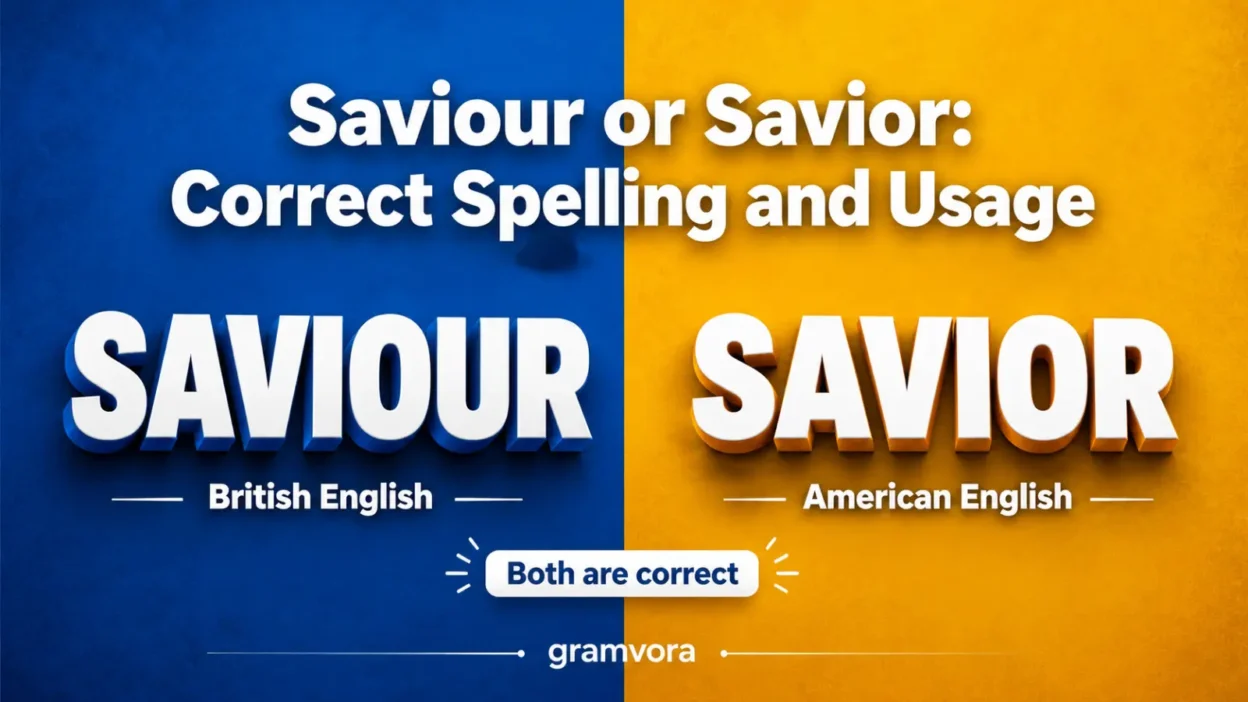
The main difference is regional. In American English, savior is the standard spelling. In British English and many Commonwealth contexts, saviour is the usual spelling. Neither spelling changes the meaning, grammar role, or basic pronunciation.
Quick Answer
Use savior for American English. Use saviour for British English and many Commonwealth audiences. Both spellings are correct, but they belong to different spelling traditions. For a US article, school paper, email, or business page, savior is usually the better choice.
Why People Confuse Them
People confuse these spellings because both appear in books, songs, religious writing, news articles, and online posts. A US reader may see saviour in British writing and think it looks formal or biblical. A UK reader may see savior and think the missing u looks incomplete.
The confusion also comes from similar spelling pairs. American English often uses -or, as in color and honor. British English often uses -our, as in colour and honour. Savior and saviour follow that same broad pattern.
Key Differences At A Glance
| Context | Best Choice | Why |
|---|---|---|
| American English | savior | This is the standard US spelling. |
| British English | saviour | This is the usual UK spelling. |
| Canadian, Australian, or New Zealand English | saviour | These varieties commonly keep the u spelling. |
| US school or business writing | savior | It matches American spelling expectations. |
| Quoting a title or source | Keep the original spelling | Titles, names, and direct wording should not be silently changed. |
| Religious writing for a US audience | Savior | The US spelling still applies; capitalize only when used as a title. |
Are They the Same Word?
Yes. Saviour and savior are the same word with different regional spellings. They both mean a person who saves someone or something from danger, loss, harm, or ruin.
They are also pronounced the same in normal speech: SAY-vyer. The extra u in saviour does not add a separate sound. The difference is visible in writing, not heard in pronunciation.
- saviour: same noun, mainly British-style spelling.
- savior: same noun, mainly American-style spelling.
- meaning and sound: the same in ordinary use.
US vs UK Preference
For a US audience, choose savior. It looks natural in American English and fits the spelling pattern used in words like color, favor, and honor.
For a UK audience, choose saviour. It fits the spelling pattern used in words like colour, favour, and honour.
This is a preference based on spelling convention, not a rule about meaning. A US reader will usually understand saviour, and a UK reader will usually understand savior. Still, the less expected spelling can look out of place in edited writing.
Which Spelling Should You Use?
Use savior if your writing is for readers in the United States. This includes US blogs, school assignments, brand copy, emails, captions, and formal documents.
Use saviour if your writing follows British, Canadian, Australian, or similar spelling style. This choice fits readers who expect the -our ending.
The best rule is simple: match your audience and stay consistent. Do not write savior in one paragraph and saviour in the next unless you are quoting different sources or comparing the spellings directly.
When One Spelling Looks Wrong
Saviour can look wrong in American writing because US spelling usually drops the u in this word. It is not truly incorrect, but it may look like a non-US spelling choice.
Savior can look wrong in British writing because British spelling usually keeps the u. Again, the meaning is still clear, but the spelling may feel too American for that context.
Capitalization is a separate issue. Use lowercase for a general rescuer: “The nurse was a savior during the emergency.” Use uppercase when the word is used as a religious title: “Christians refer to Jesus as the Savior.”
Common Mistakes (and Quick Fixes)
One common mistake is treating saviour and savior as different words. They are not different words. They are regional spellings of the same noun.
Another mistake is switching spellings in the same article. Pick one spelling style and keep it unless you are discussing the comparison.
A third mistake is thinking the u changes the pronunciation. It does not. Both spellings sound the same in everyday speech.
Some writers also confuse spelling with capitalization. Savior may be capitalized in religious titles, but the spelling choice still depends on the English variety you are using.
Everyday Examples
In American English, write: “The backup generator was a savior during the outage.”
British English usually keeps the u: “The backup generator was a saviour during the outage.”
A US sentence might say: “Her quick thinking made her the team’s savior.”
In UK style, the same sentence becomes: “Her quick thinking made her the team’s saviour.”
For general US writing, savior fits naturally: “This app was a real savior when my schedule changed.”
When used as a religious title in US style, capitalize it: “The hymn refers to Jesus as the Savior.”
UK religious writing may use the British spelling: “The hymn refers to Jesus as the Saviour.”
Dictionary-Style Word Details
Verb
saviour: Not commonly used as a verb in standard English. It is normally a noun.
savior: Not commonly used as a verb in standard English. It is normally a noun.
Use save, rescue, or deliver when you need a verb.
Noun
saviour: A person who saves, rescues, or helps someone or something in danger or trouble. This spelling is usual in British English.
savior: A person who saves, rescues, or helps someone or something in danger or trouble. This spelling is usual in American English.
Both spellings can also refer to Jesus in Christian writing, especially when capitalized as a title.
Synonyms
saviour: Closest plain alternatives include rescuer, protector, deliverer, defender, and guardian.
savior: Closest plain alternatives include rescuer, protector, deliverer, defender, and guardian.
A clear opposite is hard to give in every context. In some sentences, threat, enemy, or destroyer may work, but they are not exact opposites in all uses.
Example Sentences
saviour: “The new coach was seen as the club’s saviour after a difficult season.”
savior: “The new coach was seen as the team’s savior after a difficult season.”
saviour: “Many people called the volunteer a saviour after the flood.”
savior: “Many people called the volunteer a savior after the flood.”
saviour: “The sermon focused on Christ as Saviour.”
savior: “The sermon focused on Christ as Savior.”
Word History
saviour: This spelling reflects the British-style -our ending used in several words with older French or Latin influence.
savior: This spelling reflects the American-style -or ending, which is common in US spelling for words such as color, honor, and favor.
The safe practical point is this: both forms exist because English spelling developed differently in American and British traditions.
Phrases Containing
saviour: Common phrases include the Saviour, a personal saviour, would-be saviour, and white saviour.
savior: Common phrases include the Savior, a personal savior, would-be savior, and white savior.
For US writing, use the savior versions unless you are quoting a British source, using a title that already contains saviour, or following a non-US house style.
FAQs
Is it saviour or savior?
Both saviour and savior are correct spellings. The difference is regional. Savior is the standard spelling in American English. Saviour is the usual spelling in British English and many Commonwealth countries.
Which spelling should I use in the US?
Use savior in American English. It looks natural to US readers and matches other American spellings like color, favor, and honor.
Is saviour wrong in American English?
Saviour is not wrong in meaning, but it is not the usual US spelling. In American school, business, blog, or formal writing, savior is usually the better choice.
Is savior wrong in British English?
Savior is understandable in British English, but it looks American. For British, Australian, Canadian, or similar writing styles, saviour is usually preferred.
Do saviour and savior mean the same thing?
Yes. Saviour and savior mean the same thing. Both refer to a person who saves, rescues, protects, or helps someone in danger or trouble.
Do saviour and savior sound different?
No. Both spellings are usually pronounced the same way: SAY-vyer. The extra u in saviour changes the spelling, not the sound.
Should Savior be capitalized?
Capitalize Savior when it is used as a religious title, especially for Jesus in Christian writing. Use lowercase when you mean a general rescuer, as in “She was a savior during the emergency.”
What is the plural of savior or saviour?
The plural of savior is saviors. The plural of saviour is saviours. Use the plural that matches your spelling style.
Conclusion
Saviour and savior are both correct spellings of the same noun. The difference is regional, not grammatical or semantic. Use savior for American English and saviour for British or Commonwealth English.
For most US readers, savior is the safest choice. It looks natural, matches American spelling style, and keeps your writing consistent. Use saviour only when your audience, source, title, or house style calls for the British spelling.