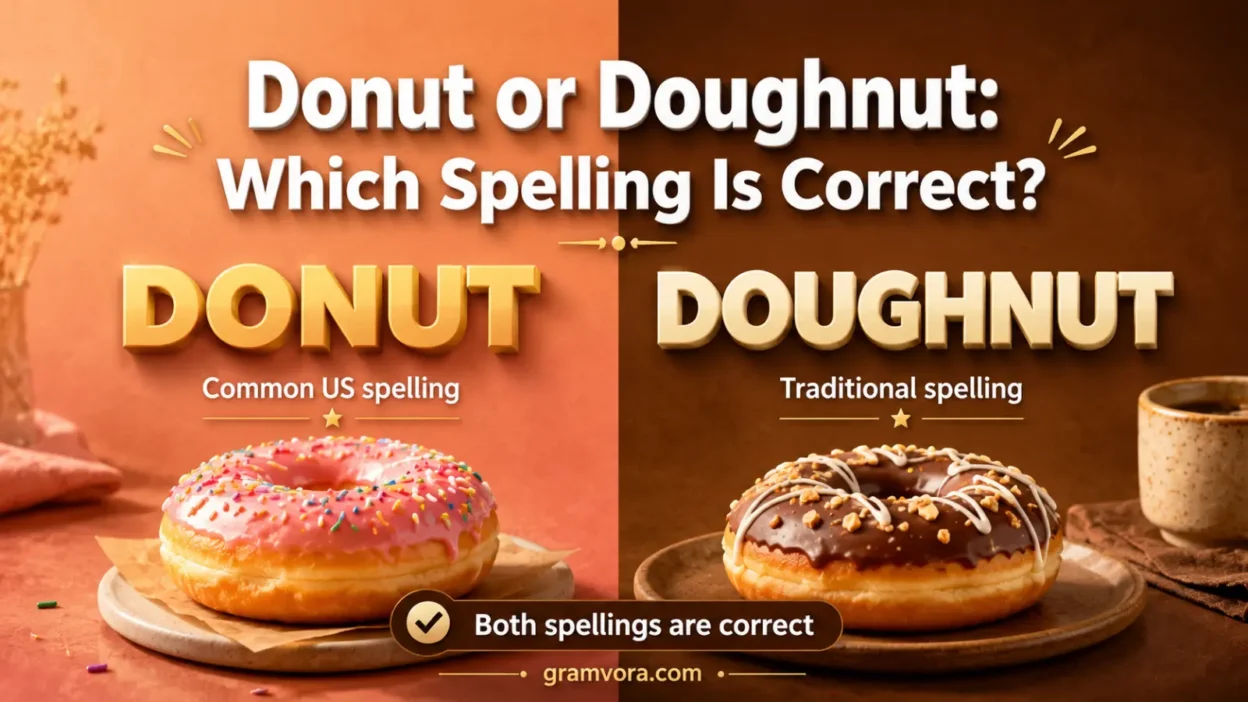
If you are choosing between donut or doughnut, both spellings can be correct. They name the same sweet fried pastry, and they are usually pronounced the same way: DOH-nut.
The difference is mainly style and context. Doughnut is the older, more traditional spelling. Donut is a shorter spelling that is very common in everyday American English, especially in shops, menus, ads, and brand names.
Quick Answer
Doughnut is the safer spelling for formal writing, schoolwork, journalism, and polished recipes. Donut is also correct, especially in casual US writing and business names. The two spellings mean the same thing, so the choice is not about meaning. It is about tone, setting, and style.
Why People Confuse Them
People confuse these spellings because English has many words where spelling does not match sound. In doughnut, the first part looks like dough, but the whole word is said like DOH-nut.
The shorter spelling donut feels more direct because it matches the sound more closely. That makes it easy to read, easy to fit on signs, and easy to use in brand names.
Another reason is daily exposure. In the United States, people see both forms: doughnut in dictionaries, recipes, and formal writing, but donut on shop signs, boxes, social posts, and menus.
Key Differences At A Glance
| Context | Best Choice | Why |
|---|---|---|
| Formal writing | doughnut | More traditional and safer in edited prose |
| School assignments | doughnut | Less likely to be marked as too casual |
| News or publication style | doughnut | Commonly preferred by major style guidance |
| Casual US writing | donut | Common, clear, and widely accepted |
| Brand names | Use the brand’s spelling | Names should match the official spelling |
| Menus and signs | donut or doughnut | Both work, depending on the business style |
| UK-focused writing | doughnut | The longer spelling is usually safer |
| Talking about car skids | donuts | Common in the phrase “do donuts” |
Small spelling comparison:
| Feature | donut | doughnut |
|---|---|---|
| Meaning | Same pastry | Same pastry |
| Tone | Casual, modern, commercial | Traditional, polished, formal |
| US use | Very common | Also standard |
| UK use | Seen, but less formal | Usually safer |
| Best fit | Menus, signs, everyday writing | Edited writing, recipes, schoolwork |
Are They the Same Word?
Yes. Donut and doughnut are spelling variants of the same word. They do not name different foods.
A glazed donut and a glazed doughnut are the same thing. A jelly donut and a jelly doughnut are the same thing. The spelling does not change the flavor, shape, filling, or meaning.
The pronunciation is also usually the same: DOH-nut. The spelling doughnut may look longer and more old-fashioned, but it is not pronounced as two separate words.
US vs UK Preference
In American English, both donut and doughnut are accepted. The shorter spelling is common in casual writing and food branding, while the longer spelling often appears in more formal or edited writing.
For a US audience, donut does not look strange in everyday contexts. A sign that says “fresh donuts” feels normal. A text that says “I brought donuts for the office” also feels natural.
In British English and other international contexts, doughnut is usually the safer spelling. Donut may still appear, especially in brand names or casual writing, but the longer form tends to look more standard in formal British usage.
Which Spelling Should You Use?
Use doughnut when you want the safest spelling. It works well in school writing, formal recipes, articles, news copy, and general edited prose.
Use donut when the tone is casual, modern, or commercial. It works well for shop signs, short captions, menu boards, social posts, and friendly everyday writing.
For brand names, copy the brand. If a business spells its name with Donut, do not change it to Doughnut. Proper names keep their official spelling.
Good rule: when in doubt, choose doughnut. When writing casually for a US audience, donut is fine.
When One Spelling Looks Wrong
Donut can look too casual in formal writing. A school paper, cookbook manuscript, or newspaper article may look more polished with doughnut.
Doughnut can look overly formal on a small menu board or playful shop sign. A business may prefer donut because it is shorter and more direct.
Neither spelling is automatically wrong. The problem usually comes from using the wrong tone for the setting.
For example, “The bakery sells handmade doughnuts” sounds polished. “Grab a donut before the meeting” sounds casual and natural.
Common Mistakes (and Quick Fixes)
One common mistake is saying donut is wrong. It is not. It is an accepted spelling, especially in American English.
Another mistake is saying doughnut is only British. That is also not true. American writers still use doughnut, especially in formal contexts.
A third mistake is switching spellings in the same article or menu. Pick one spelling and stay consistent, unless you are writing a brand name.
Also, do not change a company’s official spelling. If a shop uses Donut in its name, keep that spelling. If a recipe title uses doughnut, do not shorten it unless you are editing for a specific house style.
Quick fixes:
Keep one spelling throughout the same piece.
Everyday Examples
I stopped by the bakery for a glazed donut.
The recipe explains how to make yeast-raised doughnuts at home.
She brought two dozen donuts to the office.
The article described the history of the American doughnut.
This shop sells mini donuts with cinnamon sugar.
The cookbook includes a chapter on filled doughnuts.
We ordered coffee and a chocolate donut before the road trip.
The bakery is known for handmade sour cream doughnuts.
He did donuts in the empty parking lot after the storm.
The kids wanted donut holes for the party.
Dictionary-Style Word Details
Verb
donut: Not commonly used as a standalone verb in standard US English. It appears most naturally in the phrase do donuts, meaning to drive in tight circles.
doughnut: Not commonly used as a standalone verb in everyday US English. The phrase do doughnuts is also possible, but do donuts is more common in casual US references to car skids.
Noun
donut: A common US spelling for a small fried pastry, often ring-shaped or filled. It can also refer informally to a ring-shaped object or a circular car skid.
doughnut: The traditional spelling for the same pastry. It also works for ring-shaped objects and appears in more formal or edited writing.
Synonyms
donut: Closest plain alternatives include fried pastry, sweet roll, and pastry ring. These are not perfect synonyms because a donut is a specific kind of fried pastry.
doughnut: Closest plain alternatives are the same: fried pastry, sweet roll, and pastry ring. There is no useful everyday antonym for either spelling.
Example Sentences
Use donut for casual American writing: I grabbed a maple donut and coffee on the way to work.
A shop sign might say: Fresh donuts every morning.
In a driving context, donut can also describe a circular skid: The driver left donut marks in the parking lot.
Use doughnut when you want a more traditional or polished spelling: The bakery makes old-fashioned doughnuts from scratch.
A cookbook might say: She tested three doughnut recipes for the final chapter.
For formal explanation, the longer spelling works well: The article used the traditional spelling, doughnut.
Word History
doughnut: This is the older, traditional spelling. It connects the word to dough, which makes sense because the pastry is made from fried dough.
donut: This is the shorter spelling. It became accepted because writers and businesses used it often enough for dictionaries to recognize it. Its shorter form also made it attractive for signs, advertising, and brand names.
The history does not create a meaning difference. It only helps explain why two spellings exist.
Phrases Containing
donut: donut shop, donut hole, glazed donut, mini donut, donut box, do donuts, donut-shaped
doughnut: doughnut shop, doughnut hole, glazed doughnut, filled doughnut, ring doughnut, handmade doughnut, doughnut-shaped
Both spellings can fit many of the same phrases. The better choice depends on tone and style.
FAQs
Is donut or doughnut correct?
Both donut and doughnut are correct spellings. They mean the same thing: a sweet fried pastry that may be ring-shaped, filled, glazed, or topped. Doughnut is the older and more traditional spelling, while donut is a shorter spelling that is very common in everyday American English.
Which spelling is better in American English?
In American English, both spellings are accepted. Donut is common in casual writing, shop signs, menus, ads, and brand names. Doughnut is usually the better choice for formal writing, schoolwork, recipes, journalism, and edited content. When the tone is formal, choose doughnut.
Is donut just a misspelling of doughnut?
No. Donut started as a shorter form of doughnut, but it is now widely accepted. It may look more casual, but it is not simply a spelling mistake. The key is context. Donut fits casual US writing, while doughnut looks more traditional and polished.
Do donut and doughnut mean different things?
No. Donut and doughnut mean the same thing. A chocolate donut and a chocolate doughnut are the same food. The spelling does not change the meaning, ingredients, shape, or pronunciation. The difference is mainly style, tone, and spelling preference.
Should I use donut or doughnut in a recipe?
Use doughnut if you want the recipe to sound traditional, polished, or cookbook-style. Use donut if the recipe has a casual, friendly, or modern tone. Either spelling can work, but stay consistent throughout the recipe.
Why do many shops use donut instead of doughnut?
Many shops use donut because it is shorter, simpler, and easier to read on signs, boxes, menus, and ads. It also feels casual and modern. Business names often choose the shorter spelling for branding, but that does not make doughnut wrong.
Conclusion
Donut and doughnut are both correct spellings of the same word. The safest choice is doughnut, especially for formal writing, schoolwork, recipes, and edited content.
For casual American writing, donut is also acceptable and very common. Use it for menus, signs, captions, and relaxed everyday sentences.
The spelling does not change the meaning. It only changes the tone. Choose doughnut when you want a traditional feel, and choose donut when you want a shorter, casual US style.