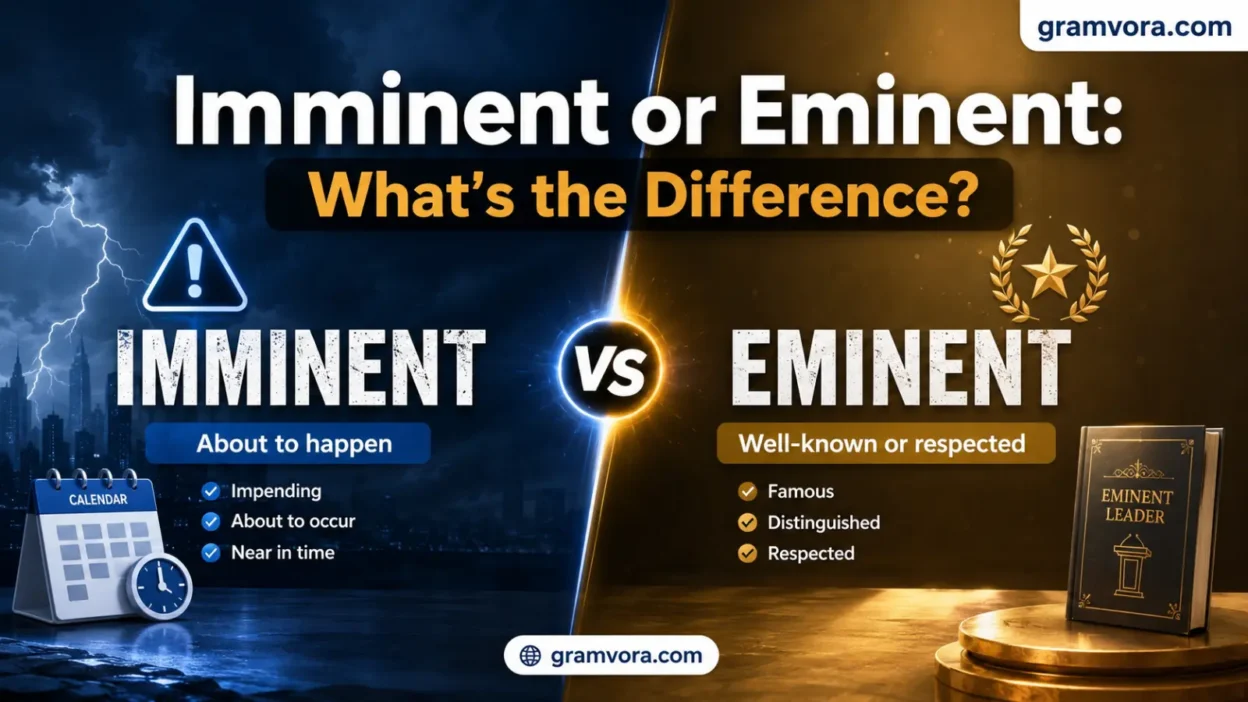
Both imminent and eminent are correct English words, but they express different ideas. Use imminent for something expected to happen very soon. Use eminent for a person or thing that is highly respected, important, or distinguished.
Because the words look and sound similar, choosing the wrong one is easy. However, checking whether your sentence is about time or status usually reveals the correct choice.
Quick Answer
Use imminent when an event, change, danger, or result is about to occur. For example, “The storm is imminent.”
Use eminent when describing someone or something that stands out because of importance, achievement, or reputation. For example, “She is an eminent physician.”
The words are not interchangeable.
Why People Confuse Them
The spellings differ by only a few letters, and the pronunciations are close. In normal speech, the first vowel may be the only clearly noticeable difference.
Their grammatical roles also match: both words are adjectives. As a result, either one can appear before a noun or after a linking verb. Meaning—not sentence position—determines which word belongs.
Another source of confusion is the fixed legal phrase eminent domain. Since government action may be approaching, some writers mistakenly use imminent domain. The established phrase is always eminent domain.
Key Differences At A Glance
| Context | Best Choice | Why |
|---|---|---|
| A storm expected very soon | imminent | It describes near timing |
| A respected scientist | eminent | It describes high professional standing |
| A serious and approaching threat | imminent | The threat is close to occurring |
| A distinguished historian | eminent | The historian is widely respected |
| An arrival expected shortly | imminent | The arrival is near |
| A recognized legal expert | eminent | The expert stands out in the field |
| Government power to take property for public use | eminent | The fixed phrase is eminent domain |
Meaning and Usage Difference
The central difference is simple: imminent concerns timing, while eminent concerns distinction.
- Imminent: About to happen or likely to happen very soon. It commonly modifies events, changes, dangers, arrivals, departures, deadlines, and outcomes.
- Eminent: Highly respected, prominent, or important. It most often modifies people and professional roles, such as scholars, physicians, judges, historians, and researchers.
Although imminent often appears with unpleasant situations—such as danger, collapse, or disaster—it is not limited to bad events. An arrival, promotion, victory, or product release can also be imminent.
Likewise, eminent does not merely mean famous. It usually suggests recognized importance, achievement, or respect within a field.
Tone, Context, and Formality
Both words are standard in American English, but they often sound more formal than everyday alternatives.
Imminent appears frequently in warnings, forecasts, reports, medical discussions, and professional writing. In casual conversation, people may simply say “about to happen” or “coming soon.”
Eminent has a respectful and complimentary tone. It is common in academic, legal, medical, historical, and professional contexts. In everyday speech, “well-known,” “respected,” or “leading” may sound more natural.
Pronunciation also helps distinguish them. Imminent begins with an “im” sound, as in image: IM-uh-nunt. Eminent begins with an “em” sound, like the name of the letter M: EM-uh-nunt. The difference is small but meaningful.
Which One Should You Use?
Ask one direct question: Is the sentence about something happening soon, or about someone’s standing?
Choose imminent when the answer involves nearness in time:
“The announcement appears imminent.”
Choose eminent when the answer involves respect, distinction, or importance:
“An eminent constitutional scholar reviewed the case.”
A useful memory aid is to connect imminent with “in a minute” and eminent with “esteemed.” These reminders are not definitions, but they can help you choose quickly.
When One Choice Sounds Wrong
Using eminent for an approaching event gives the event a sense of status rather than timing. “The eminent storm” sounds as though the storm is distinguished or respected, which is not the intended meaning.
Using imminent for a respected professional suggests that the person is about to happen. “An imminent professor spoke at the conference” therefore sounds illogical.
The surrounding noun usually makes the problem easy to detect. Storms, deadlines, arrivals, and threats are commonly imminent. Scholars, physicians, judges, and other respected experts may be eminent.
Common Mistakes (and Quick Fixes)
Incorrect: The city prepared for the eminent hurricane.
Correct: The city prepared for the imminent hurricane.
Incorrect: The university invited an imminent historian.
Correct: The university invited an eminent historian.
Incorrect: The county used imminent domain to acquire the land.
Correct: The county used eminent domain to acquire the land.
Incorrect: The patient was in eminent danger.
Correct: The patient was in imminent danger.
A quick fix is to replace the word mentally. If about to happen fits, choose imminent. If highly respected fits, choose eminent.
Everyday Examples
The weather service warned residents that flooding was imminent.
With the deadline imminent, the team finished the final review.
The flashing dashboard light suggested that engine failure was imminent.
After the final vote, approval of the proposal seemed imminent.
The museum invited an eminent historian to lead the discussion.
Her father was an eminent surgeon known for training younger physicians.
Several eminent researchers contributed to the public health report.
The court heard testimony from an eminent expert in property law.
The evacuation order came after officials identified an imminent threat.
An eminent architect presented the plans for the new civic center.
Dictionary-Style Word Details
Verb
- Imminent: Not used as a verb in standard American English.
- Eminent: Not used as a verb in standard American English.
Both words function as adjectives.
Noun
- Imminent: Not normally used as a noun. The related noun is imminence, meaning the state of being about to happen.
- Eminent: Not normally used as a noun. The related noun is eminence, meaning high rank, distinction, or prominence.
Synonyms
- Imminent: Impending, approaching, looming, near, at hand. Clear opposites include distant and remote.
- Eminent: Distinguished, prominent, renowned, notable, respected. Context-dependent opposites include obscure and little-known.
These alternatives are close in meaning, but they may differ in tone. For example, looming often sounds threatening, while approaching is more neutral.
Example Sentences
- Imminent: “Officials said no immediate closure was planned, but major repairs were imminent.”
- Imminent: “The crowd grew quiet as the winner’s announcement became imminent.”
- Eminent: “The panel included an eminent judge with decades of appellate experience.”
- Eminent: “She studied under an eminent scholar of American literature.”
Word History
The two words have related Latin histories, which helps explain their similar spelling.
Eminent developed from the idea of standing out or rising above others. That physical idea later produced the modern sense of being distinguished or prominent.
Imminent developed from the idea of overhanging, leaning toward, or being close at hand. That sense led to its modern meaning of being about to happen.
Their histories are related, but their current meanings remain separate.
Phrases Containing
- Imminent: Imminent danger, imminent threat, imminent arrival, imminent collapse, imminent departure.
- Eminent: Eminent scholar, eminent physician, eminent historian, eminent authority, eminent domain.
The phrase eminent domain is fixed. It should never be written as imminent domain.
FAQs
What is the difference between imminent and eminent?
Imminent means that something is expected to happen very soon. Eminent describes someone or something that is highly respected, distinguished, or important. For example, an imminent storm is approaching, while an eminent scientist is widely respected.
Is it imminent danger or eminent danger?
The correct phrase is imminent danger. It refers to a threat that is likely to occur very soon. Eminent danger is incorrect because eminent describes status or distinction, not approaching risk.
Is it eminent domain or imminent domain?
The correct legal phrase is eminent domain. It refers to the government’s power to acquire private property for public use under legal conditions. Imminent domain is a common error.
Can imminent describe a positive event?
Yes. Although imminent often appears with negative events, it can describe anything expected soon. A promotion, wedding, victory, product launch, or successful agreement may all be imminent.
Can eminent describe an event?
Usually, eminent describes a respected person, expert, organization, position, or achievement. It does not normally describe an approaching event. For events that are about to happen, use imminent instead.
Are imminent and eminent pronounced differently?
Yes, but the difference is small. Imminent is pronounced approximately “IM-uh-nunt,” while eminent sounds like “EM-uh-nunt.” Paying attention to the first vowel can help you recognize the intended word.
What is an easy way to remember imminent versus eminent?
Connect imminent with “in a minute” because both suggest something happening soon. Connect eminent with “esteemed” because both relate to respect and distinction.
Are imminent and eminent interchangeable?
No. They are both adjectives, but their meanings are different. Imminent relates to time, while eminent relates to reputation, importance, or professional standing.
Conclusion
Choose imminent for something that is about to happen and eminent for someone or something that is highly respected or distinguished.
Remember the basic contrast: imminent is about time; eminent is about standing. Once you identify the idea your sentence expresses, the correct word becomes clear.