
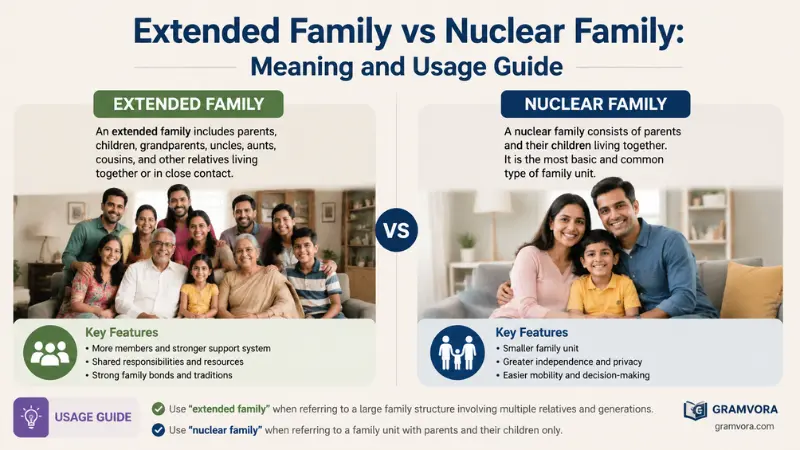
Both extended family and nuclear family are correct terms. The right choice depends on which family group you mean.
A nuclear family refers to parents and their children considered as a family unit. An extended family goes beyond that core group to include relatives such as grandparents, aunts, uncles, cousins, or other family members.
The terms can overlap in real life. A family may have a nuclear family at its center while also being part of a much larger extended family.
Quick Answer
Use nuclear family when you mean the parents-and-children family unit.
Use extended family when you mean that family unit plus additional relatives.
For example:
- “My nuclear family includes my spouse and our two children.”
- “We’re visiting my extended family for Thanksgiving.”
Neither term is more correct. They describe different scopes of family relationships.
Why People Confuse Them
The confusion comes partly from the fact that an extended family can contain a nuclear family.
Imagine two parents and their children. That group can be described as a nuclear family. If the grandparents, aunts, uncles, and cousins are included in the discussion, the broader group can be called an extended family.
There is also some flexibility in how people use extended family. It can describe relatives who live in the same household, but it can also describe relatives who live elsewhere and remain part of the wider family network.
So living arrangements alone do not always settle the question.
Key Differences At A Glance
| Context | Best Choice | Why |
|---|---|---|
| Parents and their children as one family unit | Nuclear family | It focuses on the core parent-and-child group. |
| Parents, children, and grandparents | Extended family | The group includes relatives beyond the core unit. |
| A family reunion with cousins and aunts | Extended family | The term covers the wider group of relatives. |
| A discussion focused only on parents and children | Nuclear family | The narrower family unit is what matters. |
| Relatives who live elsewhere but remain closely involved | Extended family | The term can cover relatives beyond the immediate family unit. |
Compact comparison:
- Nuclear family: narrower family unit centered on parents and children.
- Extended family: broader family group that includes additional relatives.
- Relationship: an extended family may include a nuclear family within it.
- Living arrangement: neither term should automatically be reduced to “one house” versus “separate houses.”
Meaning and Usage Difference
The main difference is who is included.
A nuclear family is normally described in terms of parents and their children. The expression is especially common when discussing family structure as a social unit.
An extended family reaches beyond that core. Depending on context, it may include grandparents, aunts, uncles, cousins, in-laws, or other relatives.
For example, suppose a married couple has two children and lives across town from the children’s grandparents. The parents and children can still be called a nuclear family. The grandparents are part of the family’s extended family.
This distinction is useful because extended family does not always mean everyone lives together. In everyday American English, someone can say, “My extended family lives all over the country,” and the meaning is clear.
Tone, Context, and Formality
Both expressions are standard American English, but they are used slightly differently in tone.
Extended family is natural in everyday conversation:
“We’re having dinner with my extended family tonight.”
Nuclear family is also normal, but it often appears in discussions about family structure, society, or relationships:
“The article examines how the nuclear family has changed.”
That gives nuclear family a somewhat more formal or academic feel in some contexts. It does not make the term unnatural in casual conversation.
Neither expression is inherently negative or positive. They describe family groupings rather than judging them.
Which One Should You Use?
Choose nuclear family when the important point is the parents-and-children unit.
Choose extended family when other relatives are part of the group you are describing.
If you are talking about a holiday gathering involving grandparents, cousins, and aunts, extended family is usually the clearer choice.
If you are explaining who lives in a particular parent-and-child family unit, nuclear family is more precise.
When the wider relatives matter but do not live together, extended family can still be correct.
When One Choice Sounds Wrong
Calling a large gathering of grandparents, cousins, and aunts a nuclear family would normally be too narrow because the term does not describe that entire group.
Likewise, calling only two parents and their children an extended family may be misleading if no additional relatives are being included.
A useful test is simple: Are you talking about the core parents-and-children unit, or the wider circle of relatives?
There is one important wrinkle. A person can belong to a nuclear family and an extended family at the same time. For example, someone may live with a spouse and children while also being part of a wider family that includes parents, siblings, grandparents, and cousins.
Common Mistakes (and Quick Fixes)
Mistake: “Extended family always lives in the same house.”
Fix: Not necessarily. The term can also refer to relatives who live elsewhere but are part of the wider family.
Mistake: “Nuclear family means any small family.”
Fix: The key idea is the parent-and-child family unit, not simply the number of people.
Mistake: “These terms are interchangeable.”
Fix: They overlap, but they do not mean exactly the same thing. Nuclear family is narrower; extended family is broader.
Mistake: “Extended family means only grandparents.”
Fix: It can include many other relatives, including aunts, uncles, cousins, and other family members.
Everyday Examples
Here are natural examples in American English:
- “My nuclear family lives in Denver.”
- “We’re flying home to see our extended family for the holidays.”
- “Her extended family includes three grandparents and several cousins.”
- “The study focuses on the role of the nuclear family.”
- “My parents live nearby, so my extended family is very involved in our lives.”
- “The reunion brought the whole extended family together.”
- “Their nuclear family consists of two parents and three children.”
- “He grew up close to his extended family, especially his grandparents.”
Notice that the last two examples can both describe the same person. A child can belong to a nuclear family at home and an extended family that includes relatives outside that household.
Dictionary-Style Word Details
Verb
- Extended family: Not commonly used as a verb in standard US English. The expression is a noun phrase.
- Nuclear family: Not commonly used as a verb in standard US English. The expression is a noun phrase.
The word extended itself can function as an adjective or as the past participle of extend, but extended family functions as a noun phrase.
Noun
- Extended family: A noun phrase for a broader family group that goes beyond the parents-and-children unit and includes additional relatives.
- Nuclear family: A noun phrase for the family unit centered on parents and their children.
Both can be pluralized:
- “Several extended families attended the reunion.”
- “Many nuclear families live in the neighborhood.”
Synonyms
Neither expression has a perfect one-word synonym that preserves every part of its meaning.
- Nuclear family: Closest plain alternatives include “parents and children” or “core family unit.” These are explanatory alternatives, not exact replacements in every sentence.
- Extended family: Closest plain alternatives include “wider family” or “larger family group.” Again, these are not exact replacements in every context.
These terms are better treated as contrasting family-structure terms, rather than strict antonyms.
Example Sentences
- Nuclear family: “Her nuclear family includes her partner and their two children.”
- Extended family: “Her extended family includes grandparents, cousins, and several aunts and uncles.”
- Nuclear family: “They moved across the country with their nuclear family.”
- Extended family: “They stay in regular contact with their extended family.”
Word History
Both expressions are modern English compounds built around the word family.
Nuclear family began appearing in English in the 1920s. Here, nuclear refers figuratively to a central or core group, not to atomic energy.
Extended family was established by the 1930s. The word extended reflects the idea of extending the family beyond its core members.
Phrases Containing
- Nuclear family: “nuclear family unit,” “nuclear family household,” “traditional nuclear family”
- Extended family: “extended family members,” “extended family network,” “extended family gathering”
These phrases are common ways to specify whether the focus is on the core family unit or the wider group of relatives.
FAQs
What is the difference between extended family and nuclear family?
A nuclear family usually means parents and their children. An extended family includes additional relatives, such as grandparents, aunts, uncles, or cousins.
Is a nuclear family part of an extended family?
Yes. A nuclear family can be part of a larger extended family. For example, parents and their children may form the nuclear family, while grandparents, aunts, uncles, and cousins make up the wider extended family.
Does an extended family have to live together?
No. An extended family does not have to share one home. Relatives can live in different houses, cities, or states and still be part of the same extended family.
Are grandparents part of the nuclear family?
Usually, no. In the standard meaning, grandparents are part of the extended family, while the nuclear family centers on parents and their children.
Are cousins part of the extended family?
Yes. Cousins are commonly considered part of the extended family.
Which is more common: nuclear family or extended family?
Both terms are common in American English, but they are used for different purposes. Nuclear family focuses on the parents-and-children unit, while extended family refers to the wider group of relatives.
Can someone belong to both a nuclear family and an extended family?
Yes. For example, a married couple and their children can be a nuclear family while also being part of a larger extended family that includes grandparents, siblings, aunts, uncles, and cousins.
Is “extended family” the same as “immediate family”?
Not always. Extended family generally covers a wider circle of relatives. Immediate family can have different meanings depending on context, so the two expressions should not automatically be treated as exact equivalents.
Which term should I use for a family reunion?
Extended family is usually the better choice if the reunion includes relatives such as grandparents, cousins, aunts, and uncles.
Are “nuclear family” and “extended family” opposites?
They describe contrasting family groupings, but they are not exact opposites. A nuclear family can exist within a larger extended family.
Conclusion
Extended family vs nuclear family is not a question of which term is correct. Both are correct, but they describe different family scopes.
Use nuclear family for the parents-and-children unit. Use extended family when the group includes relatives beyond that core unit.
And remember: a nuclear family can be part of an extended family. Once that distinction is clear, choosing the right expression becomes straightforward.


[…] nuclear family when you mean the core unit of parents and their […]
[…] a social arrangement in which women have primary authority or power. Dictionaries also recognize meanings connected with female-centered family organization, descent, or control of […]